Science1 publisher2 min readPublished
A 10 x 10 grid of light modes carries 100 teleported quantum channels at once
Jietai Jing's group at East China Normal University matched an entangled array to an input array inside one four-wave-mixing medium, then applied the reconstruction displacement to all 100 channels optically.
The Scientist · Science desk
What happened
- Researchers at East China Normal University report teleporting quantum information across 100 spatially distinct optical channels at the same time, in a paper published in Physical Review Letters.
- A programmable spatial light modulator running computer-generated holograms shaped the light into a 10 x 10 array of 100 independently controllable modes, reconfigurable by changing the displayed pattern.
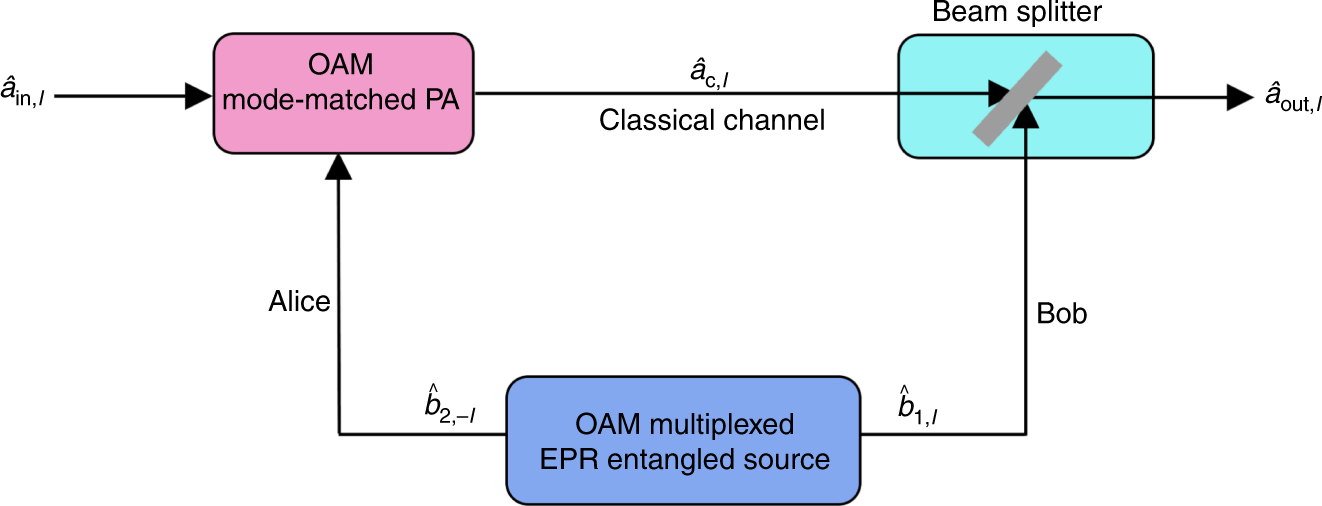
- An all-optical method applied the displacement needed to reconstruct the teleported information to all 100 channels, without measuring and processing each channel individually.
- The group teleported an image of the letter Q across the array and reported fidelities that exceeded the corresponding classical limits.
Compiled by The ScientistSomething wrong?How this is made
Why it matters
- capability The channel layout is a pattern on a modulator, so a group can change how many channels it runs and where they sit without rebuilding the optical path.
- constraint One pump beam feeds all 100 channels, so drift or non-uniformity in that single beam degrades the whole array at once rather than one link.
- precedent A hundred-channel result sets the comparison point in continuous-variable teleportation: new single-channel protocol demonstrations will now be asked whether they multiplex.
The saving is at the receiver. Getting the displacement channel by channel means one detection-and-processing chain for each channel, so a 100-channel link would need 100 of them; the group led by Jietai Jing applied the correction in a single shared optical stage [15][12].
The throughput claim here sits inside one apparatus: all 100 channels are modes of the same beam array, matched to the same amplifier, and the work was done in an experimental setting [1].
Jing said the 10 x 10 input array and the corresponding EPR entanglement array were engineered to satisfy the phase-matching conditions of the same parametric amplifier. That is what allows all 100 matched modes to be processed simultaneously in a single four-wave-mixing medium [7].
One pump beam feeds the whole array. "We also shaped the pump beam into a nearly uniform top-hat profile so that different parts of the array experienced similar nonlinear interactions," Jing said [5]. How well that held is what would separate a mode at the corner of the grid from one at the center. The Phys.org account does not include the fidelity values for the Q image, or a transmission distance [16].
The per-channel spread behind the Q image is unknown. Some of the 100 channels may have been comfortably above the classical limit and others marginal, and a single aggregate statement covers both cases. For a spatially encoded payload, that distribution matters.
Jing told Phys.org that the work grew out of long-running efforts to add channels, including orbital-angular-momentum multiplexing and the multiplexing of several degrees of freedom [11]. "We gradually realized that naturally spatially separated optical modes could provide a more direct and reconfigurable route toward large-scale parallel processing," he said [10]. He also said the architecture "could potentially be used to generate and manipulate large-scale spatially encoded quantum states" [18].
What to watch
- A test of the same 100-mode array over a transmission link, with loss and distance reported.
- Whether the array scales past 10 x 10 while one pump beam still illuminates every mode equally.
- An independent reproduction of the all-optical parallel displacement in a medium other than hot rubidium vapor.