Build1 distinct publisher3 min readPublished
Beijing is funding humanoid output at electric-vehicle scale, but the data that makes the machines useful still arrives one teleoperated attempt at a time, and the yield on those attempts is what sets the schedule.
The Engineer · Build desk

Compiled by The EngineerSomething wrong?How this is made
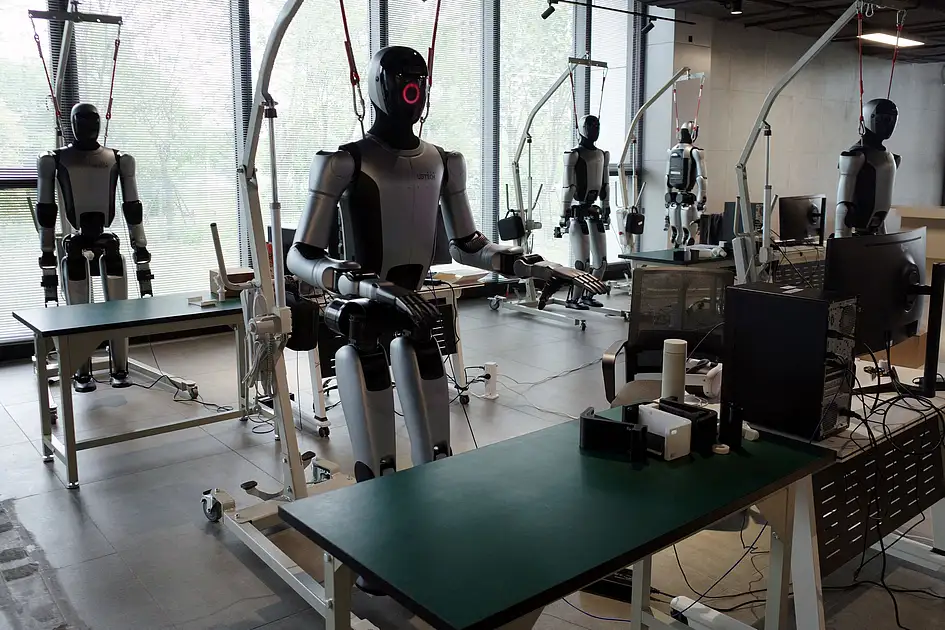
A human in a headset is the data pipeline [5]. At the Liuzhou centre more than 100 machines are being taught to sort boxes, pack instant noodles and make coffee, with trainers driving each motion through sensored controllers [1][5]. The yield on that labour is the figure worth writing down: about 300 attempts per usable motion for a beginner, about one in 50 for a practised trainer [2]. Six to one between a new hire and a trained one [3].
That would be a staffing problem if motions generalised. They do not yet: the same robots that run a rehearsed sequence cleanly get lost when the lighting, the camera angle, the surface or the object's position changes [6]. What has to be learned is grip force and trajectory against real objects, not just recognition, and that only comes from physical contact data [25]. So 300 attempts do not buy a skill, they buy a skill under one configuration. Analysts put the industry's stock of good training data at roughly 500,000 hours [22]. Tang Wenbin of Yuanli Lingji, in reporting that mezha.net credits to Reuters, put it more bluntly: robot intelligence is too low, and much of what is shown is dancing disguised as work [7][26]. A kung fu routine is a repeatability test with good lighting [27].
On the buying side the comparison is not robot against worker but humanoid against a bolted-down arm, and plants pay for precision, speed and uninterrupted running, which specialised manipulators still deliver more cheaply [19]. Xiaomi's EV plant is 91% automated and conventional industrial robots do the work; the humanoids there are being trained on individual simple tasks [20]. Galbot's pharmacy deployments are the serious counterexample, with the company claiming over 95% success at locating stock and assembling orders [21]. For that rate to transfer to a factory station you need what a pharmacy supplies free: fixed shelf geometry, light that does not move, and no penalty for taking a second attempt. A production station supplies a cycle time instead.
The money is moving faster than either curve. Government bodies spent at least $230 million in the first half of this year on robots, training systems and related equipment, against $62 million a year earlier and $6 million in 2024 [12], roughly 38 times the 2024 total [13]. UBTech's $18 million Guangxi contract is about 8% of that half-year figure on its own [4][14]. Some 20,000 humanoids shipped worldwide last year, 95% of them Chinese-built [8], call it 19,000 units [9]; China's plan for this year is more than 100,000 [10], five times last year's global total [11]. Morgan Stanley expects average prices to fall 15% in 2026 [17], which, with more than 150 developers in the field and local governments offering free premises and compute [15], reads as sellers competing rather than buyers pushing [18].
The teleoperation rigs are the honest engineering here. If contact data is the bottleneck, paying people to generate it is the right place to put the subsidy, and the training centres are where I would look first for evidence that the 300 is coming down.
Ranked by verification strength, evidence, and original report placement.
At a training centre in Liuzhou, southern China, more than 100 humanoid robots are being taught to sort boxes, pack noodles and make coffee, and the machines still move slowly and clumsily.
A novice trainer may need about 300 attempts to obtain one usable motion, while experienced trainers achieve a result in roughly one attempt in 50.
UBTech received an $18 million contract from the Guangxi government, under which it supplies robots and data collection equipment needed to develop embodied artificial intelligence.
Trainers control the machines using headsets and controllers with sensors, teaching them to interact with real objects.
The robots perform pre-rehearsed tasks well but often fail when the lighting, viewing angle, surface or position of objects changes.
Tang Wenbin, co-founder and chief executive of Yuanli Lingji, said robot intelligence is too low and that much of what we see is dancing disguised as work.
Distinct publishers with included, body-backed reporting in this cluster.
mezha.net
1 article · August 29, 2026
Follow any of these and your For You feed starts watching them — no settings page required.
invest
State orders lift China's humanoid robot procurement from $6 million to $230 million in two years1 distinct publisher
product
Unitree's $9bn Shanghai listing prices the humanoid story, not the robot-dog business1 distinct publisher
product
Missile loading and suspect restraint move onto the robot product roadmap in Beijing1 distinct publisher
product
Unitree's CEO attached a falsifiable test to the "ChatGPT moment". Hold him to it1 distinct publisher
Evidence-backed comparisons of source perspectives and observed adoption signals. Read the methodology
Which Builder, Operator, and Investor concerns the observed source mix emphasized—not a truth score.
Evidence, demonstrated adoption, hype gap, incentives, and confidence are assessed independently, each on its own current evidence. How these are measured.
One relay, named houses, unnamed estimates
Everything here reaches us through mezha.net's Ukrainian summary of a Reuters report we do not hold, credited in one line with no link or quotation. Where the numbers carry names they hold up reasonably: BofA Global Research on last year's 20,000 shipments, Morgan Stanley on 2026 pricing, Tang Wenbin quoted with title. Where the names vanish, the figures get bigger, an unattributed plan for 100,000 units this year, an unnamed superfactory promising 500,000 by 2030, 'analysts' on the 500,000-hour data stock, and Galbot grading its own pharmacy robots.
Units are real; the buyer is mostly the state
This is not vapour: 20,000 machines shipped last year, more than 100 in training at Liuzhou, UBTech delivering against a signed Guangxi contract, Galbot robots picking orders in pharmacies. But follow the money and most of it is public, from $6 million of official purchasing in 2024 to at least $230 million in half a year, much of it for demonstration and testing. The private-sector counterexample is the sharpest datum in the story: Xiaomi automates 91% of its EV plant and still gives the real work to conventional arms.
Output plans outrunning the yield curve
A plan for more than 100,000 machines this year, five times all of last year's global shipments, sits a few paragraphs from a training floor where the good operators still spend 50 attempts to bank one usable motion and the machines lose the thread when the light changes. The gap is not mezha.net's invention; this reporting is the one deflating the spectacle, quoting Tang Wenbin calling much of it dancing disguised as work. The overstatement lives in the industry's own targets and in the vendor's unaudited 95%, not in the coverage.
Subsidised on both sides of the trade
Almost every actor here is paid to be optimistic. Local governments hand out subsidies, free premises and compute, then buy the machines themselves for demos; the training centre generating the data is funded by the same authority that contracted UBTech to supply it. Two sell-side houses supply the market's headline numbers. The unusual thing is that the loudest sceptic is also an insider, the chief executive of a rival developer, whose interest in calling competitors' demos dancing is not disclosed.
Coherent story, single unchecked channel
The internal arithmetic holds up wherever it can be checked: 95% of 20,000 does give roughly 19,000 units, $18 million is about 8% of $230 million, and the procurement series climbs cleanly. What cannot be checked is the channel, one translated relay of a report we do not have, so a mistranslated figure or a dropped qualifier would be invisible to us. The direction of the story, output rising faster than usable capability, is safe to rely on; individual figures deserve a second source before anyone budgets against them.