Product1 publisher3 min readPublished
Unitree's $9bn Shanghai listing prices the humanoid story, not the robot-dog business
The Hangzhou maker sold about a tenth of itself for roughly $900mn, with retail demand covering the offer more than 8,000 times. Most of what it ships is still quadrupeds.
The Product Desk · Product desk
Drafted by a language model from the sources cited here and checked against its claim ledger before publication. How we use AISend a correction
What happened
- Unitree priced its shares at 150.8 yuan apiece, selling roughly 40mn new shares, about a tenth of the enlarged company, to raise some 6.1bn yuan, or around $900mn.
- Unitree Robotics, based in Hangzhou, is due to begin trading on Shanghai's STAR Market on 19 August, according to Reuters.
- The listing makes Unitree the first general-purpose humanoid maker to go public on the mainland.
- Unitree still sells more robot dogs than androids.
- The offer values the business at close to 61bn yuan, near $9bn, comfortably above the 42bn yuan the market had pencilled in only weeks earlier and well beyond the $7bn figure floated during the run-up.
Compiled by The Product DeskSomething wrong?How this is made
Why it matters
Unitree Robotics priced its Shanghai STAR Market offering at 150.8 yuan a share, selling roughly 40mn new shares, about a tenth of the enlarged company, to raise some 6.1bn yuan, or around $900mn [1]. Trading is due to begin on 19 August, according to Reuters, and the listing makes Unitree the first general-purpose humanoid maker to go public on the mainland [2][3]. The operational point is narrower than the milestone: a company that still sells more robot dogs than androids can now fund itself at near-unlimited scale at home without having answered what recurring humanoid demand looks like [4].
The repricing happened fast. The offer values the business at close to 61bn yuan, near $9bn, against the 42bn yuan the market had pencilled in only weeks earlier and the $7bn figure floated during the run-up [5]. That is roughly 45 percent above the mark investors were using in the same quarter [6]. China's securities regulator signed off on the registration earlier in the year, when the numbers looked far more modest [7].
Demand was not a rounding error either. Retail investors oversubscribed by more than 8,000 times, a record for the STAR Market, the overall book was covered several thousand times over, and the allocation rate came in at about 0.018 percent [8]. That works out to roughly one share allotted for every 5,500 applied for [9]. Grey-market pricing has pointed to first-day gains of triple to quadruple the offer price [10], which is a 200 to 300 percent gain and therefore straddles the 233 percent average debut return on Chinese new listings in the first half of 2026 [11][12]. Exuberance here is the baseline, not the signal.
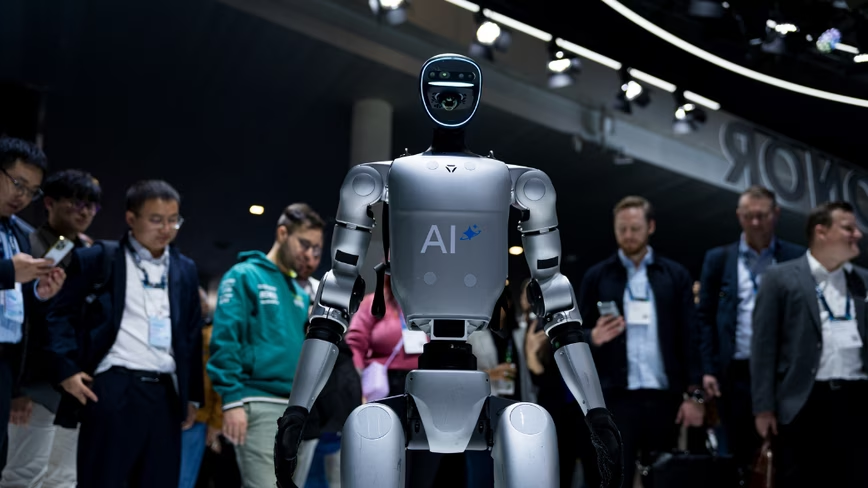
Two days before pricing, timed to the opening of the World Robot Conference in Beijing, Unitree unveiled a high-speed humanoid nicknamed "Superman", which it says was built in little over three months and can jump two metres from standing and reach 12.66 metres per second, quicker over the ground than Usain Bolt at his peak [13]. The company calls it a work in progress [14]. Its shipped line, the G1 and H-series bipeds, followed the quadrupeds that made its name and now function largely as content in the internet's robot-video economy [15].
Underneath, the accounts are more mixed than the order book. Revenue has more than quadrupled year on year and Unitree has been profitable for several years, which is unusual in this sector [16]. But first-quarter net profit fell sharply, by close to half depending on the filing, as research and marketing spending climbed [17]. Founder Wang Xingxing holds about a third of the company and is on paper China's first humanoid-robot billionaire; backers include Tencent, Alibaba and DeepSeek [18][19]. Beijing has put its weight behind humanoids as a strategic industry, and the debut is read at home as a milestone for Chinese hardware rather than a corporate event [20].
What to watch is whether the capital window stays open once the debut pop is absorbed. AgiBot, Leju and EngineAI are chasing their own listings in Hong Kong and Shenzhen [21], and their pricing will show whether the 8,000-times book was about Unitree or about the category. Nvidia, whose chips power much of the boom, has been quietly spreading its bets across other robot makers [22], which is what a supplier does when it does not know which demonstrations convert into orders.