Invest1 distinct publisher3 min readPublished
The buyers are ministries and a state-owned utility rather than factory managers, and the arithmetic of the training-data deficit suggests what Beijing is actually purchasing is operating hours.
The Investor · Invest desk

Compiled by The InvestorSomething wrong?How this is made
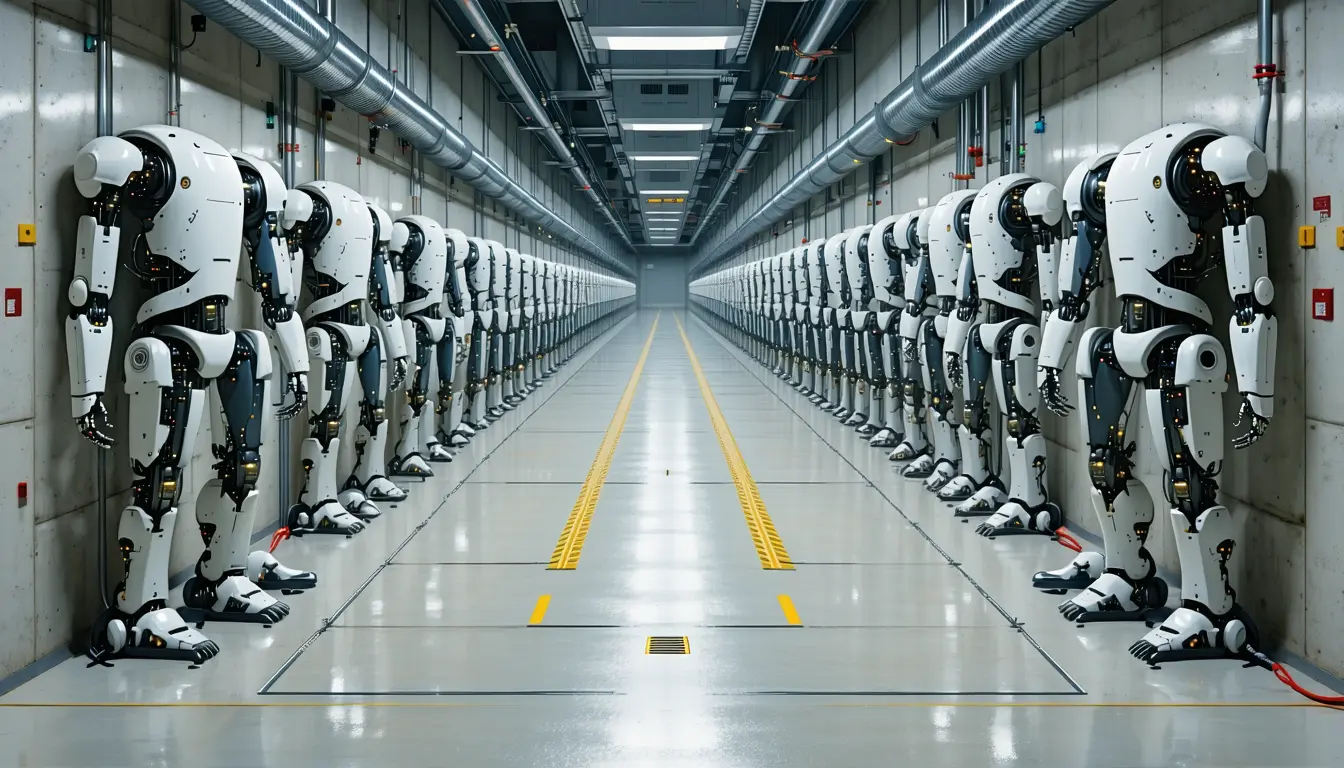
The interesting quantity here is denominated in hours, not dollars. Researchers put the requirement for robust, generalisable physical capability at roughly 100 million hours of real-world interaction data, against a present shortfall measured in the hundreds of thousands of hours [12], and the June directive asks for 10,000 units in commercial use by the end of the year [16]. Divide one by the other and each machine carries 10,000 hours, or about 417 days of round-the-clock operation, before the fleet has retired the deficit once [17]. That makes the ninety-plus training centres, most of them state-backed and explicitly built to generate the missing data [13], the actual product being funded: they exist to manufacture hours.
Then the price check. Annualise the first half's $230 million and you get $460 million of government buying [1], divide that by Morgan Stanley's revised forecast of 50,000 shipments [9], and you land at roughly $9,200 a unit [28]. Either the state is directly buying a minority of the units its policy is credited with driving, or the machines are cheap, and the source material does not say which. My reading is the former, or rather the more useful version of the former: the procurement line is the signal that mobilises utility-scale capex and provincial land, and the purchase orders are the smaller half of what it moves. China made between 12,800 and 20,000 humanoids in 2025, some 90 to 95 percent of world output [7], so one country's procurement policy is setting the global unit count.
The demand underneath is not imaginary. An ageing population has produced a labour shortage for which humanoids are the government's stated long-term answer [26], and Made in China 2025 frames the effort as a race with the United States in AI and advanced robotics [23]. None of that makes the hardware competent this year, since current models struggle with basic dexterity and degrade outside the environments they were trained for [11].
This is probably wrong in at least one direction, so here are the directions. Say the data mandate works, generalisable dexterity arrives out of those centres, and $230 million turns out to have been the cheapest capability purchase on the table. Or the hours accumulate but stay narrow, filling the mandate's 100 deployment scenarios [16] with 100,000 units [8] that are each good at exactly one task, which is a machine-tool industry rather than a robotics one and still worth owning. Or procurement flattens while roughly 150 manufacturers burn through it [20], and the consolidation the reporting treats as a matter of when rather than if arrives abruptly [25].
My view is the second, and the thing that would kill it is specific: second-half orders placed by buyers who are neither ministries, provinces, nor state-owned enterprises, at prices set by output rather than by policy targets. Until those show up, the sector's demand curve has a signature on it.
Ranked by verification strength, evidence, and original report placement.
Central and local governments in China committed at least $230 million to humanoid robotics procurement in the first half of 2026.
Chinese government humanoid robotics procurement was $62 million in the first half of 2025.
Chinese government humanoid robotics procurement was $6 million in the first half of 2024.
China produced between 12,800 and 20,000 humanoid robots in 2025, accounting for roughly 90 to 95 percent of global output.
The Chinese government's target for 2026 is to surpass 100,000 humanoid robot units.
Morgan Stanley raised its 2026 humanoid shipment forecast to 50,000 units in response to the scale of government demand.
Distinct publishers with included, body-backed reporting in this cluster.
cryptobriefing.com
1 article · August 29, 2026
Follow any of these and your For You feed starts watching them — no settings page required.
product
Unitree's $9bn Shanghai listing prices the humanoid story, not the robot-dog business1 distinct publisher
build
Agility wants public money for the jump from nine sites to volume, and Unitree just set the price1 distinct publisher
invest
The humanoid supply chain is already Chinese: 18,500 of 19,100 units in six months1 distinct publisher
build
Unitree's 8,000x book is now the comparable every humanoid banker will quote2 distinct publishers
Evidence-backed comparisons of source perspectives and observed adoption signals. Read the methodology
Which Builder, Operator, and Investor concerns the observed source mix emphasized—not a truth score.
Evidence, demonstrated adoption, hype gap, incentives, and confidence are assessed independently, each on its own current evidence. How these are measured.
One unsourced account carrying every number
The procurement ladder that titles this story, the 12,800-to-20,000 output range, the 90-plus training centres and the 100-million-hour data requirement all rest on a single Crypto Briefing article that cites no tender data, no ministry release and no analyst by name. Two items survive independent scrutiny in principle because they identify institutions and specifics: the June 2026 MIIT and SASAC directive, and State Grid's $1 billion programme. The rest is precise-looking arithmetic on figures whose origin the reader cannot follow.
Money and mandates are moving faster than machines
There is genuine activity to point at: tens of thousands of units built in 2025, more than 90 training centres in place or going up, a provincial site mandate with a floor of 200 locations, and a utility with a billion-dollar programme. But the buyers are ministries and a state-owned enterprise, the 10,000 commercially deployed units are an instruction rather than a census, and the reporting itself says today's robots do best in choreographed demonstrations. Procurement adoption is real; end-use adoption is asserted.
The subject is ahead of itself; the telling mostly isn't
The overstatement sits with Beijing and the sell side rather than with Crypto Briefing, which flags the gap repeatedly. A 100,000-unit target against 12,800 to 20,000 units built last year, and a bank revising shipments upward on the strength of state orders, are both claims running well ahead of demonstrated capability. Where the reporting adds its own stretch is the tidy arithmetic — annualising a half year of government purchases into a $9,200-per-robot figure treats procurement as if it were the entire market a paragraph after naming State Grid and a commercial field.
The scorekeeper is also the buyer
Beijing sets the 100,000-unit target, writes the cheques, mandates the provincial sites and reports the progress, which makes every quantity here both an outcome and a performance metric for the officials producing it. Morgan Stanley marking shipments up on procurement news serves clients who own the supply chain. And the four manufacturers Crypto Briefing names as positioned to capture State Grid's spending have obvious reason to encourage the count of active competitors to look like a coming consolidation they will survive.
Directionally believable, numerically unverifiable
That China is buying humanoids aggressively, that capability lags the spending, and that a data bottleneck is being attacked with state infrastructure are all consistent with the named directive and the utility programme. Confidence stops at the decimal points: with one unsourced publisher, a production estimate whose upper bound is 56 percent above its lower bound, and an anonymous 100-million-hour benchmark, no individual figure here should be carried into a model without a second source.