Product1 publisher3 min readPublished
Unitree's CEO attached a falsifiable test to the "ChatGPT moment". Hold him to it
Wang Xingxing says a robot should complete about 80% of voice or text instructions in a house it has never seen. He also says the software may be a decade away.
The Product Desk · Product desk
Drafted by a language model from the sources cited here and checked against its claim ledger before publication. How we use AISend a correction
What happened
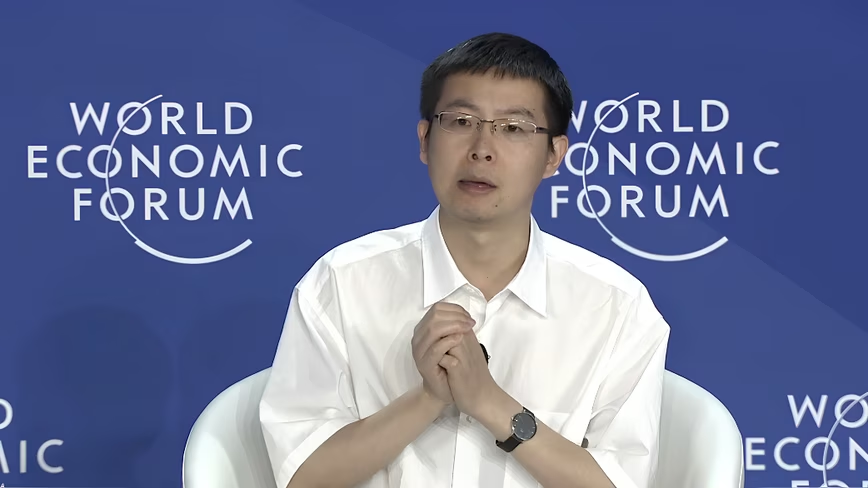
- Wang Xingxing spent Thursday morning at the World Robot Conference in Beijing telling the room that humanoid robots are approaching their "ChatGPT moment", and said "We are marching towards a 'ChatGPT moment' in embodied intelligence".
- During part of the same appearance, Wang explained why that moment might still be a decade away.
- The test as Wang set it out is a robot introduced into a household it has never seen before, taking instructions by voice or text, and completing roughly 80% of what it is asked to do.
- Wang called that threshold an important tipping point for the industry.
- At the Hongqiao forum in Shanghai last November, Wang pinned the formulation to a double target of 80% of tasks across 80% of unfamiliar scenes, with no scene-specific training beforehand.
Compiled by The Product DeskSomething wrong?How this is made
Why it matters
Wang Xingxing told the World Robot Conference in Beijing on Thursday morning that humanoid robots are approaching their "ChatGPT moment", then used part of the same appearance to explain why that moment might still be ten years off [1][2]. The reason to pay attention is not the slogan, which the sector has worn smooth, but the test he attached to it: a robot dropped into a household it has never seen, taking instructions by voice or text, completing roughly 80% of what it is asked [3].
That is a specification, not a mood. It names the input modality, the novelty condition, and the pass rate, and Wang called the threshold an important tipping point for the industry [4]. He has been sharpening it for a while. At the Hongqiao forum in Shanghai last November he put it as a double target: 80% of tasks across 80% of unfamiliar scenes, with no scene-specific training beforehand [5]. Multiplied out, that November version is a 64% success rate across the full space of unfamiliar task-and-scene pairs [6], which is a harder bar than the single 80% figure sounds.
What has moved is the date. Wang told the Beijing audience the necessary software breakthroughs could land in two to three years if things go well, or five to ten if they do not [7]. Last year he was saying two [8]. The top of the range is now five times his own earlier estimate [9], and a spread that wide will retire quietly whichever way the engineering goes.
The market is not pricing the wide end. Unitree listed in Shanghai on Wednesday after demand that Chinese brokers described as unprecedented for a robotics name [10], and the shares climbed almost sixfold on debut [11] before giving back 11% on Thursday, leaving the stock at roughly 5.3 times its listing price [12][13]. Its flagship products are quadrupeds and a humanoid that competitors mostly buy for their own laboratories [14]. It is the world's largest maker of robot dogs and, by shipments, the second-largest producer of humanoids [15].
The demand-side picture explains the caution better than the share price does. Chinese manufacturers shipped more than 40,000 humanoids in the first half of 2026, close to the entire global total [16], while the commercialisation problem has barely shifted and universities and research institutes still make up the bulk of the customer base [17]. Morgan Stanley has doubled its forecast for Chinese humanoid output this year [18]. Hardware volume is not the constraint.
Wang says Unitree is pouring capital and staff into world models, the systems that let a machine predict how a physical environment will behave before it acts [19]. That is the layer where the 80% is won or lost, and it is also the layer where, per the report, Nvidia has been courting alternatives to Unitree [20]. Meanwhile Wang He, founder of the Beijing company Galbot, told the same conference he expects the sector's breakthrough around 2028, with robots then handling 70% to 80% of everyday tasks without bespoke training [21]. Two prominent founders landing on the same percentage band is either engineering consensus or a phrase that has hardened into a talking point [22].
Watch for the protocol. Nobody has published the task list, the scoring rule, or who runs the evaluation, and Unitree has not published a target date of its own for the household robot it described [23]. Wang also did not say what the company would do differently if the five-to-ten-year end proves right, and nobody at the conference appeared to ask [24]. Until the customer mix moves off research institutions [17], the 80% claim is a promise about software written on top of a hardware business.