UMass Amherst team animates a 3D imperial woodpecker from one museum skin and a few seconds of film
UMass Amherst researchers built an animated 3D imperial woodpecker, unconfirmed in the wild since 1956, from one museum specimen. The model is freely available, and its feathers and flight motion draw partly on living woodpeckers.
The Scientist · Science desk
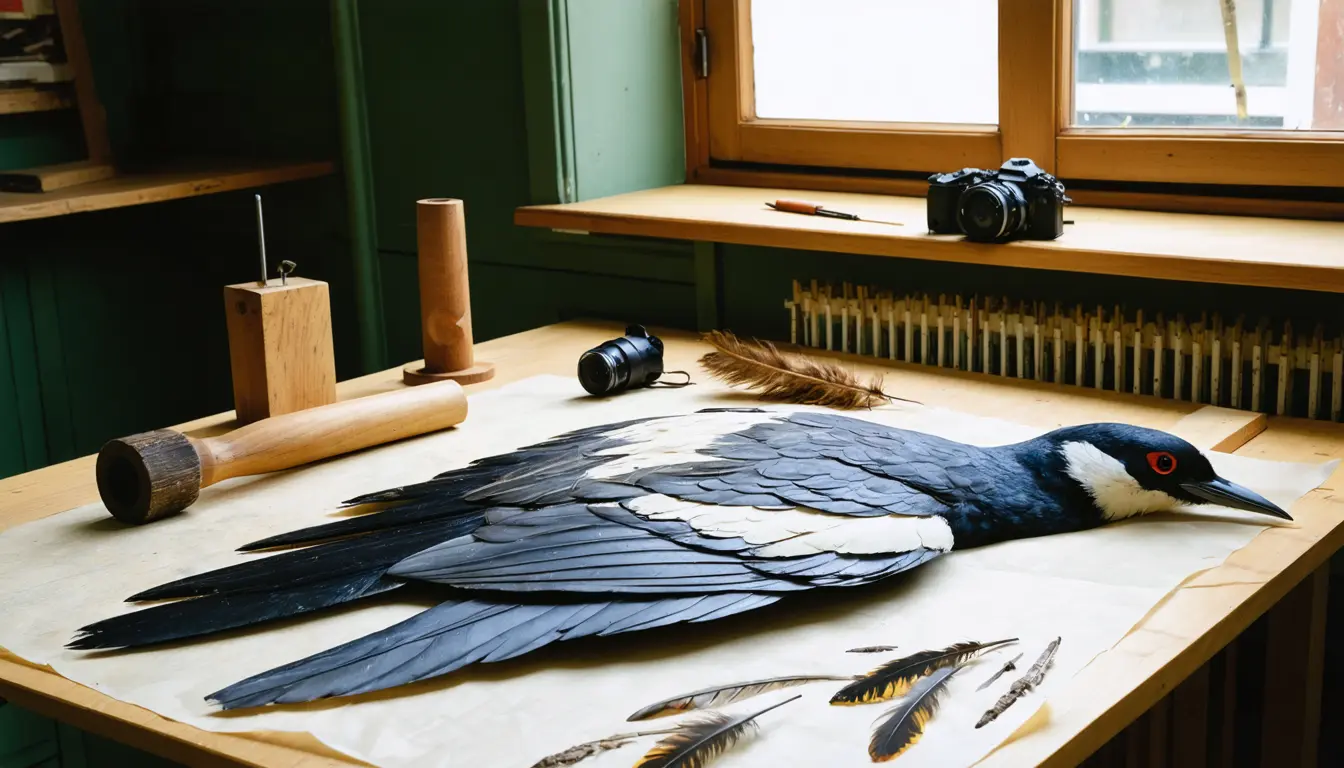
Key figures: a female imperial woodpecker specimen was photographed 288 times from every angle for the model; around 100 preserved specimens exist in museums worldwide; the species was over 60 centimeters long.
| Figure | Value | Note | Claim |
|---|---|---|---|
| Photographs of the female specimen, from every angle | 288 photos | 5 | |
| Museum specimens, around | 100 specimens | 4 | |
| Species length, over | 60 cm | 3 |
What happened
- A female specimen at the Moore Laboratory of Zoology was photographed 288 times, and photogrammetry captured its shape to sub-millimeter accuracy.
- Because individual feathers are hard to see on a specimen, the team modeled feather shapes on the pileated woodpecker and resized them to the imperial's known proportions.
- In Blender, the researchers rigged 10 primary, 10 secondary and 12 tail feathers individually so each can spread, bend and fold.
- Two animations, a looping flight and a tree-climbing clip with drumming, are grounded in the 1956 film and supplemented by pileated woodpecker video and published wingbeat data.
- The study, led by Joshua Medina, appears in Natural History Collections and Museomics, with coauthors at Occidental College's Moore Laboratory of Zoology and Oregon State University.
Why it matters
- What's now possible capability Researchers get a shared mesh for estimating body volume and surface area, comparing shape with living relatives and simulating flight, and the authors suggest it could inform flying-robot design.
- What it limits constraint Every estimate from the model describes one female bird, and soft tissue and flight kinematics are among the acknowledged weak points, so it cannot speak to males or to variation between individuals.
- What it sets up precedent Researchers and communities in Mexico can work from the model without travelling to a foreign collection, though the authors call its role in repatriation an open question.
The model rests on a sample of one. Around 100 preserved imperial woodpeckers sit in museums worldwide [4], and the team modeled a single female [10], about 1% of them [17]. The living bird is represented by a few seconds of grainy film shot in 1956 [4].
The team took measurements of the head, bill, body, wings and tail throughout to keep the digital bird true to the original [16]. Individual feather shapes came from a living relative, the pileated woodpecker [6]. Wing patterning came from scientific illustrations, and wingbeat timing came from published data [c7, c9].
We can't say how closely the flight loop matches the way the bird actually flew. The 1956 film, a few seconds long, is the only direct evidence [4]. In our view, anyone running a flight or feather simulation on this rig should treat wingbeat timing as an assumption taken from published woodpecker data.
According to Phys.org's account of the paper, the authors say that, as far as they know, the model is among the first openly released bird reconstructions built from a real specimen that pair a body captured by photogrammetry with feathers animated one by one [13].
The imperial woodpecker has a place in the traditions of Indigenous communities in the Sierra Madre Occidental, but Mexico itself holds few museum specimens of the bird, possibly none [14].
The outreach case is the team's own. It starts from an estimate that "arguably 99.9% of people have never heard of it," said the research team [12]. Then the argument: "If a digital specimen can increase public awareness of extinct species by even a fraction of a percent, that's millions of people who have an idea for what extinction can erase from the planet," the team said [11].
What to watch
- Any test of the flight animation against the 1956 footage or against measured wingbeat data would show how much of the motion is evidence and how much is assumption.
- Models built from additional specimens, especially a male, would show whether results from this single female hold across the species.
- Use of the model in flight or feather simulations, or by museums and institutions in Mexico, would show whether the open release gets picked up as a working reference.
Clarity's read
What the record supports and how the coverage leans. The claims behind it follow.
Reality
- Evidence58
- Adoption
- Not scored
- Hype gap+10
- Incentives
- Not scored
- Confidence50
Claim ledger
Ranked by verification strength, evidence, and original report placement.
- [1]
Researchers created a detailed, animated 3D model of the imperial woodpecker (Campephilus imperialis), which has not been confirmed in the wild since 1956; the model is freely available to scientists, educators and the public.
- [2]
The study, led by Joshua Medina at the University of Massachusetts Amherst, is published in the open-access journal Natural History Collections and Museomics; the team includes colleagues from the Moore Laboratory of Zoology at Occidental College and Oregon State University.
- [3]
The imperial woodpecker was the largest woodpecker on record, over 60 centimeters long, lived in the old-growth pine forests of Mexico's Sierra Madre Occidental and is presumed extinct following widespread logging of its habitat.
- [4]
Around 100 preserved imperial woodpecker specimens exist in museums worldwide, and the only moving images of the species are a few seconds of grainy film shot in 1956.
- [5]
The team photographed a female specimen held at the Moore Laboratory of Zoology 288 times from every angle and used photogrammetry to capture its shape with sub-millimeter accuracy.
- [6]
Because individual feathers are difficult to see on a specimen, the team modeled feather shapes on those of the pileated woodpecker, the largest living woodpecker in North America, and resized them to the known proportions of the imperial woodpecker; wing patterning was drawn from scientific illustrations and checked against the available visual record.
- [7]
Using the open-source software Blender, the researchers built a digital skeleton and individually modeled and rigged 10 primary, 10 secondary and 12 tail feathers so they can spread, bend and fold independently.
- [8]
Two animations, a looping flight sequence and a short clip of the bird climbing a tree trunk and drumming against the bark, are grounded in the 1956 film footage, supplemented by behavioral video of the pileated woodpecker and published data on woodpecker wingbeat timing.
- [9]
Researchers can use the model to estimate body volume and surface area, compare shape with living relatives, or run simulations of flight and feather movement; the authors note it could also inform the design of bird-inspired flying robots.
- [10]
The model is based on a single female specimen, and the researchers acknowledge limits in aspects such as soft tissue and flight kinematics.
- [11]
"If a digital specimen can increase public awareness of extinct species by even a fraction of a percent, that's millions of people who have an idea for what extinction can erase from the planet."
- [12]
The research team said the imperial woodpecker might be the last bird species to have gone extinct in continental North America, "but arguably 99.9% of people have never heard of it."
- [13]
To the team's knowledge, the model is one of the first open, specimen-based bird reconstructions to combine a photogrammetric body with individually animated feathers.
- [14]
The imperial woodpecker features in the traditions of Indigenous communities of the Sierra Madre Occidental, yet few, if any, museum specimens are held in Mexico.
- [15]
The authors suggest that freely shared digital models may help offset geographic and institutional barriers, while acknowledging that whether such work can contribute to the repatriation of biological and cultural heritage remains an open question.
- [16]
Measurements of the head, bill, body, wings and tail were taken throughout to keep the digital bird true to the original.
- [17]
The single specimen modeled is about 1% of the roughly 100 preserved specimens.
Get this ledger inside ChatGPT. Ask about any of our stories and the answer brings its figure, each claim’s verdict and the sources. Free, no account.
Sources
1 independent publisher whose own reporting we read for this story.
- phys.orgImperial woodpecker returns to life as a detailed digital specimen
1 article · October 15, 2026
Topics and entities
Follow any of these and your For You feed starts watching them — no settings page required.