Science1 publisher3 min readPublished
A timescale, not a diffraction peak: how ultrafast XUV makes exciton condensation testable
A group reports in Nature Physics that selenium core-level dynamics in 1T-TiSe2 speed up with laser fluence. The result that matters is the assay, not a verdict on excitonic insulators.
The Scientist · Science desk
Drafted by a language model from the sources cited here and checked against its claim ledger before publication. How we use AISend a correction
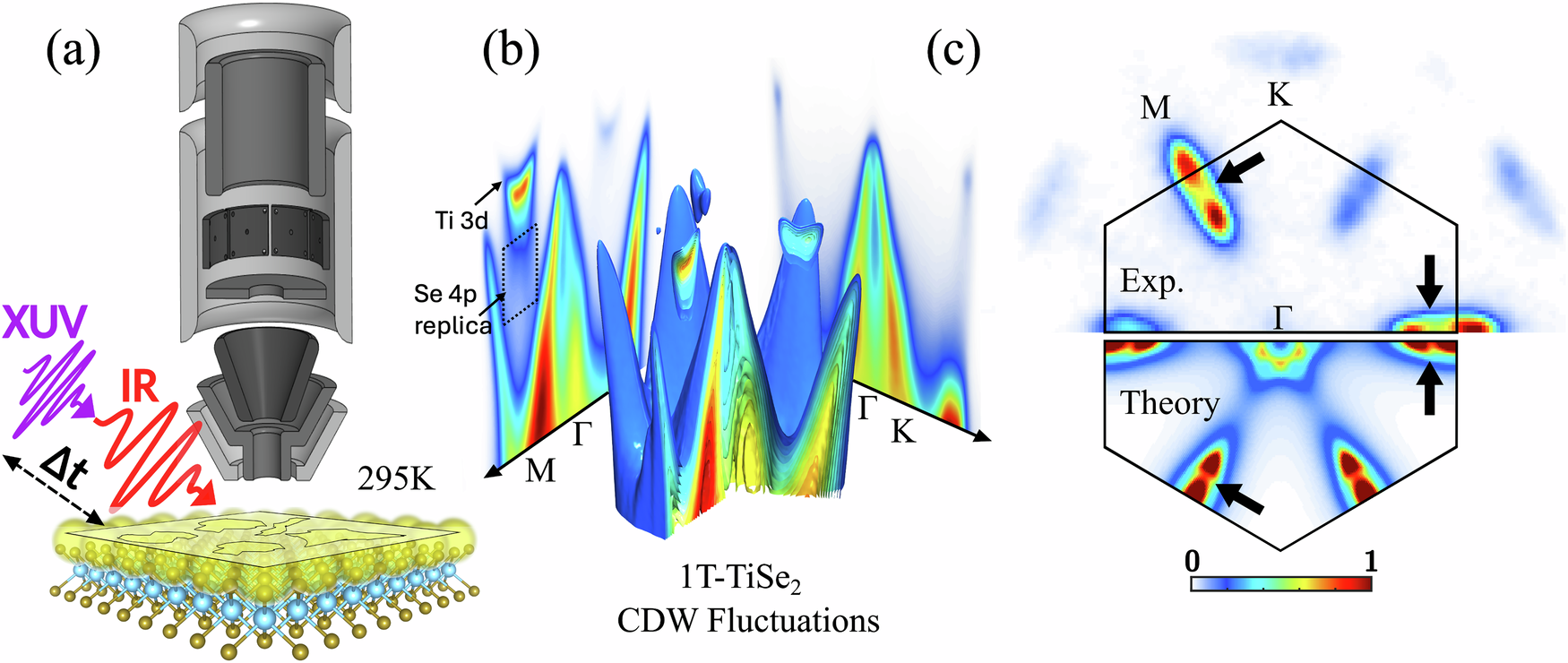
What happened
- Collective phases in quantum materials do not necessarily appear only when a material crosses a transition temperature; microscopic fluctuations can already be present before long-range order develops.
- Understanding precursor fluctuations is important because they can indicate which interactions are responsible for driving a material toward an emergent phase.
- Most experimental signatures of phase transitions are easiest to recognize once long-range order has formed, for example a new periodic structure in a diffraction experiment.
- Fluctuations that precede long-range order are transient and lack a well-defined spatial pattern, making them much harder to measure directly.
- 1T-TiSe2 is a layered quantum material that undergoes a phase transition at a critical temperature of approximately 200 K, below which it develops a charge-density wave in which its electronic density and atomic lattice become periodically modulated.
Compiled by The ScientistSomething wrong?How this is made
Why it matters
A research group has taken a decades-old argument about the layered material 1T-TiSe2 and turned it into a stopwatch reading: hit the sample with an ultrashort laser pulse, then watch how fast the selenium core-level absorption responds [8][11][12]. That matters less as a claim about exciton condensation than as a measurement recipe, because it targets fluctuations that appear before long-range order and that conventional structural probes are poorly suited to see [1][3][4].
The setup for the problem is generic to quantum materials. Collective phases do not switch on at a transition temperature out of nothing; microscopic fluctuations can already be present above it, and those fluctuations are what identify the interactions pushing a material toward the ordered phase [1][2]. The usual experimental signatures, though, are easiest to read once order exists, for instance as a new periodic structure in a diffraction pattern [3]. Precursor fluctuations are transient and lack that well-defined spatial pattern, which is why they resist direct measurement [4].
1T-TiSe2 is the awkward test case. It orders at a critical temperature of roughly 200 K, below which its electronic density and atomic lattice become periodically modulated into a charge-density wave [5]. Researchers have argued for decades over whether excitons are central to forming that state [6], with one proposal being that excitons form spontaneously and condense collectively into an excitonic insulator [7]. Because the charge-density wave arrives with a lattice distortion, and the electronic and structural changes are strongly intertwined, isolating an excitonic signature has been hard, and tracking it across the transition harder still [9].
The method is ultrafast broadband extreme-ultraviolet absorption spectroscopy, which the authors chose for element- and orbital-specific sensitivity to the Se 4p and Ti 3d states proposed to participate in condensation [10]. Two engineering details carry the result. The beamline operates in the cryogenic regime, so the photoinduced response can be followed across the transition temperature rather than only deep inside the ordered phase [11]. The broadband spectrum captures multiple elements at once, which lets the team separate channels: Ti 3d is strongly influenced by lattice dynamics, while Se 4p, where the exciton holes are proposed to live, gives a cleaner electronic window [13]. They then used the rise time of the Se 4p response as a proxy for exciton dissociation after photoexcitation [12].
Far below the transition temperature, higher excitation fluence made that response faster, with the response time decreasing inversely with the square root of the excitation [14]. Taken at face value, that scaling means quadrupling the fluence halves the response time [15], which is the kind of functional dependence that can be checked, and broken, by another group.
Two cautions. The paper is described as set to appear in Nature Physics, so it is a forward-looking account by the authors themselves rather than a settled literature entry [8]. And the source text available here stops mid-sentence in the fluence discussion, so the behavior at and above 200 K is promised in the headline but not documented in the body [16][17]. The generalization the authors reach for, that this bears on many-body pairing including Cooper pairs in superconductors, remains an aspiration until the above-Tc data are on the table [18].
What to watch: whether the Se 4p response time shows the same square-root fluence scaling above 200 K, whether the Ti 3d channel can be held responsible for the lattice contribution independently, and whether a second cryogenic XUV beamline reproduces the numbers.