Invest1 publisher3 min readPublished
Lagarde says Europe's postwar growth model is eroding and will not return in the form it knew
The ECB president told business leaders in Geneva that all three pillars of European growth are weakening at once. That makes the reset a planning assumption, not a cycle.
The Investor · Invest desk
Drafted by a language model from the sources cited here and checked against its claim ledger before publication. How we use AISend a correction
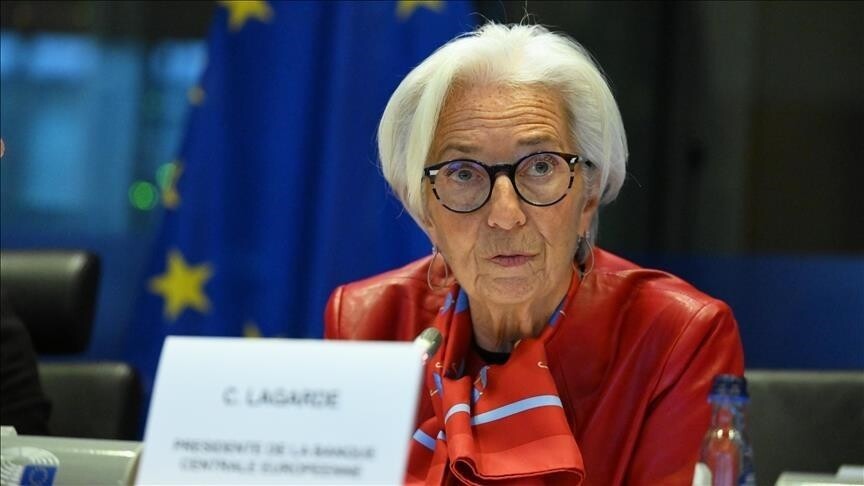
What happened
- European Central Bank President Christine Lagarde spoke at the World Economic Forum's International Business Council in Geneva, Switzerland, on Wednesday.
- Lagarde warned that Europe's post-war growth model is "eroding" and "unlikely to return to the form we once knew."
- Lagarde said European growth rested on three pillars: expanding global trade, manufacturing supported by access to cheap energy, and "a stable, rules-based global order, underpinned by a U.S. security umbrella."
- Lagarde said all three of those pillars are weakening today.
- Lagarde said that last year alone, more than 2,500 trade restrictions were implemented globally.
Compiled by The InvestorSomething wrong?How this is made
Why it matters
Christine Lagarde told the World Economic Forum's International Business Council in Geneva on Wednesday that Europe's post-war growth model is "eroding" and "unlikely to return to the form we once knew" [1] [2]. Central bankers usually describe weakness as cyclical; describing it as structural changes what companies should budget for.
Lagarde said that growth rested on three pillars: expanding global trade, manufacturing supported by access to cheap energy, and a stable, rules-based global order underpinned by a U.S. security umbrella [3]. All three, she said, are weakening today [4]. The trade pillar has a number attached: more than 2,500 trade restrictions were implemented globally last year, according to Lagarde [5]. Europe's own exposure is concrete. After returning to the White House, President Donald Trump announced targeted tariffs including a 20% baseline levy on EU goods entering the U.S. [6], later cut to 15% under a trade deal [7], a five-percentage-point reduction [8] that leaves open both the durability of the agreement and how goods such as European steel will be taxed [9].
The security pillar is the one Lagarde tied most directly to investment behaviour. The old order, she said, "allowed European supply chains to deepen, and enabled firms to organize investment around efficiency rather than resilience" [10]. Now "geopolitical tensions are bringing critical dependencies and chokepoints into sharper focus, while Europe faces growing security threats on its doorstep" [11]. The backdrop she is describing includes a U.S. administration that has threatened to withdraw from NATO and to bring NATO territory under Washington's control by force [12], Russian aircraft increasingly encroaching on European airspace, and a U.S.-Iran war that has weighed on the continent's economy [13]. Her conclusion is a cost-of-capital argument: capital flows into Europe are at risk [14], and "firms invest less when capital is seen as less safe, weighing on output and consumption" [15].
Note what the reported remarks did not quantify. The energy pillar got no figure, which matters because it is the one European policy can act on fastest and the one manufacturers price daily.
On the upside, Lagarde pointed to the world's largest network of trade agreements, world-class manufacturing and the EU single market [16]. Then came the sharper warning: Europe largely missed the first digital revolution, and "we cannot afford to repeat that experience with artificial intelligence, the second digital revolution" [17]. The scale gap is stark. Europe's 34 most valuable listed tech companies are worth a combined 1.37 trillion euros, or about $1.59 trillion; the U.S. Magnificent Seven are worth more than $23 trillion [18], roughly 14 times as much [19]. Lagarde said there are "encouraging signs" of European AI investment but open questions about whether it can spread and scale [20], and cited "EU Inc," an optional EU-wide corporate legal form allowing a company to incorporate once and operate under one rulebook across the bloc [21], alongside capital market reforms meant to help firms scale [22]. Her framing: turning European size into European scale [23].
Watch three things. Whether the 15% tariff rate holds and how steel is finally treated [7] [9]. Whether EU Inc moves from proposal to legislation, given that Lagarde called it a proposal rather than a plan [21]. And whether the resilience premium she describes shows up as lower fixed investment in the hard data, which is the mechanism she named [15].