Invest2 distinct publishers3 min readPublished
A 52.5-47.5 refusal to reopen accession talks shuts the quickest route to euro alignment for a small open economy, and it happened in a country with no army while the US president was threatening Greenland.
The Investor · Invest desk

Compiled by The InvestorSomething wrong?How this is made
Five points of margin on about 190,000 counted ballots comes to roughly 9,500 votes [1][1], so fewer than 5,000 people changing their minds would have produced the opposite headline [2]. Hold onto that figure, because it is the one both camps will misread this week.
The other number worth holding is 5.75, the distance in percentage points between Iceland's 8.00 per cent benchmark and the European Central Bank's 2.25 per cent deposit facility [12][3], which is to say the Icelandic rate runs about 3.6 times the euro-area one [4]. That gap is what the cost-of-living argument was reaching for [5]. Look at the route to it, though: reopen talks, close a deal that some analysts put at one to two years given how far the file had advanced before 2013 [3][2], ratify, and then arrive at what the campaign itself described only as the possibility of adopting the euro [5]. Four conditionals deep, a 5.75-point saving discounts hard, and it was being offered in exchange for something voters already own outright, namely the rules governing fishing and farming [6]. A contingent future coupon against a present asset, and written that way the outcome is ordinary.
The direction the campaign travelled is the part worth studying. One survey had 51.3 per cent in favour [8]; Gallup, nearer the vote, had 51.6 per cent opposed [7]; the count came in at 47.5 per cent in favour [1]. So the yes share finished 3.8 points below that earlier reading [6], and Gallup still understated the no side by 0.9 [7]. (The earlier survey's two figures sum to 99.7, which is the published arithmetic, not mine [8].)
This is probably wrong, but the more interesting reading is that the security case lost under about the friendliest conditions available to it. Iceland has no armed forces [9]. It voted while the US president was threatening to take over Greenland, an autonomous territory of Denmark [10], with Bruegel describing an Arctic in which China flexes economic muscle in partnership with Russia as melting ice opens new routes [11], and the governing party ran on precisely that exposure [4]. The counter-thesis deserves equal weight: 5 points sits inside a poll series whose margin moved 6.1 points between two readings [9], turnout in a small electorate can account for a move that size, and on that view Greenland did shift votes and simply did not shift enough of them.
Iceland applied in 2009, suspended in 2013 [2], and returned to the question about 13 years later [13], which is something like 17 years of not deciding [5], and a 52.5 per cent no forbids nothing about a third attempt. What would prove this desk wrong: a fresh application inside this parliament, which would show the referendum was a mood rather than a constraint; or a post-vote breakdown showing the yes share rose among the voters most exposed to Arctic risk rather than sliding 3.8 points [6] while security was the loudest argument in the field.
Ranked by verification strength, evidence, and original report placement.
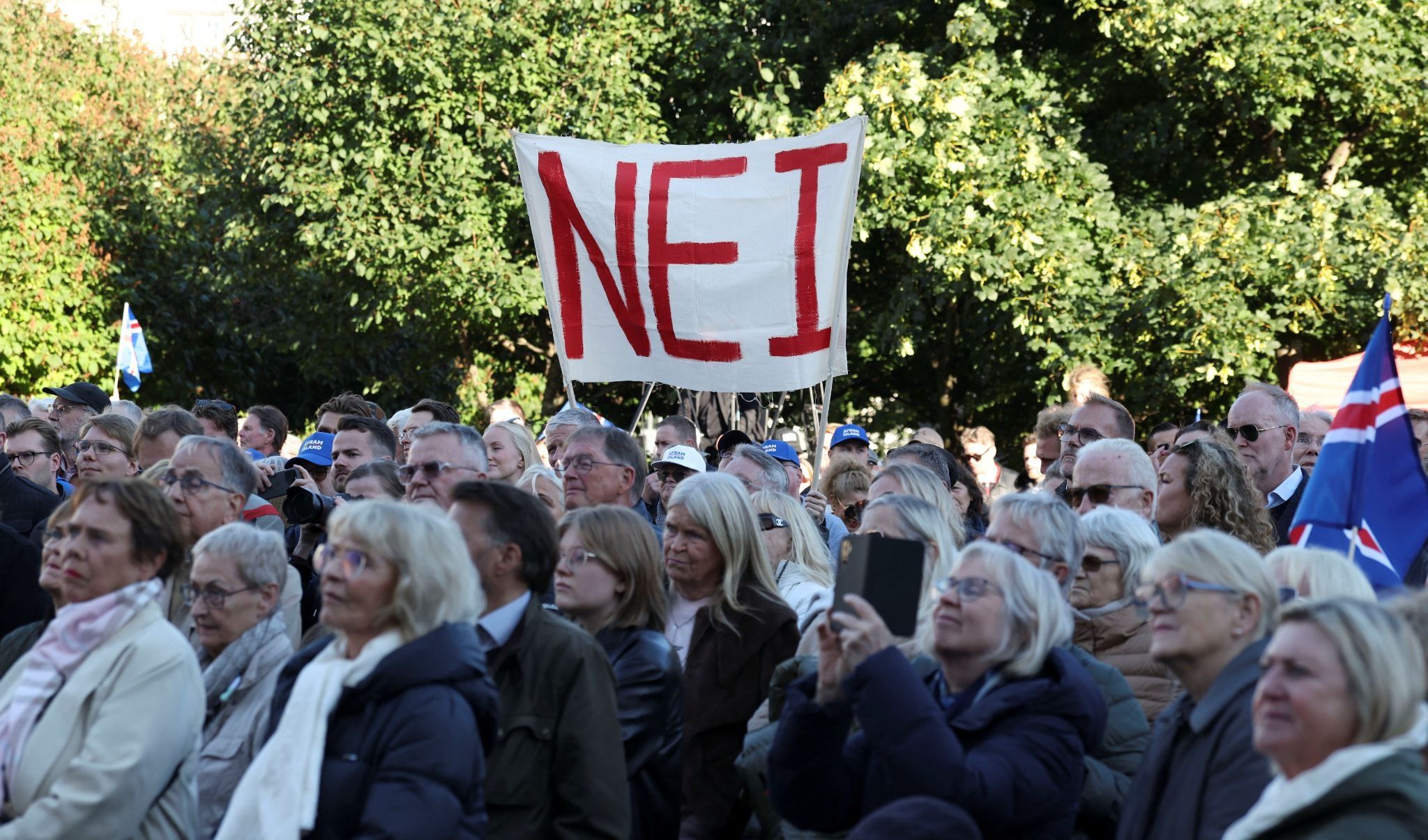
Opponents of reopening EU membership talks led 52.5% to 47.5% when about 190,000 votes had been counted, Iceland's public broadcaster RUV reported on the 30th, with only a small number of ballots remaining at one of the country's six counting centres, making a reversal unlikely.
The ruling party led by Prime Minister Kristrun Frostadottir and other supporters argued Iceland needs EU membership to respond to a rapidly shifting international situation, including the war in Ukraine and US President Donald Trump's stated intent to annex Greenland.
Opponents countered that Iceland, among the world's highest-ranking countries by GDP per capita, would gain little practical benefit, and said their greater concern was loss of national sovereignty and control over core natural resources, pointing in particular to EU rules applying to fishing and farming.
Trump has threatened to take over Greenland, an autonomous territory belonging to Denmark.
Iceland applied to join the EU in 2009 and began negotiations, but halted the process in 2013 after a euroskeptic government took power.
Supporters said EU membership and the possibility of adopting the euro could ease the burden of high interest rates and living costs.
Distinct publishers with included, body-backed reporting in this cluster.
en.sedaily.com
1 article · August 30, 2026
semafor.com
1 article · August 28, 2026
Follow any of these and your For You feed starts watching them — no settings page required.
invest
Lagarde says Europe's postwar growth model is eroding and will not return in the form it knew1 distinct publisher
invest
Texas froze 474 gigawatts of interconnection queue, and the audit is now the schedule risk1 distinct publisher
invest
German direct investment in the US falls to EUR 4.3bn, and the new money is going to Asia1 distinct publisher
invest
Governors, Not GPUs, Are Becoming the Binding Constraint on the AI Buildout1 distinct publisher
Evidence-backed comparisons of source perspectives and observed adoption signals. Read the methodology
Which Builder, Operator, and Investor concerns the observed source mix emphasized—not a truth score.
Evidence, demonstrated adoption, hype gap, incentives, and confidence are assessed independently, each on its own current evidence. How these are measured.
One relay of one broadcaster's running count
Every figure that carries this story — the 52.5-47.5 split, the 190,000 ballots, 8.00% against 2.25%, both surveys — reaches us through Sedaily quoting RUV rather than through RUV itself, and Semafor, published two days earlier, can corroborate the stakes but not one number of the outcome. The count described was still running. The poll with a name on it, Gallup, lands within a point of the result; the 'earlier survey' pointing the other way has no pollster, no date, and shares that add to 99.7%.
Vote held, count all but finished
This is the unusual case where the real-world event is the entire claim: a country voted, and roughly 190,000 ballots were tallied. What is absent is everything that normally follows — a certified total, a turnout figure, any word from Kristrun Frostadottir's government about losing on its own signature question. Semafor's near-tie polling two days out and the finished tally bracket the event tightly enough that the decision is real; its formal edges are not yet in evidence.
Framing runs a step ahead of the tally
The headline arithmetic is honest but softer than it looks: roughly 9,500 votes is five points of a total Sedaily itself rounds to 'about 190,000', so a ballot count wears four significant digits it has not earned. The larger stretch is calling this the closing of the quickest route to the euro, which leans on a one-to-two-year timeline that unnamed analysts floated back in 2013 and nobody in this reporting will now defend. The rate spread, by contrast, needs no help.
Both campaigns quoted, neither audited
Every argument in the story comes from someone with something to win: a governing party seeking shelter in a Trump-era Arctic, and a no campaign defending fishing and farming rules that sit at the centre of Icelandic identity. Sedaily lays the two side by side without refereeing, and neither publisher has a stake in the answer. Gallup's poll arrives with no disclosed client, and Bruegel's line on China and Russia is relayed as think-tank framing rather than tested.
Direction firm, decimals borrowed
Which way Iceland went is not seriously in doubt — a five-point gap with a handful of ballots left does not turn. Confidence erodes as the precision rises: a vote total inferred from rounded inputs, a mystery survey pointing the opposite way, no independent read on RUV's numbers anywhere in our coverage, and a second publisher who left the scene before the polls closed.