Product8 publishers3 min readPublished Updated
Trump's "super intelligence" rename takes over a term the field reserves for a hypothetical system
The president told the UN General Assembly that all US documents will drop "artificial". CNET reports that no order has followed, so anyone drafting federal-facing text is weighing a speech against a settled technical definition.
The Product Desk · Product desk
What happened
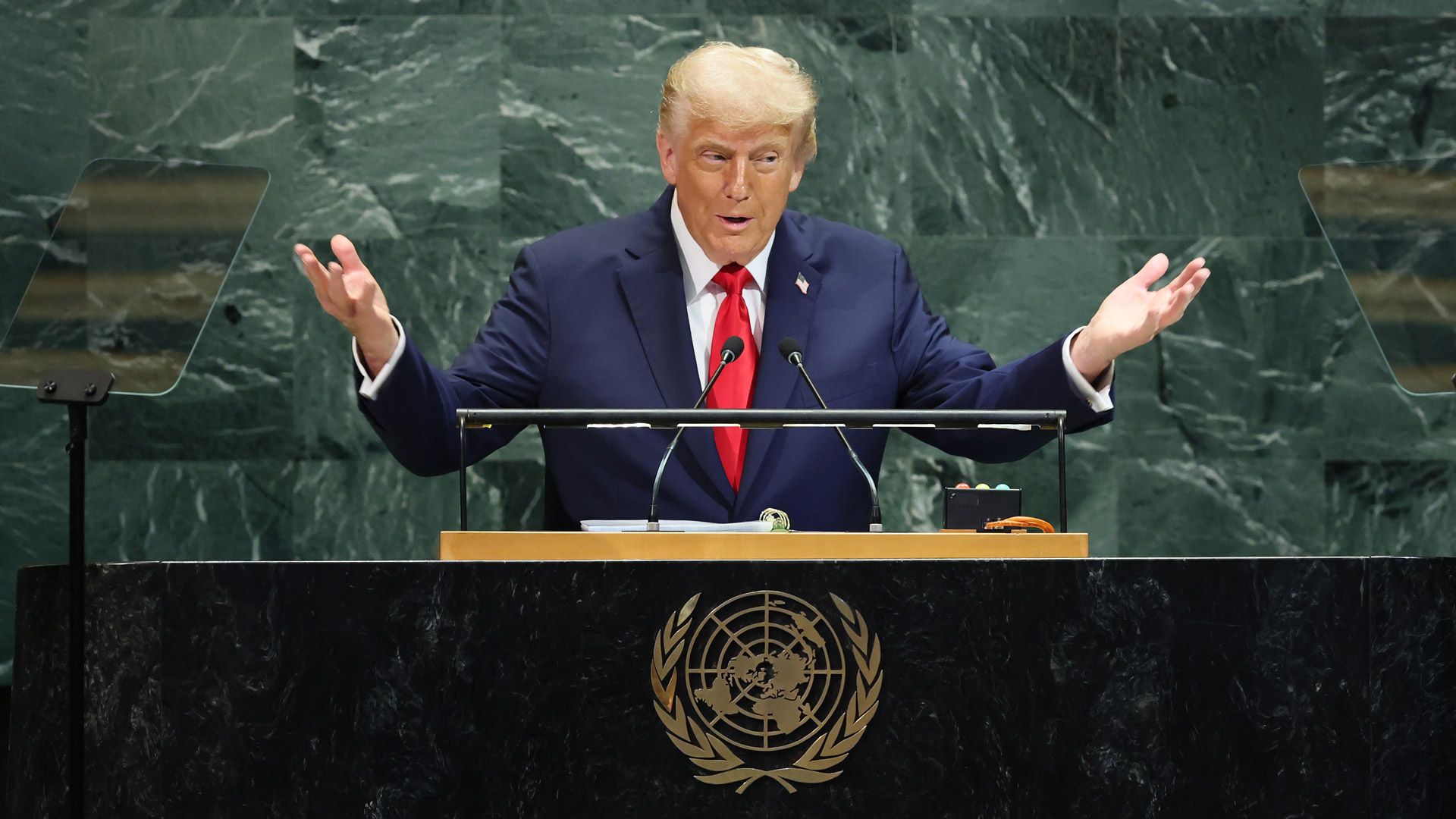
- Trump told the UN General Assembly on Tuesday that all United States documents would be changed to use the term "super" instead of "artificial", introducing the label SI.
- CNET reported that no official government order forcing the change from AI to SI had appeared, and that a White House representative referred the site to the president's UN comments.
- IBM describes artificial superintelligence as a hypothetical system with intellectual abilities beyond those of humans, and Google similarly calls it a theoretical form of AI.
- The wording came out of Truth Social polling, where "super" beat "superior" by a razor-thin margin in a second poll posted less than an hour after the first.
- US Chief Technology Officer Ethan Klein wrote on social media, "The Super Intelligence (SI) President has spoken! The United States is and will remain the global leader in SI."
Compiled by The Product DeskSomething wrong?How this is made
Why it matters
- decision Documentation owners have to decide whether to rewrite standing language on the strength of a speech, with no order number, effective date or list of bound agencies to enter in a change log.
- constraint Once one label covers today's assistants, more autonomous agents and a system nobody has built, a federal risk section has to define its terms before it can say anything specific about any of them.
- exposure Support and enablement teams absorb the distance between the label and the product, because users who hear "super intelligence" form expectations that hallucinations and failed multistep tasks then break.
- contradiction Adoption inside the administration and adoption in the industry are pulling in opposite directions, so a writer picking wording cannot lean on consensus in either camp.
A compliance writer who takes the instruction literally hits the problem on the third page. The controls section has to separate systems in production from systems that exist only in theory, and the new label covers both.
Trump's stated reason is about connotation. "The use of the word artificial makes intelligence sound fake," he said at the UN. "It is not fake. It's actually amazing." [3] TechRadar reported that he also admitted during the same address that he does not know whether he has the power to rename an entire science, technology discipline and industry [23].
The word he picked is already occupied. Researchers separate narrow AI, which covers image recognition and today's large language models, from artificial general intelligence, a hypothetical system matching human ability across a broad range of tasks, and from artificial superintelligence, a theoretical step past AGI whose abilities exceed humans in essentially every intellectual domain [11]. Nobody has demonstrated the third [12]. The definition traces to Nick Bostrom, who more than a decade ago described an "intellect" superior to humans in all forms, and it is still entirely hypothetical [14].
Ben Leong, a computer science lecturer at the National University of Singapore, told the BBC: "My guess is that professionals will want to save 'SI' for a higher level of AI, not so much to describe AI today. It doesn't feel like it's at that level yet." [18] Simon Coghlan, a digital ethics lecturer at the University of Melbourne, called the rebranding "misleading" because super intelligence typically refers to a system able to improve itself [16]. He said: "I doubt 'SI' will stick, in part because it exaggerates the current capacities of AI." [17]
Inside government, a rename normally arrives with paperwork. A January 2025 executive order directed federal agencies to refer to the Gulf of Mexico as the Gulf of America in official documents [5]. Last month Trump ordered Lake Ontario designated Lake America [6]. Those give a records officer a date to act from. SI has so far travelled by repetition: Trump's ambassador to the UN, Michael Waltz, said, "If you didn't see the president's speech, it's now super intelligence. I think he's absolutely right." [20]
The term is also four days old as a choice. Trump was still saying AI on Saturday, when he proposed an AI Force as a follow-up to the Space Force [7]. On Monday he posted a poll offering "superior intelligence", "extreme intelligence" and "supreme intelligence", and "superior" led before it closed [8]. The label he announced at the UN won the second poll, not the first [10].
Two things settle this for a given document: whether a written instrument names the term, with an effective date and the agencies it binds, and whether the sentence has to distinguish systems shipping now from systems that remain hypothetical. There is no such instrument, and a controls sentence has to draw that line. So the cheapest option is to leave "artificial intelligence" in the text and add one defined-terms line noting that some US government communications use "super intelligence" or "SI". The cost of that hedge is a glossary entry; the cost of guessing wrong on a rewrite is every downstream document that quoted the old wording. If an order does land, the mandated label goes in headings and the narrow/general/super ladder stays in the glossary, so an evaluator can still tell which system a control covers.
Coghlan told the BBC that a superintelligent system, "if it came about, would be regarded by experts as the most consequential technology ever made" [26].
What to watch
- Whether an executive order or agency memo names SI and gives an effective date, the way the January 2025 Gulf of America order did.
- Whether the term starts appearing in the text of federal solicitations and agency reports. Contractors would first have to match it there.
- Whether Trump keeps using AI himself in the way he did on Saturday when proposing an AI Force.