Invest1 publisher3 min readPublished
The ballroom case is really about whether the executive can spend without Congress
The administration wants the Supreme Court to let a $400 million project Congress never funded proceed while it appeals. Chief Justice Roberts gave the plaintiffs until Tuesday to respond.
The Investor · Invest desk
Drafted by a language model from the sources cited here and checked against its claim ledger before publication. How we use AISend a correction
What happened
- On Friday, the Trump administration asked the U.S. Supreme Court to allow the White House to continue construction on its $400 million ballroom project while it appeals a lower court's order to halt the work.
- Chief Justice John Roberts set a deadline of Tuesday for a response by the plaintiffs challenging the ballroom project.
- A divided three-judge panel of the U.S. Court of Appeals for the D.C. Circuit ruled last week, 2-1, that Trump must stop the White House ballroom's construction because Congress has not approved the project, upholding an order to pause aboveground construction and siding with historic preservationists who sued.
- The panel majority said Trump does not have unilateral authority to build a 90,000-square-foot ballroom where the White House's East Wing stood before he ordered its demolition last fall.
- The majority wrote: "Whether or not a massive ballroom should be constructed is for Congress to decide and is not a matter for Executive self-help."
Compiled by The InvestorSomething wrong?How this is made
Why it matters
The Trump administration asked the Supreme Court on Friday to let construction of a $400 million White House ballroom continue while it appeals a D.C. Circuit order to stop the work [1], and Chief Justice John Roberts set Tuesday as the deadline for the challengers to respond [2]. What is in front of the Court is not a design dispute but the question of whether the executive can build something Congress has not funded, and whether it can finish enough of it that a court order stops mattering.
The divided three-judge panel ruled last week that the work must halt because Congress has not approved the project, and that the president has no unilateral authority to build a 90,000-square-foot ballroom where the East Wing stood before he ordered its demolition last fall [3][4]. "Whether or not a massive ballroom should be constructed is for Congress to decide and is not a matter for Executive self-help," wrote the two judges in the majority, both appointed by Democratic presidents [5][6]. The panel suspended its own ruling for two weeks, and Solicitor General D. John Sauer has asked for a decision before it takes effect on Aug. 21 [7][8]. Once the response lands on Tuesday, the Court has roughly three days [9].
The filing says the project is "on time and under budget" and that approximately $400 million in private donations means no taxpayer dollars are needed [10]. That sits awkwardly next to two other facts in the record: congressional Democrats say money from the tax cuts bill appears to be paying for ballroom work [11], and the administration has asked Congress for additional funding, which lawmakers have not approved [12]. If the financing is entirely private, the appropriations request is unnecessary. If the request is necessary, the financing is not entirely private.
The security framing is doing the heavy lifting. Sauer calls the injunction "extraordinary and unlawful" and says it halts "the ongoing construction of the integrated military complex, including a totally secure ballroom space" [13]. The filing is also the administration's first confirmation that the threat of a missile attack against Air Force One on July 8 led the Secret Service to fly Trump out of Turkey on an alternate military aircraft [14]. But the April district court order already allowed underground work to continue, including bunkers, military installations and medical facilities, and paused only aboveground construction [15]. The bunker and the ballroom are separable, and the lower courts separated them.
The quieter precedent is standing. Judge Neomi Rao, dissenting, found the preservationist group had no legal right to sue, writing that the district court "elevated the aesthetic displeasure of a single passerby over the government's security interests in the ballroom" [16][17]. The administration argues the National Trust for Historic Preservation cannot sue at all [18], and that the project "should be a matter for the President and the political process, not construction-by-injunction" [19]. Win on standing and the spending question survives with no plaintiff able to raise it.
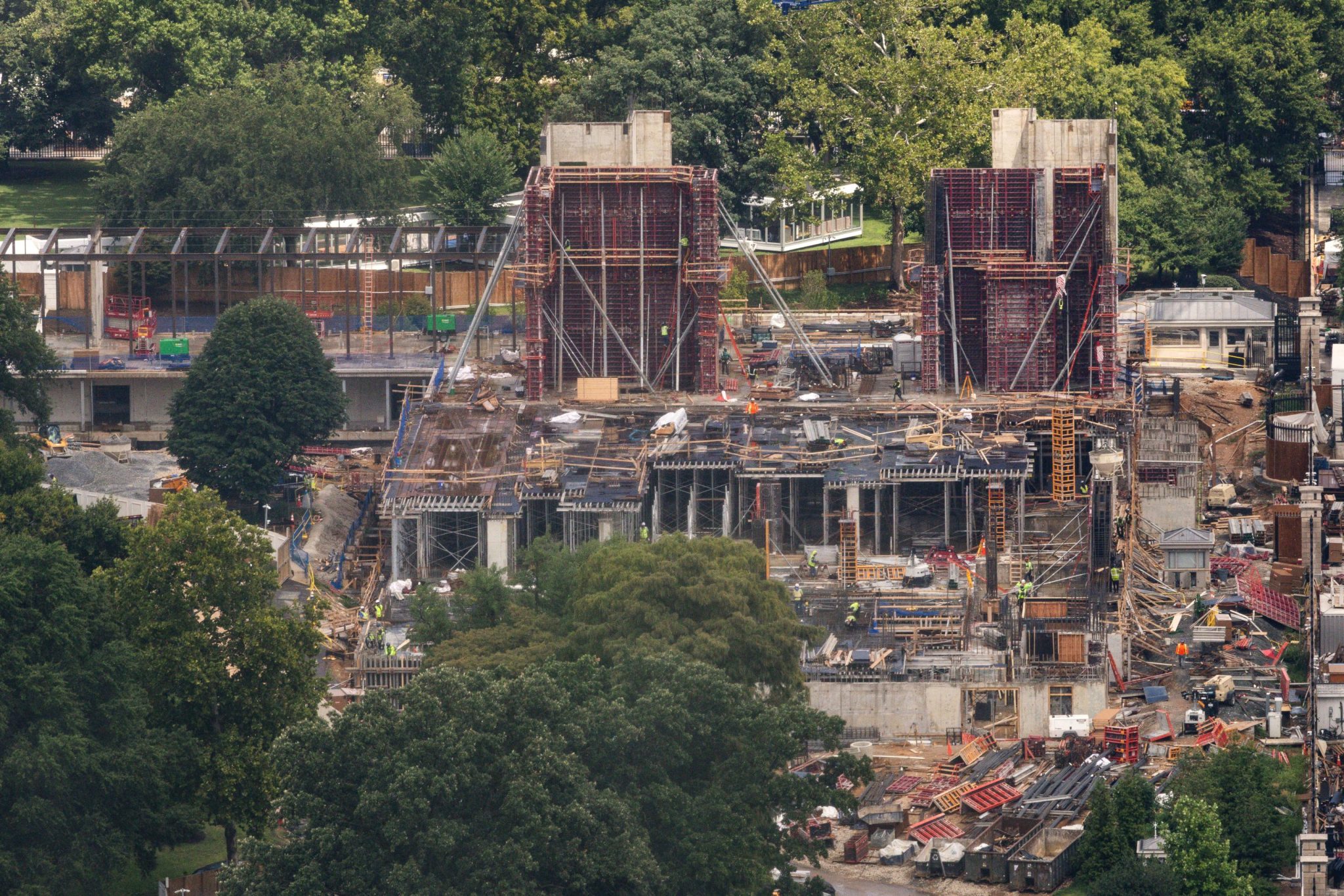
Meanwhile the concrete moves. The Trust says the White House is trying to "outrun the courts," citing plans to install 1 million pounds of rebar and pour another 3,000 cubic yards of concrete in the next week alone [20][21]. At the stated cost and footprint, the ballroom prices out near $4,400 per square foot [22].
Watch whether Roberts acts alone or refers the stay to the full Court, and whether any order touches standing or only the balance of harms. Watch the appropriations request: a vote either way settles more than the litigation does. And watch the pour schedule, because rebar in the ground is the administration's most effective argument.