Science1 publisher2 min readPublished
Study projects the six largest tech firms' AI electricity use will at least double by 2030
Researchers project the six largest tech operators' AI electricity use will reach 239 to 295 TWh by 2030, up from 118 TWh in 2024. That growth is expected to cluster, so most of the strain falls on the power and water systems of a few places.
The Scientist · Science desk
What happened
- Microsoft, Google, Meta, Oracle, Amazon and Apple would account for about two-thirds of the world's AI energy consumption under the projection.
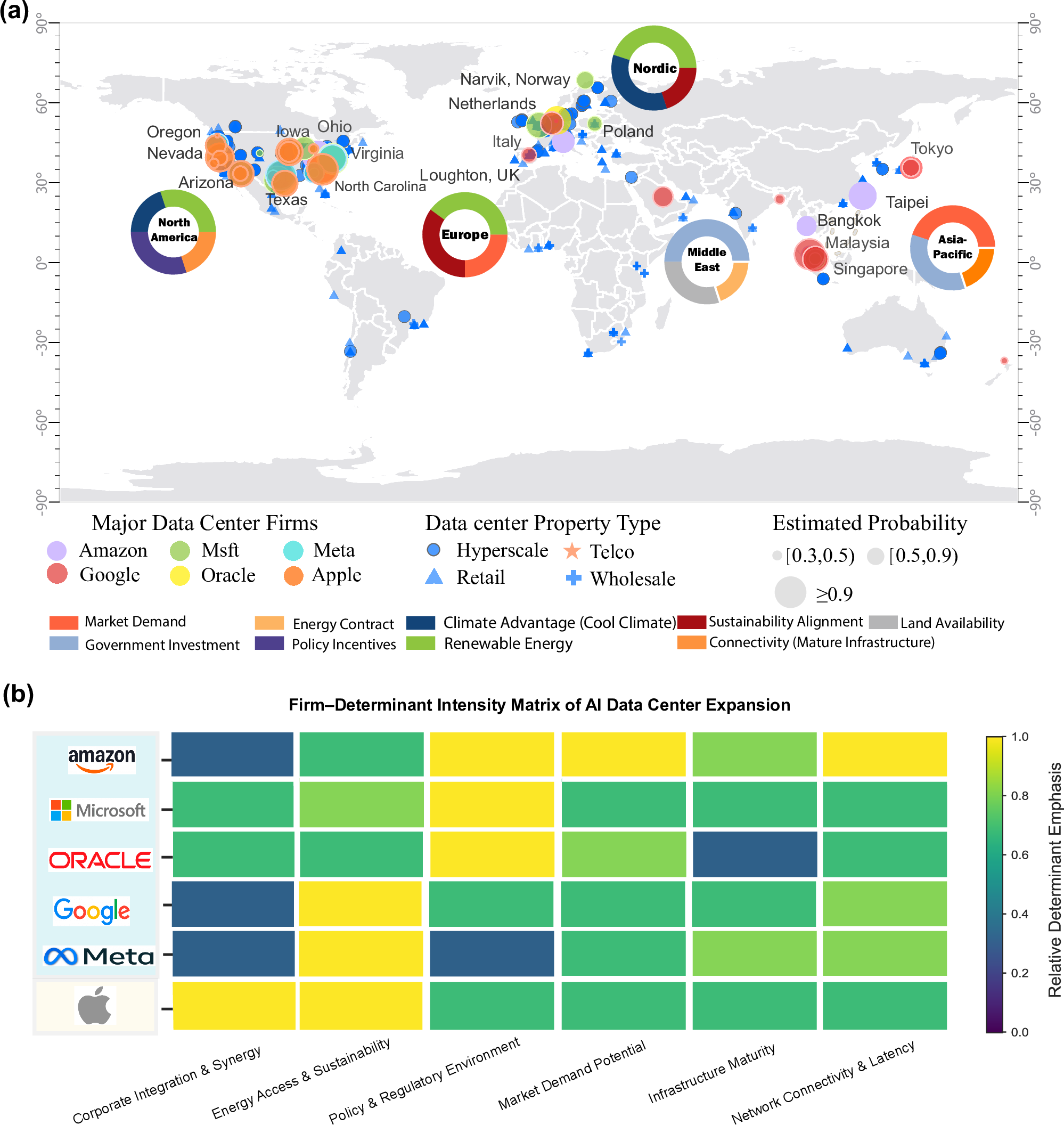
- More than 90% of the projected global computing capacity is clustered across just three regions, according to Scientific American's summary of the study.
- The Environmental and Energy Study Institute estimates a large data center can use up to 5 million gallons of water a day, as much as a town of tens of thousands.
Compiled by The ScientistSomething wrong?How this is made
Why it matters
- decision Utilities in the cluster states have to decide which scenario to build for, because the low and high cases differ by 56 TWh, nearly half the six firms' entire 2024 AI use.
- constraint With more than 90% of capacity in three regions, a roughly 1% global share understates the load on the few grids that actually host the buildings.
- exposure Residents near the seven named US clusters take on the water draw, noise and diesel exhaust of AI demand generated across the whole country.
At the low end of the projection, the six operators' AI demand roughly doubles from 2024. At the high end it grows about 2.5 times [2]. That is 121 to 177 TWh of added annual demand [1]. The gap between the two scenarios is 56 TWh on its own, close to half of everything the six used in 2024 [3].
The global numbers make the load look modest. AI data centers would draw about 1% of all electricity by 2030, according to the study as summarized by Scientific American [1]. All data centers together could reach 945 TWh, or 3% of world consumption [4]. On those figures, the six firms' AI workloads would be 25% to 31% of worldwide data center electricity [4].
Concentration changes the picture. More than 90% of projected global capacity sits in just three regions [5]. In the US, the podcast lists Virginia, Ohio, Oregon, Iowa, Texas, Arizona and North Carolina as the places where data centers are expected to cluster [6]. "That means that folks in certain areas will bear the environmental burden of the whole country's generative AI usage," said Rachel Feltman, host of Scientific American's Science Quickly [7].
The summary does not name the three regions, split the load among the seven states, or give peak demand for any single site. Its figures are annual terawatt-hours at global and company scale [2][4]. A 1% global share is a national-scale unit. It says little about whether a particular county's grid can serve a new campus.
The local costs mentioned alongside the projection come from a different source. The Environmental and Energy Study Institute estimates that a large data center can use as much as 5 million gallons of water a day, about what a town of tens of thousands of residents uses [8]. That estimate belongs to the institute, not the Communications Sustainability paper. Cooling systems, fans and backup diesel generators add noise, and the generators also pollute the air [9].
I think the evidence supports treating AI growth to 2030 as a siting question for a short list of states [5][6]. The case rests on one journal paper, reported secondhand, and its own two scenarios sit 56 TWh apart [3].
What to watch
- The paper's own regional breakdown: which three regions hold the 90% and how the load divides among Virginia, Ohio, Oregon, Iowa, Texas, Arizona and North Carolina.
- Reported 2025 and 2026 electricity use from the six firms, to see whether demand tracks the 239 TWh path or the 295 TWh path.
- Utility load forecasts in the seven named states, to check whether local planning matches the clustering the study projects.