Science1 publisher2 min readPublished
Slow-frozen lab droplets sort their salts in a way that could explain Cassini's Enceladus grains
Institute of Science Tokyo researchers found that salts separate inside 200-micrometre lab droplets frozen at about 10 K a minute or slower. Slow freezing in the vents could explain Cassini's oddly varied Enceladus grains, though the droplets held salts and organics remain untested.
The Scientist · Science desk
What happened
- Cassini's Cosmic Dust Analyzer measured individual ice grains in Saturn's E-ring, a ring fed by Enceladus's eruptions, from 2004 to 2017.
- A Freie Universität Berlin team led by Frank Postberg examined 961 mass spectra of salt-rich grains and found their compositions varied widely.
- Chloride and carbonate rarely turned up together in the same sodium-rich grain, one of the patterns the lab work set out to explain.
- The team proposes that droplets freeze slowly deep in the vents, then shatter against narrow ice channels near the surface into chemically distinct fragments.
Compiled by The ScientistSomething wrong?How this is made
Why it matters
- constraint Salt ratios in a single Cassini grain can no longer be read straight across as the ocean's ratios, since grains from the same water can differ sharply.
- contradiction Vent models built on fast freezing and a quick exit would need reworking if Cassini's grain diversity is taken as evidence of slow freezing underground.
- decision Instrument teams planning plume flybys would need to collect enough grains to reassemble bulk ocean chemistry from sorted fragments, a larger sample than well-mixed grains would require.
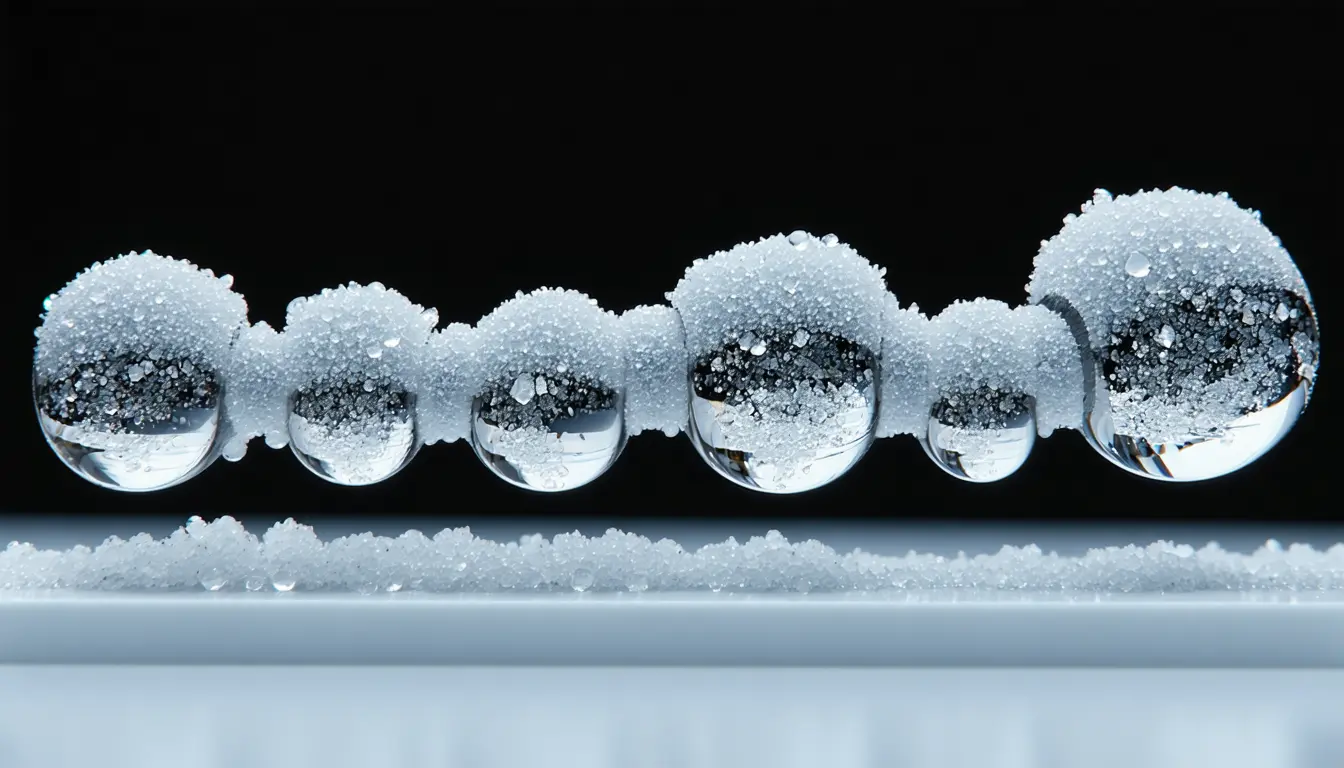
The experiment has its control built in. Yasuhito Sekine and colleagues at the Earth-Life Science Institute (ELSI) made droplets carrying the major salts thought to be in Enceladus's ocean, then froze them at different sizes and cooling rates [5]. In droplets about 200 micrometres across, freezing at roughly 10 K per minute or slower pushed the salts into separate regions [6]. Faster freezing left the same ingredients much more evenly mixed, so the sorting follows the cooling rate [7].
"What surprised us was that the diversity seen by Cassini could emerge from droplets originating from essentially the same ocean water," Sekine said [8]. Frozen droplets that are later broken apart, he said, "can produce much smaller ice grains, each with very different chemical compositions" [15].
The lab result shows that slow freezing can produce this kind of sorting. Whether Enceladus's vents cool spray that slowly is an inference from the lab threshold. Earlier studies generally assumed the spray froze quickly and headed for space soon after leaving the ocean [10]. The team's alternative has droplets tens to hundreds of micrometres across moving slowly along complicated fracture paths deep in the crust, freezing as they go [11]. The shattering near the surface is also a proposal. The release says collisions with the walls of narrower channels "may break the droplets into much smaller pieces" [9].
Sampling this ocean without a drill was already the premise of plume science, because fractures near the south pole vent water vapour and ice particles into space [12]. The release goes further. It says the sorting could give future spacecraft an advantage in searching for organic compounds and clues to life [13]. I think that holds only if organic molecules behave as the salts did, crowding into some regions of a slowly freezing droplet and so into some fragments. The brines in these experiments were salt mixtures [5].
What to watch
- A repeat of the slow-freezing test with organic compounds in the brine, showing whether they gather into separate regions as the salts did.
- Impact experiments that shatter sorted frozen droplets against ice, testing whether the fragments keep distinct salt mixes.
- Models of Enceladus's vents that check whether spray can travel slowly enough to freeze at about 10 K per minute or less.