Science1 publisher3 min readPublished
Collision history barely moves an icy moon's odds of an ocean, Maryland-led simulations find
Marc Neveu's group ran the biggest collisions it could devise against simulated icy moons, and the result says a shattered past tells you little about whether a moon holds water under its shell today.
The Scientist · Science desk
What happened
- A University of Maryland-led team reporting in Nature Astronomy simulated the largest collisions it could construct on icy moons and found they did not change whether a moon ends up holding an ocean.
- The runs followed moons of roughly 500 and 1,000 kilometres in radius as smaller rocks blew them apart and they reassembled, then tracked 4.5 billion years of interior heating and cooling.
- Moon size mattered more than the team expected, with the aftereffects of comparable collisions pointing in opposite directions for the two radii modelled.
- The bodies covered include Saturn's Mimas, Enceladus, Tethys, Dione and Rhea, five Uranian moons from Miranda to Oberon, and Neptune's Triton.
Compiled by The ScientistSomething wrong?How this is made
Why it matters
- decision Ocean-world target lists no longer need a collisional-history filter for the larger bodies, while a disrupted moon near 500 kilometres should be ranked lower than its size alone would place it.
- capability Rhea turns into a checkable prediction: a spacecraft can look for the interior heat signature an ancient ocean boost would leave, instead of inferring warmth from crater shapes.
- constraint With two radii and one class of extreme impact modelled, the work cannot say whether any named moon holds water now, so instrument sensitivity still has to be set from observations.
The two sizes in the study sit far apart thermally. Doubling a radius from 500 to 1,000 kilometres multiplies volume by eight and surface area by four, leaving the bigger moon half as much radiating surface for every unit of interior [15]. "In larger moons, the energy of the crash converts into extra heat that can actually thicken up an existing ocean for a couple of billion years. In smaller moons, the story flips," said Marc Neveu, the study's lead author and an associate research scientist in astronomy at Maryland [9][17].
The small-moon reversal is about layering. Neveu said those moons start out with "a jumbled outer layer of mixed ice and rock that acts like an insulating blanket", and that after the fragments come back together "the rock sinks to the center and the ice floats to the top" [10]. The ocean gets harder to hold once the mixed layer is gone, he said, "but in neither case did a collision create an ocean that would've otherwise stayed frozen" [10].
Timing matters for anyone planning to go and look. A couple of billion years of thickening inside a simulated history of 4.5 billion years is under half the span, and a moon disrupted early would have spent about 2.5 billion years with the boost already spent [16].
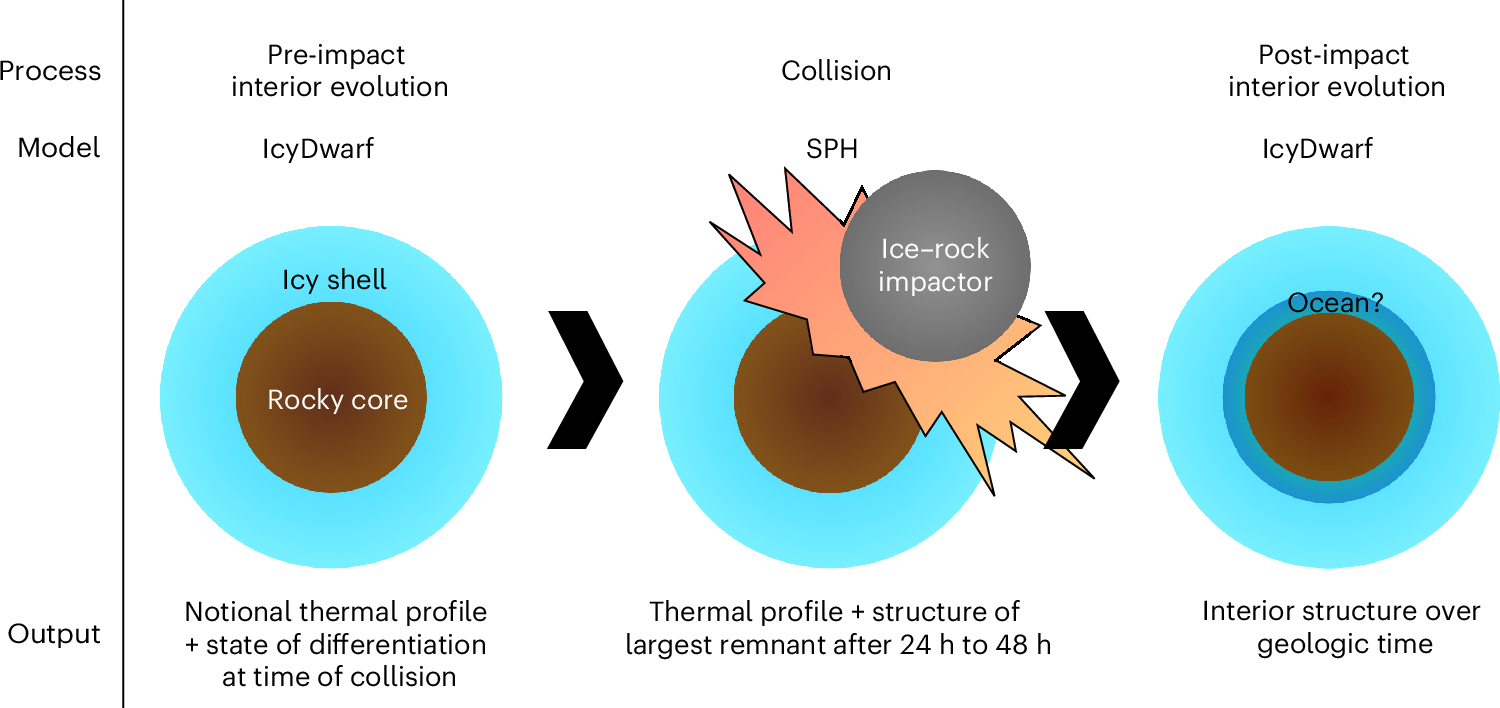
The design is two simulation families joined end to end: one tracking millions of rock and ice fragments as they shatter, heat and clump back together, the other following heat into and out of a core over billions of years [6]. The coupling is what lets the impact set the interior structure that the long-run thermal model then evolves [6]. Neveu said these were close to the biggest collisions the team could come up with, and that if those made no difference, smaller ones were unlikely to either [5]. The argument is from the upper bound, and the phys.org account does not say how many runs were done or what the impactor masses were [18]. The outcome surprised Neveu and his co-authors at the Southwest Research Institute in Colorado and the Weizmann Institute of Science in Israel [4].
Saturn's Rhea drew the team's attention as a test case because its ancient craters look strangely smooth and softened, as though warmed from beneath [12]. "Rhea's craters look smoothed out like that, but it wasn't the sun. The heat came from below," Neveu said [13]. An old collision that boosted an interior ocean is offered as a candidate explanation for the relaxed craters [12].
For mission planning the result changes a prior. A body near 1,000 kilometres that was shattered and rebuilt should not be ranked down for that history; one near 500 kilometres with the same past is a weaker candidate than its size alone suggests [9][10]. The team lists what would settle it on arrival: the gravitational fingerprint of a hidden ocean, salty surface deposits, icy cryovolcanoes, and how sensitive a life-detection instrument needs to be [14].
What to watch
- Whether a Rhea flyby returns a gravity or thermal signature consistent with interior heating from an ancient collision.
- Whether the same coupled modelling run at radii below 500 km or above 1,000 km, or with slower and oblique impacts, holds the neutral result.
- Whether decadal-scale target lists for Uranian moon missions cite this work to keep disrupted moons in contention.