Science1 publisher2 min readPublished
Slowly freezing spray sorts Enceladus's ocean into single-substance ice grains
Frank Postberg's team finds that Enceladus plume droplets freeze slowly, sorting salts and organics into separate grains a few micrometers across. A probe would need to check many grains to find one holding microbial material, though that grain should be easy to read.
The Scientist · Science desk
What happened
- In Science Advances, Frank Postberg of Freie Universitat Berlin and an international team report that Enceladus's ocean constituents are easier to determine than assumed.
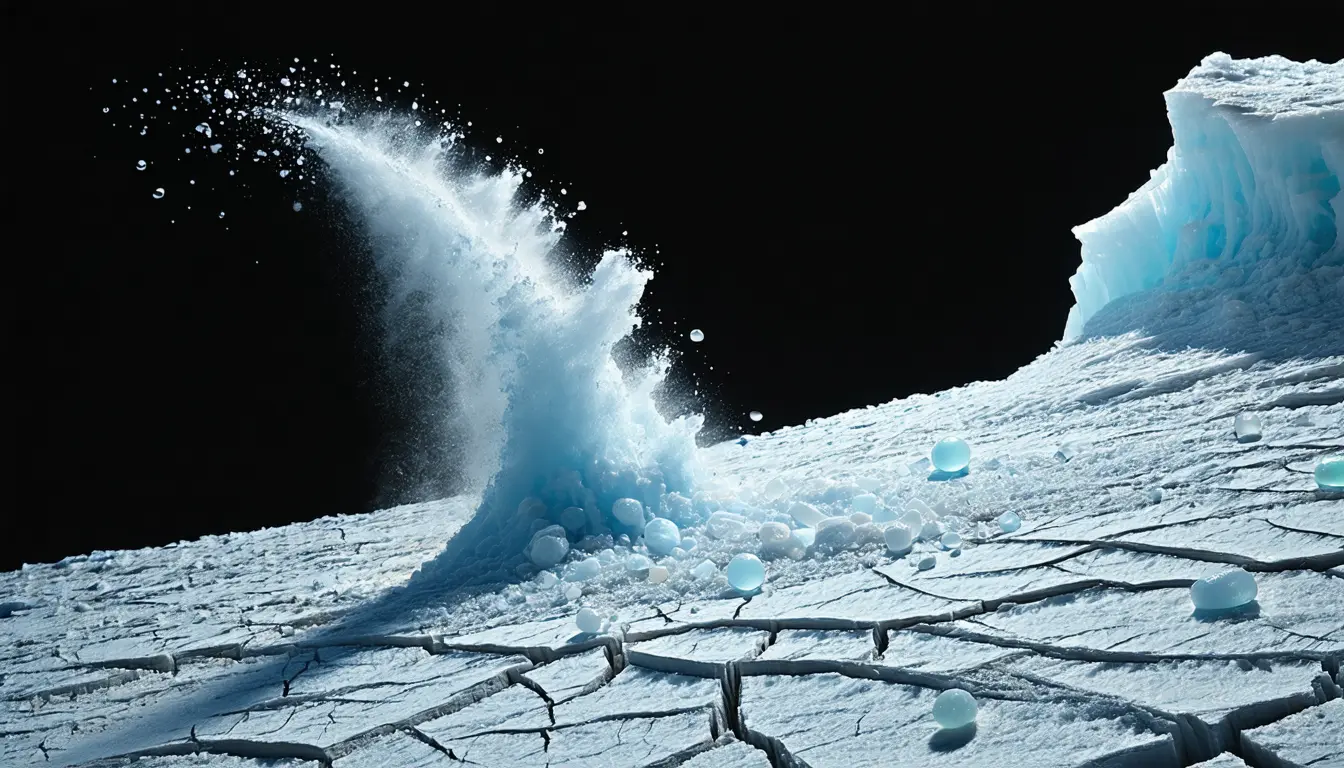
- Scientists had assumed spray droplets froze instantly; the team finds they freeze slowly, so salts and organics, and even different salts, separate within each droplet.
- Moving at up to 1,000 km/h, the frozen droplets break against crack walls into fragments a few micrometers across, often made of one concentrated substance.
Compiled by The ScientistSomething wrong?How this is made
Why it matters
- decision A life-seeking payload for a mission such as ESA's planned L4 has to be built to analyze plume grains one at a time and in large numbers, because any microbial signal would sit in a small fraction of them.
- constraint With grains often made of one substance, a single grain's makeup cannot stand in for the ocean's, so the bulk chemistry has to be rebuilt statistically from many grains.
- capability If Postberg is right that existing technology can read a microbe-bearing grain, the unsolved engineering problem becomes collecting and screening enough grains, and no new detector needs inventing.
Any material from microbes in an ocean droplet would be sorted the same way, according to the phys.org report on the work [9]. It could separate from everything else as the droplet froze. After fragmentation it would sit in only a small fraction of the grains, highly concentrated and relatively pure [9]. Postberg described both sides of that result. "That is great news in the search for life," he said. "Future spacecraft will have to analyze many individual ice particles in the plume. But if they come across one with microbial material in it, they could identify biosignatures in the particle relatively easily with already available technology." [8]
The share of grains that carry any single constituent is still unknown. A mission team would need that figure to know how many grains a probe must analyze before it meets the rare one.
The paper's title says Cassini's CDA instrument recorded compositional segregation of the ice grains [2]. The team then used long-term laboratory experiments and theoretical models to reconstruct the process [3]. It starts at the ocean surface, where rising gas bubbles pop and throw off droplets that water vapor carries up through cracks in the ice shell [4]. Cassini flew through the plumes multiple times, and Enceladus's ocean is the only body of water beyond Earth that scientists have sampled directly [11]. "Enceladus actually does a lot of the work for us in preparing samples for analysis that usually take a lot of effort in chemical labs on Earth," Postberg said. "The oceanic constituents are separated from each other and simultaneously concentrated into individual ice particles." [7]
The second study is described only briefly. Postberg and Khawaja, a planetary scientist also at Freie Universitat, helped show that certain microorganisms could tolerate conditions in Enceladus's ocean better than previously thought [10]. The report does not name the organisms, the conditions tested or the journal. The tolerance result does not show that anything lives there. Microbes tolerating those conditions is evidence about whether the ocean is habitable. The phys.org report says the results increase the likelihood of finding evidence of life on the moon [14].
ESA is planning its L4 mission to look specifically for signs of life on Enceladus [12]. The Science Advances result bears on how that mission samples the plume, and the microbe result on whether there is anything there to find. Ranking Enceladus against other outer-planet targets for funding is a separate argument about cost and competing science.
What to watch
- Whether the Science Advances paper quantifies what share of plume grains carry a given constituent, the figure that sets how many grains a probe must screen.
- Full publication of the microbe tolerance study, naming the organisms and the Enceladus-like conditions they were tested against.
- ESA's definition of the L4 payload, and whether it specifies single-grain analysis at high particle counts.