Science2 publishers3 min readPublished
Flow control gets a shared benchmark, and a 38% friction cut nobody had to simulate first
HydroGym ships more than 60 validated environments reaching Re = 4 x 10^5, plus a proof of concept where agents trained on cheap surrogates cut local skin friction on a 3D wing section.
The Scientist · Science desk
Drafted by a language model from the sources cited here and checked against its claim ledger before publication. How we use AISend a correction
What happened
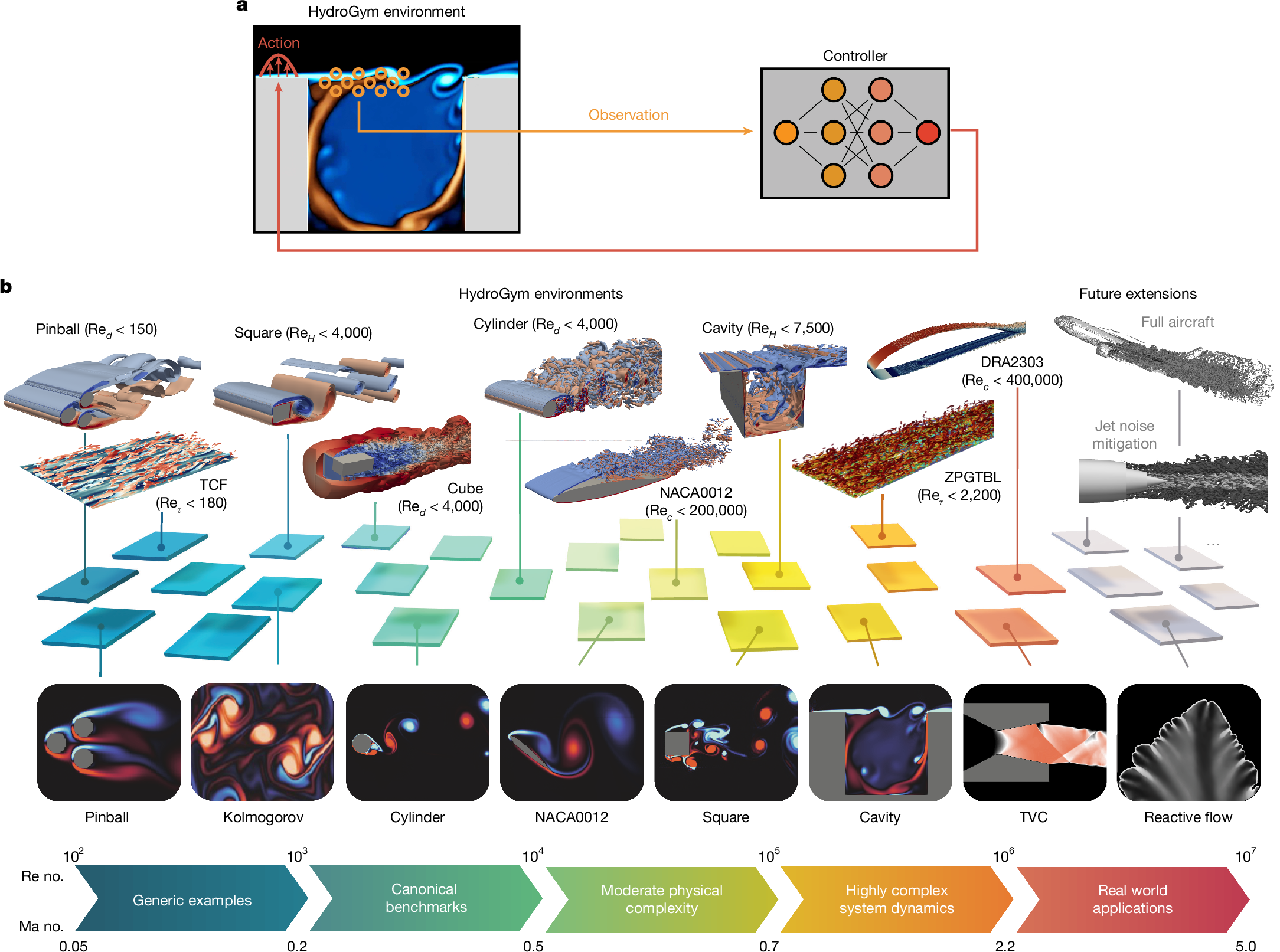
- HydroGym is a solver-independent reinforcement learning platform providing more than 60 validated, openly available flow control environments spanning canonical laminar flows to complex turbulent flows, with systematic progression in Reynolds number up to Re = 4 x 10^5 and Mach number variations in two and three dimensions.
- In much of today's flow control literature, each controller is carefully tuned to a single geometry, a specific operating point and a unique numerical set-up; under these conditions algorithmic progress and rigorous comparisons are nearly impossible.
- Reinforcement learning has driven progress in fields such as protein folding and complex games, which have shared benchmarks and standardized environments; fluid dynamics has lacked such infrastructure.
- Training effective RL agents typically requires thousands or millions of interactions with the environment, and each evaluation in a fluid environment requires an expensive computational fluid dynamics simulation.
- Steven Brunton at the University of Washington: "Simulating fluids usually involves millions or billions of coupled differential equations, and even with Moore's law, with the fastest computers in the world, we're maybe 100 years away from simulating the flows we actually care about at engineering scales."
Compiled by The ScientistSomething wrong?How this is made
Why it matters
A team reporting in Nature has released HydroGym, a solver-independent reinforcement learning platform carrying more than 60 validated, openly available flow control environments, from canonical laminar cases to complex turbulent ones, with a systematic progression in Reynolds number up to Re = 4 x 10^5 and Mach number variation in two and three dimensions [1]. The point is not the environment count: it is that until now each controller in the literature was tuned to a single geometry, a single operating point and a unique numerical setup, which made algorithmic progress and rigorous comparison nearly impossible [2].
That is the gap the authors identify between fluids and the fields where reinforcement learning has actually compounded. Protein folding and complex games had shared benchmarks and standardised environments; fluid dynamics did not [3]. The reason is cost, not indifference. Training an RL agent typically takes thousands to millions of interactions, and every one of those interactions in a fluid environment means an expensive computational fluid dynamics run [4]. Steven Brunton at the University of Washington puts the ceiling bluntly: simulating fluids usually involves millions or billions of coupled differential equations, and even with Moore's law and the fastest machines available, he says, we are perhaps 100 years from simulating the flows engineers actually care about [5].
The result worth arguing about is the transfer demonstration. Agents trained exclusively in inexpensive surrogate environments were deployed, zero-shot, to a three-dimensional wing section [6]. The reported outcome is a 38% reduction in local skin friction with exploration costs cut by four orders of magnitude relative to direct on-wing optimisation [7], which is roughly a ten-thousandfold reduction in the sampling bill [8]. In the practical account given to New Scientist, the agents first learned to control turbulent flow in a flat channel, then handled the curved wing model [11]. Ricardo Vinuesa, at the University of Michigan and part of the team, argues the agents were "picking up something genuinely general about how fluids behave, not just fitting to the one setup" [12].
The authors are more careful than that quote. They state that the transfer exploits shared near-wall physics, and that the breadth of generalisation remains open [9]. Read literally, the wing worked because the wing's boundary layer resembles the channel's. Nothing here says a policy trained on near-wall turbulence will do anything useful for a separated wake or an acoustic problem.
Across the suite, agents repeatedly converged on recognisable control principles: boundary layer manipulation, disruption of acoustic feedback, and reorganisation of turbulent wakes [10]. Actuation includes injecting fluid or changing the object's motion to reduce drag [16]. Team member Christian Lagemann at RWTH Aachen says the agents could also coordinate with each other, which he describes as untried for fluids problems at this scale [13]; that claim rests on his account.
Keep the economics at arm's length. The paper cites literature putting active drag reduction at up to 15% of aviation fuel consumption and coordinated control at 4 to 5% more wind farm output [14], and Brunton estimates a one percentage point cut in global shipping drag would mean billions of dollars in fuel [15]. Those are motivations, not measurements.
What to watch: whether independent groups report on these environments rather than their own, since a benchmark only earns the name when other people's numbers land on it [18]; and whether transfer survives a case where the near-wall physics is not shared [9].