Science1 publisher3 min readPublished
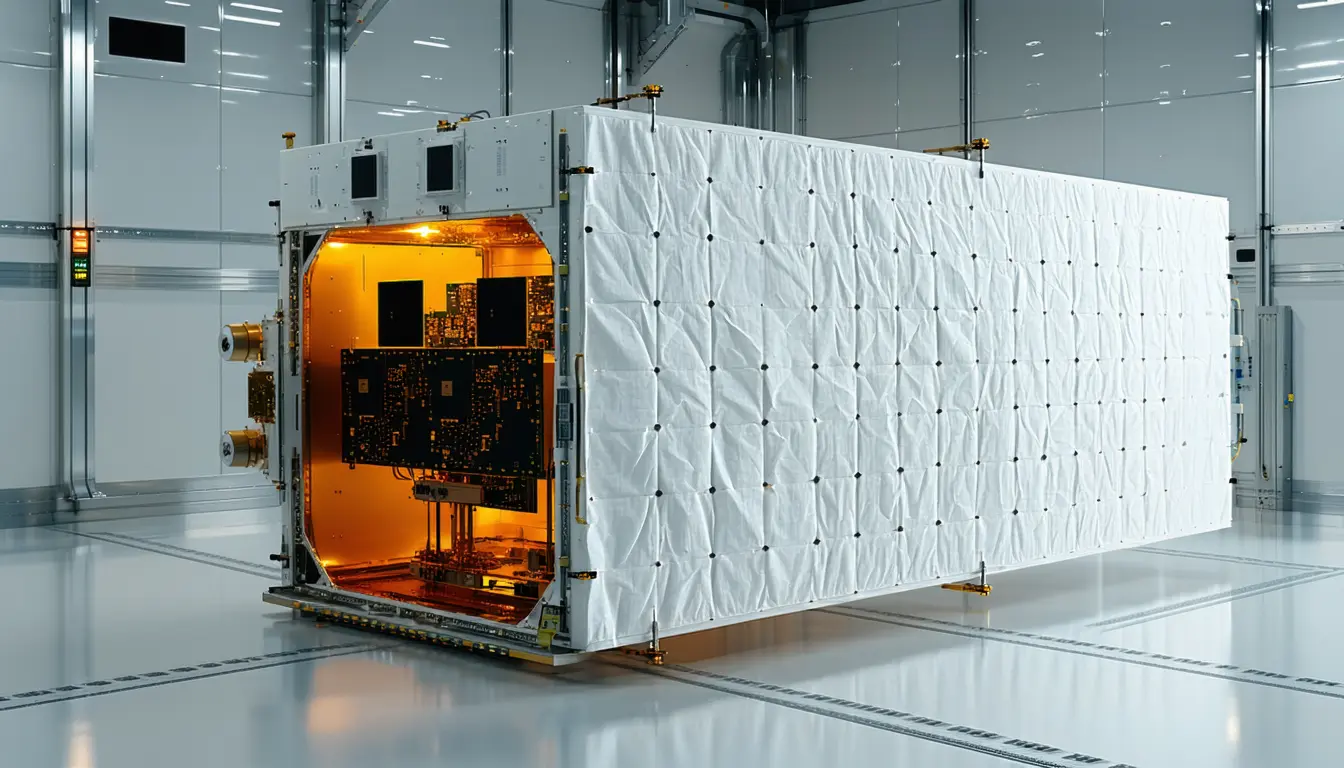
Google's Suncatcher satellite carries four AI chips that must cool down after each 15-minute Gemini run
Google's Project Suncatcher is launching four processors that can run Gemini for only 15 minutes before they must shut down to cool. Heat, launch mass and downlink stand between that payload and the orbital data centers SpaceX pitched when it went public in June.
The Scientist · Science desk
Drafted by a language model from the sources cited here and checked against its claim ledger before publication. How we use AISend a correction
What happened
- The test satellite is launching aboard a SpaceX rocket, carrying Google's AI processors into orbit.
- Google's eventual aim is constellations of thousands of satellites that share the work of running AI models and beam their answers to Earth.
- The largest AI data centers now under construction pack hundreds of thousands of chips and draw up to a gigawatt of power.
- The International Energy Agency projects data centers will use around 3 percent of world electricity by 2030, roughly double today's share.
- For months before launch, Google shook spacecraft to simulate launch and bombarded its chips with proton beams to test radiation response.
Compiled by The ScientistSomething wrong?How this is made
Why it matters
- constraint Radiators needed to shed heat in a vacuum add to the mass a scaled-up constellation must launch, on top of the solar arrays it needs for power.
- exposure Investors who valued SpaceX partly on space data centers are relying on a scale-up of at least 25,000-fold in chip count beyond Google's test payload.
- constraint Free sunlight does not lower downlink cost, so an orbital data center saves on power but still pays to send every answer back to Earth.
- capability Flight results let Google check what its proton-beam and shake tests predicted against real radiation and thermal cycling in orbit.
Fifteen minutes is a heat limit. Space is cold, but its vacuum is a poor place to get rid of heat. Suncatcher's chips therefore have to shut down and cool between runs, and the satellites need specialized radiators [10].
Even if a large ground facility held only 100,000 chips, it would have 25,000 times as many processors as this satellite [1]. The open question is whether run time and chip count per satellite can grow enough for Google's planned constellation to add up to a data center's worth of continuous work [3][4]. Google readily admits that scale is the main question, according to Scientific American [17].
The draw is power. Google says a solar panel in orbit generates up to eight times what it would on the ground [6]. A gigawatt, though, is several thousand times the output of the International Space Station's solar arrays [19]. "It's going from arrays that are several meters on a side to arrays that are a couple of kilometers on a side," said Kerri Cahoy, a professor of astronautics at the Massachusetts Institute of Technology [8]. "Launching enough mass to generate the power is huge," she said [9].
Every answer the chips produce also has to come down. Satellites can transmit data to Earth, but doing so at scale is expensive and difficult [14]. "We don't have the convenient, easy way to get that data back to the ground," said Alan George, a University of Pittsburgh professor of electrical and computer engineering who heads a National Science Foundation center focused on space computing [15]. During the Cold War the problem was bad enough that U.S. spy satellites parachuted their film back to Earth [16].
In my view, Suncatcher asks sensible first questions. Cosmic radiation that Earth's atmosphere filters out can scramble calculations, so orbital computers have to catch and correct errors on the fly [11]. Google's proton-beam work on the ground was a test of how its chips respond to that radiation [12]. "It's about seeing what works, identifying points of failure, and applying those findings to future missions," said Travis Beals, a senior director at Google who worked on the project [13].
SpaceX's valuation rests on a much larger claim. When Elon Musk took the company public in June, promises of data centers in space were a big part of its value proposition [1]. Delivering them means solving launch mass, heat rejection and downlink at gigawatt scale [7][9][10][14]. Suncatcher carries four chips, and they must stop every 15 minutes [3]. Scientific American's report concludes that the gulf between Suncatcher and a working orbital data center suggests how far off that future still is [18].
What to watch
- Whether Google publishes Suncatcher's in-orbit error rates and thermal data, and whether later missions run longer than 15 minutes or carry more chips.
- What hardware, power budget and timeline SpaceX discloses for its own orbital data centers.
- Any demonstration of moving AI outputs from orbit to the ground at volume and at a stated cost.