Invest2 publishers3 min readPublished Updated
Druckenmiller buys the racks and sells the silicon: $88M into Bitdeer and Hyperliquid
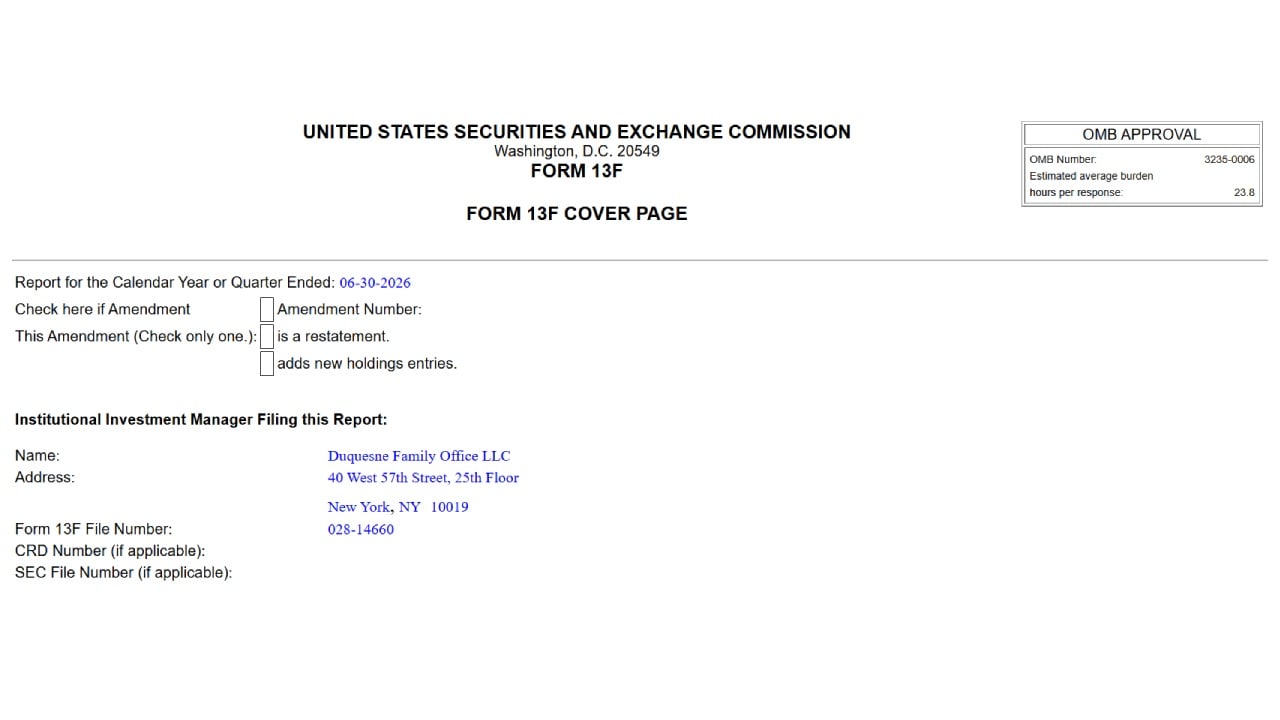
Duquesne's second-quarter filing pairs $64.7 million of Bitdeer with $23.1 million of Hyperliquid Strategies, and part of the funding came from leaving traditional semiconductors.
The Investor · Invest desk
Drafted by a language model from the sources cited here and checked against its claim ledger before publication. How we use AISend a correction
What happened
- Duquesne Family Office's second-quarter 13F, filed in August and dated to 30 June, shows two new crypto-linked stakes worth about $87.8 million.
- The smaller is about 2.9 million shares of Hyperliquid Strategies, a Nasdaq treasury vehicle built around the HYPE token, at roughly $23.1 million.
- Jane Street, Citadel, BlackRock and State Street also raised positions in Bitdeer or Hyperliquid Strategies over the period.
Compiled by The InvestorSomething wrong?How this is made
Why it matters
- decision Anyone holding chip designers as their AI exposure now has a named macro allocator funding the opposite side of that bet, and has to decide whether the margin really migrates to power and premises.
- constraint Without a contract term, Bitdeer's headline AI deal cannot be converted into an annual rate, which caps how much of the compute story any buyer can actually underwrite rather than assume.
- exposure The Hyperliquid leg is priced off a US regulatory outcome that moved on a single presidential remark about CFTC work, a policy dependency the mining leg does not carry.
- contradiction The share count, the carrying value and the quoted average cost cannot all be right, so the entry price now circulating needs checking against the primary filing before it anchors anyone's model.
Duquesne's disclosed US book ran to about $5.21 billion across roughly 95 positions at the end of June [9], which puts the average slot near $54.8 million [10]. Bitdeer at more than $64.7 million sits a little above that line [2]. Hyperliquid Strategies at about $23.1 million is under half of it [4]. The pair together is roughly 1.7% of the reported equity [11]. For an office known for concentration, that is a foothold, and it deserves to be read as one rather than as conviction.
The more interesting entry is on the sell side. The same filing added exposure across bitcoin mining and related infrastructure while exiting certain traditional semiconductor holdings [12]. Taken as a pair, that is a rotation inside the AI trade rather than a crypto sleeve bolted onto it: away from the companies that design the parts, toward the ones holding the power contracts and the buildings. Bitdeer is the cleanest available expression of that, because it both manufactures mining rigs and operates data centres in the US and elsewhere [3].
Underwriting it is harder than describing it. The Tydal campus in Norway carries an artificial intelligence agreement valued at $4.7 billion for 121 megawatts [6], which is about $38.8 million per megawatt of contracted capacity [19]. That figure is unusable as a revenue rate, because the disclosure calls the deal long-term without fixing a duration, and an annual number requires one [20]. The company is still losing money, though losses narrowed quarter over quarter [18], and the Nevada plant meant to turn out thousands of mining units a month is under construction rather than producing [c6b].
There is also an arithmetic problem in the Bitdeer line worth naming before anyone models off it. About 4.1 million shares at a stated average purchase price near $12.26 comes to roughly $50.3 million [13], not the $64.7 million the stake is carried at [2]. Divide the value by the share count and the implied mark is closer to $15.78 [14], which would put the position about 29% above the quoted cost by 30 June [15]. One of those numbers is doing something other than what it appears to.
The crowding matters too. Jane Street, Citadel, BlackRock and State Street all increased positions in Bitdeer or Hyperliquid Strategies in the same quarter [16], which means a filing being read as one macro investor's call was in practice a queue. And 13Fs cover listed equity only, disclosing nothing about direct token holdings [17]. The Hyperliquid Strategies stake is a wrapper for HYPE exposure, including accumulation, staking and yield, without touching the token [5]. Whether it is the whole position or the visible slice of a larger one, this document cannot say.
What to watch
- The third-quarter 2026 13F: whether Bitdeer grows past one average slot, or gets sold into the higher mark.
- Disclosure of the Tydal contract term, the only route by which $38.8 million per megawatt becomes a revenue run rate anyone can underwrite.
- Whether CFTC work on Hyperliquid produces a real US registration path, since the PURR leg's case rests on it.