Science1 publisher2 min readPublished
Spin-resolved photoemission finds altermagnetic signatures in a layered cobalt compound
UCF physicists led by Madhab Neupane report signatures of altermagnetism in Co1/4TaSe2, a layered crystal containing magnetic cobalt atoms. The evidence is surface maps of its electron bands, so device builders get a well-characterized test material whose spin currents still need measuring.
The Scientist · Science desk
What happened
- Altermagnets, as the UCF release describes them, avoid stray magnetic fields the way antiferromagnets do while still generating and detecting spin currents.
- Because photoemission is extremely sensitive to surfaces, Neupane's team screened collaborator-grown crystals for ultraclean surfaces before mapping them.
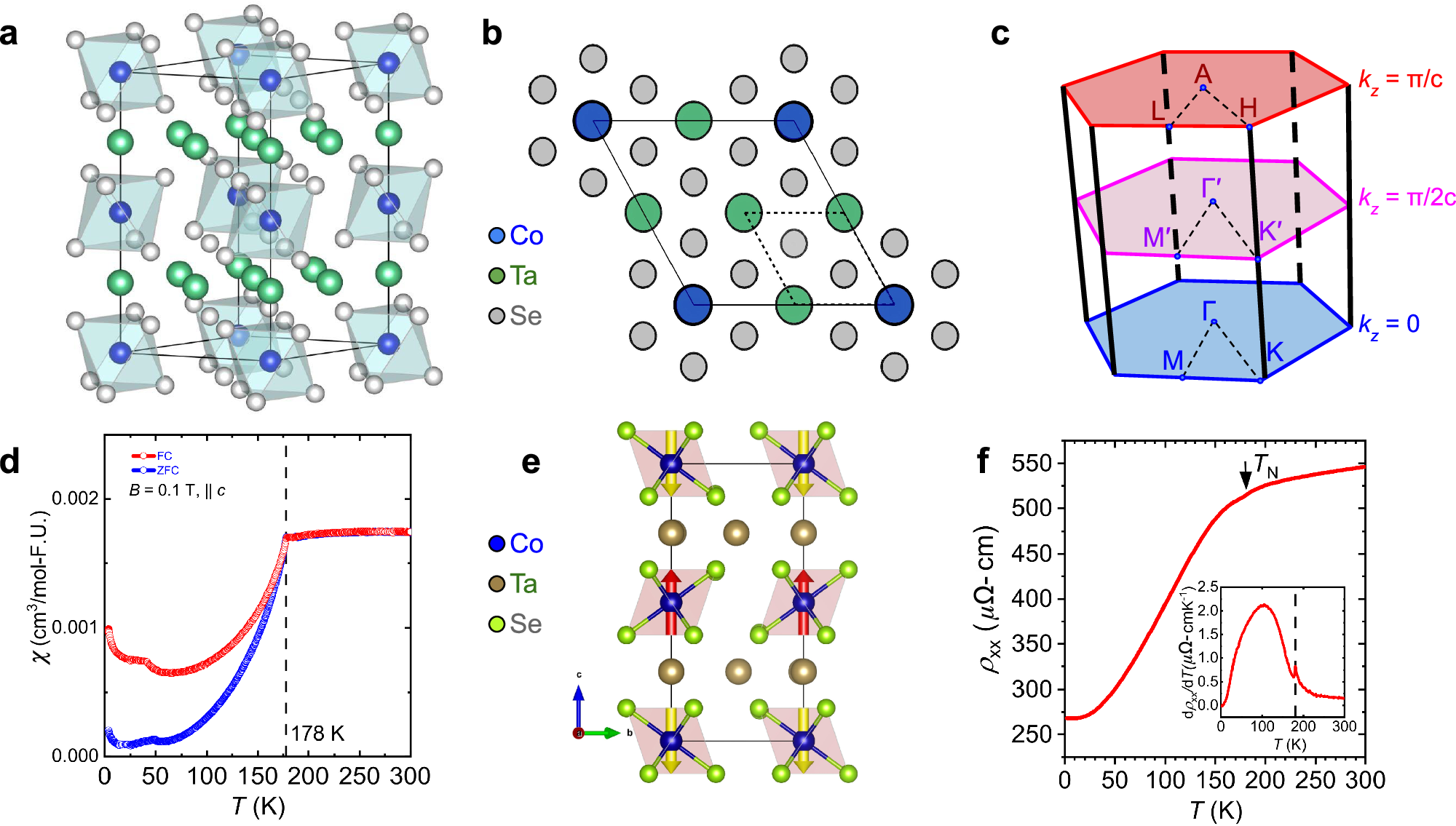
- Co1/4TaSe2 is built from thin, weakly bound layers that can be separated and recombined into very thin structures, a trait valued for thin-film devices.
Compiled by The ScientistSomething wrong?How this is made
Why it matters
- capability Thin-film spintronics groups now have a specific layered crystal, with measured altermagnetic band structure, to thin down and build test structures from.
- constraint All the reported evidence comes from the surfaces of hand-screened crystals, so behaviour in films, at interfaces and at device temperatures has to be established separately.
- precedent Pairing high-resolution spin-blind ARPES with spin-resolved ARPES gives other groups a concrete two-step standard to meet before calling a candidate an altermagnet.
ARPES maps a material's electronic structure by measuring the energy and movement of electrons knocked out of it [7]. Neupane described running it twice over the same bands. "Our approach was to use higher-resolution methods that were insensitive to the electron's spin to measure the splitting in the energy levels," he said. "Then, we complemented this measurement with spin-resolved ARPES to conclusively tell if this looks like altermagnetism." [8]
The order makes sense. A spin-blind measurement can resolve the gap between two bands finely, and the team found the characteristic splitting that way first [9]. That measurement cannot say what spin each band carries. The spin-resolved pass can. Opposite spin polarization in the split states is what the team counts as its key evidence [10].
Next the team compared the maps with calculation. "The significance became clear once the experimental measurements consistently matched our theoretical predictions," Neupane said. "Seeing those independent pieces of evidence converge gave us confidence that we had identified a genuine layered altermagnet." [14] Two kinds of measurement agreeing with a prediction make a stronger case than either one alone. Every piece of that case comes from photoemission, a technique that reads the surface, on crystals selected for clean surfaces [11]. The release does not report the measurement temperature, the size of the splitting, how many crystals were screened, or any spin-current or device measurement on this material.
The thing this doesn't tell you is whether Co1/4TaSe2 does the things that make altermagnets attractive. Ferromagnets are useful in electronics, but their stray fields can interfere with nearby components [3]. Antiferromagnets cancel those fields and lose some useful electronic properties along the way [4]. Altermagnetism is pitched as combining the useful traits of both [2]. "These materials are distinguished from more conventional antiferromagnets by their ability to generate and detect spin currents without the negative effect of producing stray fields," Neupane said [15]. He listed "spintronics, ultrafast memory devices, terahertz networks and energy-efficient electronics" among the possible uses [16].
Those are properties claimed for the class. The university's release calls the crystal a versatile platform for studying altermagnetism [17]. I think that description fits the evidence. What has been shown in Co1/4TaSe2 so far is its band structure: split bands with opposite spins, matching theory [10].
What to watch
- Transport or device measurements showing Co1/4TaSe2 generating or detecting spin currents, the property every proposed application depends on.
- Whether the opposite-spin band splitting survives when the crystal is exfoliated into few-layer flakes.
- The temperature at which the altermagnetic signature appears, and how far it sits from room temperature.