Science1 publisherNot yet confirmed elsewhere2 min readPublished
Tiny sparks igniting electrolysis hydrogen make pickles glow, a Portland State engineer says
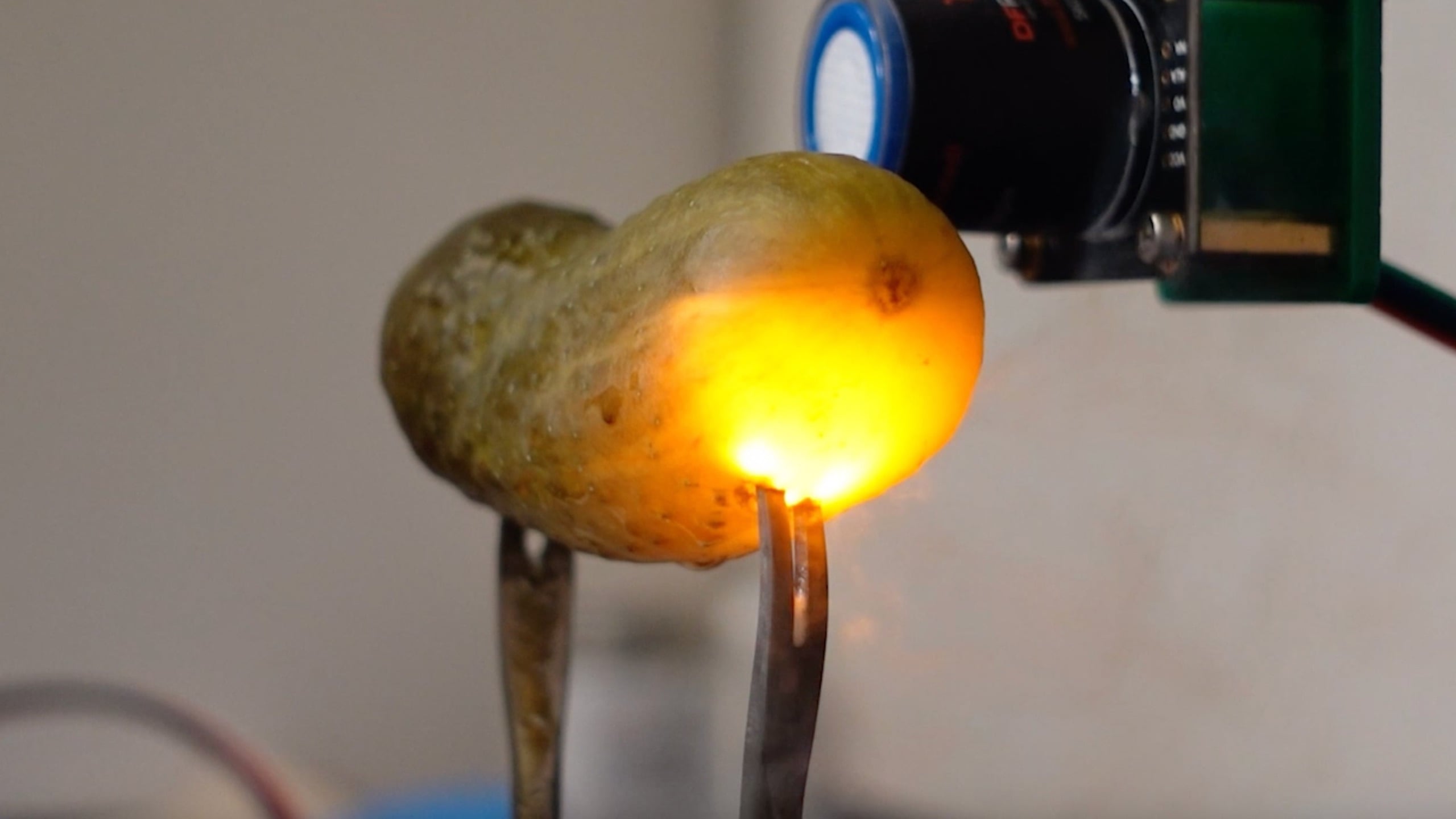
Joshua Méndez Harper told a June electrostatics meeting that sparks at the fork, not heat, ignite hydrogen split from a pickle's brine. His version merges the two explanations that had competed for the trick, and so far it rests on a live demonstration and his own description of it.
The Scientist · Science desk
Drafted by a language model from the sources cited here and checked against its claim ledger before publication. How we use AISend a correction
What happened
- In the demonstration, two forks go into a pickle, the setup is plugged into a power source, and one end of the pickle glows.
- One older explanation held that boiling brine forms insulating gas pockets that shrink as the pickle cools, letting brine rush back toward the fork.
- The other said electrolysis splits the brine's water into hydrogen and oxygen, with heat from the electrodes setting off tiny hydrogen explosions.
Compiled by The ScientistSomething wrong?How this is made
Why it matters
- exposure If the gas-and-spark account holds, anyone repeating this outlet-powered demo is making a flammable gas and sparking it, a hazard on top of the shock ScienceAlert already warns about.
- capability Tying the color to the salt gives the account a direct test: Méndez Harper says a pickle cured in a different salt would glow a color unique to that salt's elements.
- constraint The merged account still has only a tentative answer for the one-sided glow, the same observation Méndez Harper used against the arc-only story; ScienceAlert says that end is possibly where extra salt water collects.
Méndez Harper's version takes one part from each of those stories. Electrolysis supplies the fuel [6]. The arc at the fork supplies the trigger [4][11]. "There is hydrogen involved, but it's actually not heat that's igniting it," he said, adding: "it's the spark" [11]. He dropped heat, the trigger the electrolysis account had proposed [6]. "It's just like why you don't light a cigarette at a gas station. You're producing a spark that ignites the gas," he said [12].
The arc comes from the boiling cycle. "As that water comes back in toward the electrode a little arc crosses between the liquid and the electrode, just as when you reach for a doorknob and you get a zap," he said [4]. By itself, the arc left a gap. "That doesn't explain everything that happens, though," he said, noting that only one end of the pickle glows [5].
The color has a separate cause. According to ScienceAlert, the yellowish-orange light comes from excited sodium in the brine [7]. "You're exciting sodium ions, which produce that characteristic orange glow," Méndez Harper said [7].
The thing this doesn't tell you is what was measured. ScienceAlert's report covers a demonstration and Méndez Harper's description of it at the 2026 Electrostatics Society of America meeting [1]. It does not mention gas sampling, a spectrum, or a control run that would separate spark ignition from heat ignition. The outlet's own headline says physicists "may" have figured it out [9].
I think the account is plausible. Every step in it was already part of one of the two older explanations [3][6]. Its new claim is about which step lights the gas, and a measurement would have to test exactly that.
What to watch
- A written paper or proceedings from Méndez Harper reporting gas or spectral measurements behind the hydrogen-and-spark account.
- A measurement of brine distribution in a running pickle showing whether salt water really pools at the end that glows.