Science1 publisher3 min readPublished
Smithsonian uses AI to trace 10,000 Revolutionary-era objects across catalogs
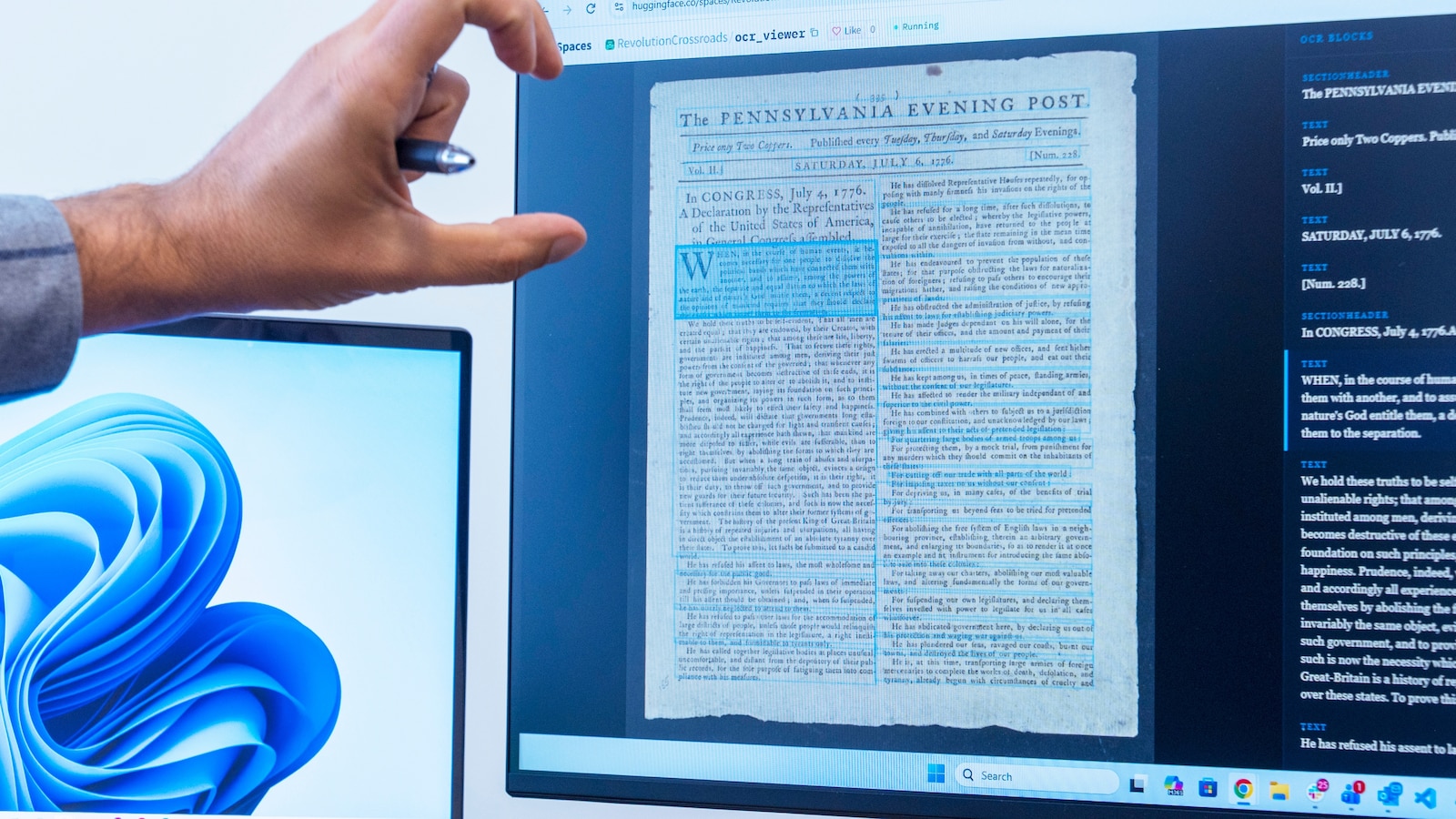
Smithsonian researchers are using AI to match about 10,000 Revolutionary-era objects with records at the Library of Congress and elsewhere. The project says links that once took long manual searches now come quickly, and it has published one example so far.
The Scientist · Science desk
Drafted by a language model from the sources cited here and checked against its claim ledger before publication. How we use AISend a correction
What happened
- Researchers found a silversmith who advertised a creamer in newspapers around 1774, similar to one held at the National Museum of American History.
- The team had to digitize, and in some cases redigitize, the objects so AI models could work with them.
- Becky Kobberod, the Smithsonian's chief digital and innovation officer, said the institution is not using any of the current frontier models.
- Trained historians review the data the models produce, according to Kobberod, to catch nuance a machine would miss.
- Natalie Buda Smith of the Library of Congress said the work helps researchers who do not know whether to start at the Smithsonian, the library or elsewhere.
Compiled by The ScientistSomething wrong?How this is made
Why it matters
- constraint Reviewer time sets the pace: confirmed links arrive only as fast as trained historians can check what the models propose, however quickly the models propose them.
- cost Any museum copying the approach pays for digitization before a model can do anything, since the Smithsonian had to scan, and in places rescan, its objects first.
- decision Scholars using the public search have to decide whether to cite a machine-suggested link or wait until a historian has ruled out a nickname or a generic term.
The creamer is a fair test of the speed claim [4]. It joins a newspaper advertisement to an object in a museum collection, and the Associated Press account says links of that kind would once have required extensive manual searches across multiple catalogs [3]. The report does not describe a second find, name the models, count the links proposed or confirmed, or compare search times before and after the models went into use in the spring [2].
The project is built around people. Becky Kobberod's team chose about 10,000 objects centered on people who lived between 1770 and 1810 [6], and the stated ambition is to surface stories about people whose lives have faded over the centuries [18]. I'd expect matching people across 18th-century records to be where a model goes wrong most often. Kobberod, the first person to hold her post at the Smithsonian [17], described two such failures.
"What they might say is, 'actually that is a known nickname for so-and-so' or 'that is a generic term that's used for X, Y, Z," she said of the historians who review the output [11] [12]. "That is the nuance that a historian or someone who's spent their whole career studying that time period is going to know that a machine is not." [12]
Those two errors run in opposite directions. A missed nickname splits one person into two records. A generic term read as a name joins records that have nothing in common.
She acknowledged a "healthy fear" of the technology [19] and argued for using it anyway. "It's not going away," she said. "We do believe we need to lean in and figure out the part that this technology plays in our work." [15]
Whether this changes how big collections are searched depends on links that cross institutions. The Smithsonian was founded in 1846 and now spans 21 museums and galleries, including the National Zoo [9], and this project already reaches into the Library of Congress [1]. Natalie Buda Smith, the library's director of digital strategy, said the creamer "illustrates that there's a richness out there and you might find part of the story at the Smithsonian and part of the story at the library" [14]. "Open up those doors to people so they can understand, because they found it in the Smithsonian doesn't mean it's the end of the story," she said [14].
Kobberod measured success in names. "An ideal scenario is that we get to a place where we're actually adding to the public record," she said. "Maybe they're not Thomas Jefferson or George Washington, but they did live in a community and build that community, and that name is now known." [5]
What to watch
- Whether Revolution Crossroads publishes counts of links proposed and confirmed by historians, or a before-and-after comparison of search times.
- Whether a historian-confirmed name from the project enters the public record, the outcome Kobberod described as the ideal.
- Whether the linking extends beyond the Library of Congress to other institutions, or beyond the 1770 to 1810 window.