Science1 publisher3 min readPublished
Wild blacktip sharks off Florida turn away from low-pitched sounds up to 74 meters away
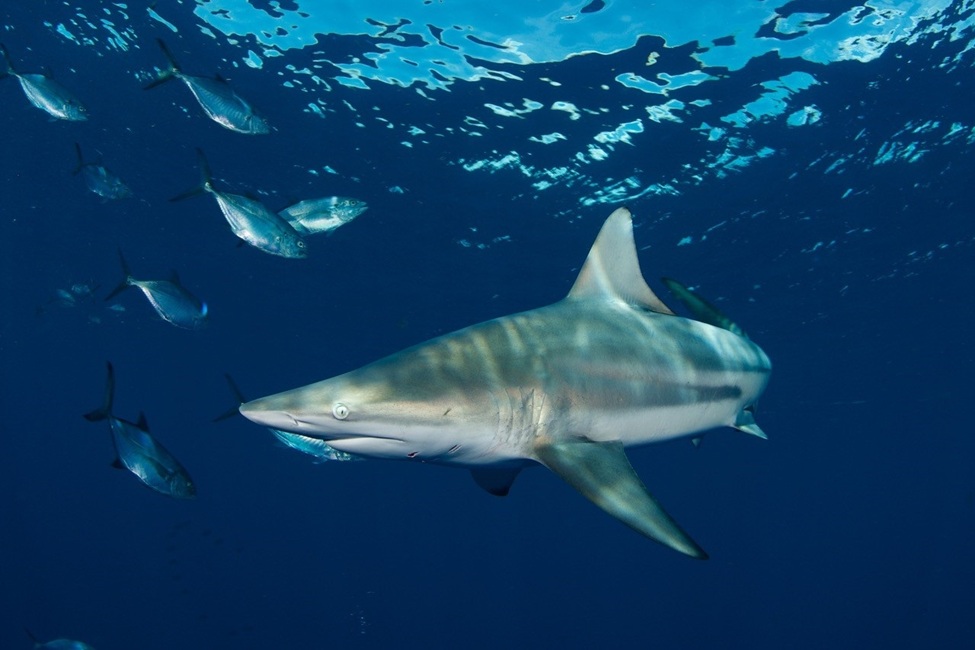
Florida Atlantic University researchers recorded wild blacktip sharks turning from low-frequency sounds as far as 74 meters away. The sounds were played loud enough to startle, so the study measures what sharks can hear and locate; how they respond to quieter human noise is still untested.
The Scientist · Science desk
Drafted by a language model from the sources cited here and checked against its claim ledger before publication. How we use AISend a correction
What happened
- The team let an underwater speaker drift up to 19 meters from an anchored boat in shallow Palm Beach County water, so the boat was less likely to sway the sharks.
- Sharks reacted to all three test bands spanning 100 to 800 hertz and showed no response to a 10-kilohertz control tone outside known shark hearing.
- The sharks were most sensitive to the lower frequencies, detecting them from greater distances and at lower sound levels.
Compiled by The ScientistSomething wrong?How this is made
Why it matters
- constraint Applying the result to any other sound source means working from the received levels the hydrophones logged, because the 74-meter distance applies only to this speaker at this volume.
- capability Pairing drone tracking with calibrated hydrophones ties a wild shark's turn to the exact sound it received, a design other groups can reuse to test specific noise sources on free-swimming animals.
- decision Noise assessments can now cite field evidence that sharks locate and avoid loud low-frequency sources at tens of meters, but any disturbance threshold for quieter, sustained noise would have to come from new trials.
The best piece of design here is the control. The 10-kilohertz tone came from the same speaker, beside the same anchored boat, filmed by the same drone [5][8]. It sits 12.5 times above the top of the highest test band [1]. The sharks ignored it [9]. That rules out the rig itself as the trigger, because the boat, the speaker in the water and the drone were all present for the control too. The speaker was also allowed to drift as far as 19 meters from the boat to reduce the chance that the vessel affected the sharks [4].
Florida Atlantic University describes the paper, published in Integrative Organismal Biology, as the first quantified evidence that free-swimming sharks detect and orient away from sounds in the acoustic far field [3]. The release does not give the number of sharks filmed, the number of responses scored, or the share of responses that were turns away from the speaker. So "more than 70 percent" of responses in the far field [10] is a fraction of an unstated total. "Often" is the release's only word on how consistently the sharks turned away [2]. Seventy-four meters is the farthest response recorded [1].
That distance also depends on the loudspeaker. The team did not try to lure sharks toward the speaker; it played sounds loud enough to provoke a startle [6]. Sound fades with distance, so a louder source would cross a shark's detection limit farther out and a quieter one closer in. The measurement that transfers is the one the calibrated hydrophones took: the sound level at each shark's position when it reacted [7]. The frequency result comes from those levels too. Lower frequencies were detected from greater distances and at lower sound levels [11].
Detecting a sound and knowing where it came from are separate abilities. The rapid turns away from the speaker are the evidence for the second [2]. Stephen Kajiura, the senior author and a professor of biological sciences at FAU [17], singled out where the responses happened. "What makes this finding particularly interesting is that the sharks were responding to sounds beyond the acoustic near field, where the sound behaves differently than it does close to the source," he said [12]. That, he said, "suggests that they are detecting the particle motion associated with sound" [13].
Blacktips were chosen because they gather predictably off Palm Beach County, in water clear and shallow enough to watch from the air [14]. The result covers one species in one habitat. The release sets up the open question in terms of sounds from prey, predators and other animals [16]. For people assessing human noise in the ocean, the study establishes that a free-swimming shark can hear a loud low-frequency source at tens of meters, work out where it is and swim away from it [1][2]. Finding out whether quieter or continuous noise produces the same turn, and whether sharks stop turning after repeated exposure, needs trials built to find thresholds instead of startles.
What to watch
- The paper's counts: how many sharks were filmed, how many responses were scored, and what share were turns directed away from the speaker.
- The received sound levels at which sharks first reacted in each frequency band, the figure that would let noise assessments compare against specific sources.
- Repeat trials with quieter or continuous playback, or with other shark species in deeper or murkier water.