Science1 publisher3 min readPublished
Wild blacktip sharks turn away from low-frequency sound up to 74 meters from the source
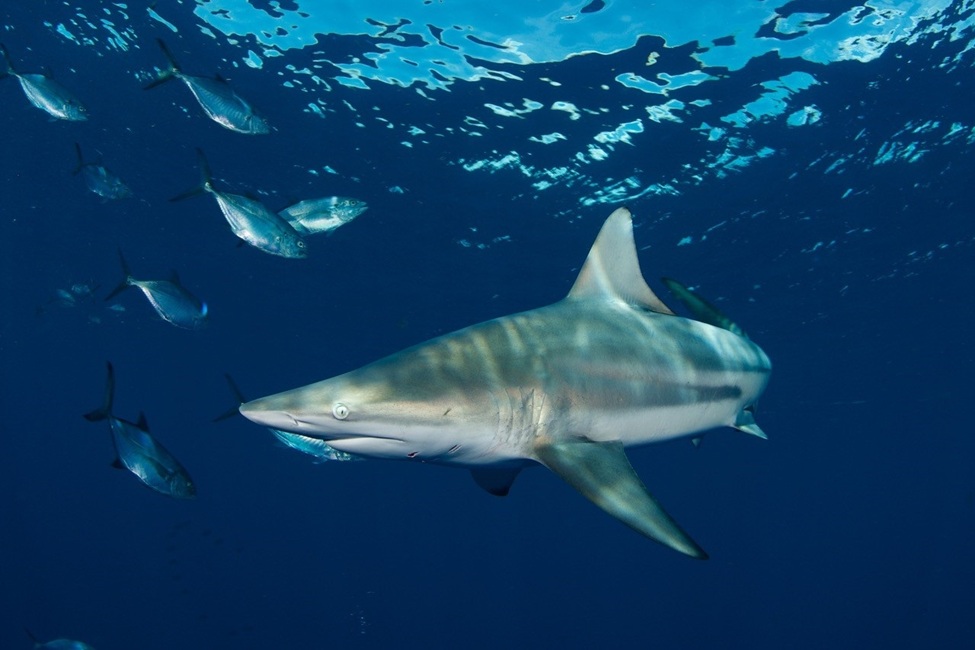
Florida Atlantic University researchers filmed wild blacktip sharks turning away from low-frequency sounds played as far as 74 meters away. The speaker was played loud enough to startle, so the result maps hearing range and direction in open water and leaves everyday human noise untested.
The Scientist · Science desk
What happened
- Florida Atlantic University researchers used an underwater speaker and an aerial drone to test hearing in free-swimming blacktip sharks, reporting in Integrative Organismal Biology.
- The team played tones in three bands between 100 and 800 Hz, plus a 10 kHz control tone outside the known hearing range of sharks.
- The sharks responded to all three low-frequency bands and did not respond to the 10 kHz control.
- The farthest measured response came at 74 m (243 feet), with sharks rapidly changing course away from the speaker.
- More than 70% of responses occurred in the acoustic far field, and lower frequencies were detected from farther away and at lower sound levels.
Compiled by The ScientistSomething wrong?How this is made
Why it matters
- capability Pairing drone tracking with hydrophone-mapped sound fields lets researchers tie a free-swimming shark's turn to the sound level it received, a measurement tank reflections make hard to get.
- constraint The 74 m range belongs to one speaker played loud enough to startle, so comparing it with any other noise source means working from received levels in the paper itself.
- contradiction The release's own opening figure of 76 m rounds up the 74 m measured maximum, so anyone citing the range should use 74 m.
I would defend the control tone before any other part of this design. It sits at 12.5 times the upper edge of the highest test band [19], and it came out of the same speaker on the same rig as the test tones [3]. A shark reacting to the equipment, or to the act of playback, should have reacted to the control as well. None did [7].
The distance figure needs one correction. The farthest response, 74 m, is 243 feet [8]. The release opens with "nearly 250 feet (76 meters)" [10], 2 m beyond the measured maximum [11].
Distance is also a property of this speaker at this volume. The sounds were played at high intensity to startle the sharks [4]. Calibrated hydrophones mapped sound levels at different distances so the team could calculate what each shark heard at the moment it responded [5]. That received level is the number another researcher could carry to a different sound source. The release reports the far-field share of responses [9] but does not give the received levels, or the count of sharks and responses behind the percentage.
The far-field responses are what interest the researchers. "What makes this finding particularly interesting is that the sharks were responding to sounds beyond the acoustic near field, where the sound behaves differently than it does close to the source," said Stephen Kajiura, the senior author and a professor of biological sciences at Florida Atlantic University [12][20]. Sharks lack the gas-filled swim bladder that helps many bony fish detect sound pressure. They are thought to rely on inner-ear structures, including the macula neglecta, that sense movement and vibration [14]. Kajiura said the result "suggests that they are detecting the particle motion associated with sound even at considerable distances from the source" [13].
The open-water setting made the measurement possible. Blacktips gather in large numbers along the Palm Beach County coast each winter [17]. "Their abundance and accessibility made it possible for us to observe them from above without disturbing their natural behavior, while also presenting controlled underwater sounds," Kajiura said [16]. A drone filmed the sharks from 40 to 50 m up, and frame-by-frame analysis measured each response distance and heading change [6]. The speaker drifted up to 19 m from the anchored boat to limit the boat's influence [2]. According to the release, working in the wild avoids the wall reflections and other limitations of laboratory tanks [15].
The release calls the work the first quantified evidence that free-swimming sharks detect and orient away from sound in the acoustic far field [18]. On the method described, that claim about hearing holds. A loud, low-frequency source changed the heading of blacktips at up to 74 m [8]. Saying that human-made noise changes shark behavior at such ranges is a larger claim. It would need received-level thresholds and a stimulus closer to that noise, and this playback was designed to startle [4]. The behavior the release describes measuring is response distance and change in swimming direction [6].
What to watch
- A repeat of the drone-and-hydrophone design with quieter or longer-lasting sounds would test whether the turning response appears at levels sharks meet routinely.
- The same open-water setup applied to other shark species would show whether far-field detection is specific to blacktips.
- Follow-up tracking of whether startled blacktips leave an area or return after playback would show whether a turn has any lasting effect.