Invest1 publisher3 min readPublished Updated
Two crypto senators sign on to interchange reform, and the $100B routing mandate gets real
Moreno and Lummis have cosponsored the Credit Card Competition Act, joining Durbin, Marshall, Welch and King. The bill would make banks above $100B in assets run two unaffiliated networks on credit cards.
The Investor · Invest desk
Drafted by a language model from the sources cited here and checked against its claim ledger before publication. How we use AISend a correction
What happened
- Senators Bernie Moreno (R-OH) and Cynthia Lummis (R-WY) cosponsored the Credit Card Competition Act (S. 3623) in early August, joining Senator Angus King (I-ME) in backing the bill. The report is published by Crypto Briefing and credited 'Via paymentsdive.com'.
- The bill's core requirement is that banks with more than $100B in assets would have to enable at least two unaffiliated payment networks on their credit cards.
- Senators Dick Durbin (D-IL), Roger Marshall (R-KS) and Peter Welch (D-VT) were already cosponsors before Moreno, Lummis and King signed on.
- The Credit Card Competition Act was reintroduced in January 2026.
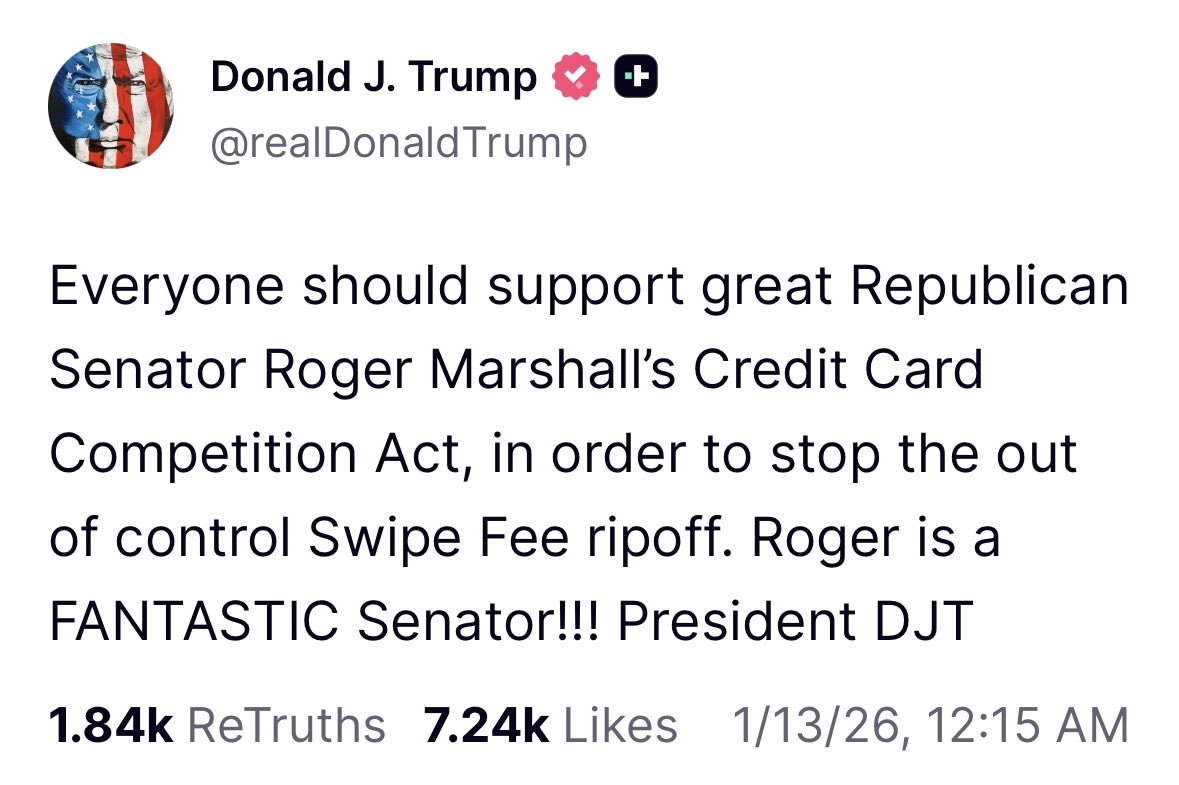
- Former President Trump publicly endorsed the legislation before this latest round of cosponsors joined.
Compiled by The InvestorSomething wrong?How this is made
Why it matters
Senators Bernie Moreno (R-OH) and Cynthia Lummis (R-WY) have cosponsored the Credit Card Competition Act (S. 3623), joining Senator Angus King (I-ME) on a bill whose core requirement is that banks with more than $100B in assets enable at least two unaffiliated payment networks on their credit cards [1][2]. That moves interchange from a standing merchant grievance to a bill with a coalition that is genuinely awkward to whip against, and it puts a specific engineering obligation on the table for the largest issuers.
The roster now runs through Dick Durbin (D-IL), Roger Marshall (R-KS) and Peter Welch (D-VT), who were on the bill before Moreno, Lummis and King signed on [3]. That is six named senators: three Republicans, two Democrats and one independent [1]. The bill was reintroduced in January 2026 [4], and former President Trump endorsed it before this latest round of cosponsors arrived [5]. Crypto Briefing, relaying Payments Dive, dates the Moreno and Lummis cosponsorships to early August without stating the year, so the sequencing is worth confirming before anyone builds a legislative calendar on it [1].
The mechanism is worth reading literally. Most credit cards today route through either Visa or Mastercard, which is the source of those two companies' pricing power [6]. Under the bill, merchants would be able to route through competing networks, which is the theory of the case for lower per-swipe fees [7]. For a bank above the threshold, that is not a pricing negotiation. It is issuance, BIN configuration, authorisation plumbing and dispute handling against a second network, on cards that currently have one.
Merchant groups are predictably in favour: the Merchants Payments Coalition and the National Association of Convenience Stores have both voiced support, framing the bill as a competitive correction in a market tilted toward the largest institutions [8]. Visa, Mastercard and the largest card-issuing banks oppose it [9], arguing that interchange funds rewards programmes and that cheaper routing would starve the cashback and points economics that banks use to sell cards [10]. Credit unions have also objected, warning that reduced interchange revenue would hurt smaller institutions that rely on those fees [11]. On the face of the text they are outside it, since only banks above $100B in assets carry the routing mandate [12], but critics argue the downstream effects on fee structures spread past the threshold anyway [13].
The politics are the interesting part. Both Moreno and Lummis have spent political capital on crypto legislation, particularly the CLARITY Act on digital asset market structure [14], and reports have surfaced of tension between the two senators and the banking industry over delays to that bill [15]. The source does not claim the cosponsorship is retaliation, only that it leaves both senators pressing large banks on two fronts at once [16].
What to watch: whether any further Republicans attach themselves, since the marginal Republican signature is what makes this different from prior attempts; whether the $100B threshold survives negotiation intact, because that number is where the compliance cost lands; and whether large issuers begin scoping dual-network issuance as contingency work rather than waiting for a floor vote.