Science1 publisher3 min readPublished
Why GIP agonists and antagonists both cut weight: two brain regions, not one contradiction
A Cambridge mouse study locates the GIP paradox in anatomy: agonists act through the brainstem, antagonists release a hypothalamic brake. Combination design becomes a targeting question.
The Scientist · Science desk
Drafted by a language model from the sources cited here and checked against its claim ledger before publication. How we use AISend a correction
What happened
- A mouse study from researchers at the Institute of Metabolic Science, University of Cambridge, published in Nature Metabolism, found that whether activating or blocking the GIP receptor promotes weight loss depends on which part of the brain is targeted.
- In the study, GIPR agonists primarily worked through the brainstem; activating GIPR in this region reduced appetite and led to lower body weight.
- GIPR antagonists promoted weight loss through the hypothalamus, where GIPR appears to act as a brake that limits how strongly the brainstem responds to signals indicating the body is full; blocking the receptor releases that brake.
- Some medications, including Mounjaro and Zepbound, activate GIPR, while others, such as MariTide, block it, and both approaches can promote weight loss.
- Several widely used medications, including Wegovy and Ozempic, activate the glucagon-like peptide 1 receptor (GLP-1R).
Compiled by The ScientistSomething wrong?How this is made
Why it matters
Researchers at the University of Cambridge's Institute of Metabolic Science report in Nature Metabolism that activating and blocking the same receptor both reduce body weight in mice because the two drug classes act in different parts of the brain [1]. That resolves an awkward fact the field has been living with: some approved obesity drugs, including Mounjaro and Zepbound, activate the GIP receptor, while others, such as MariTide, block it [4].
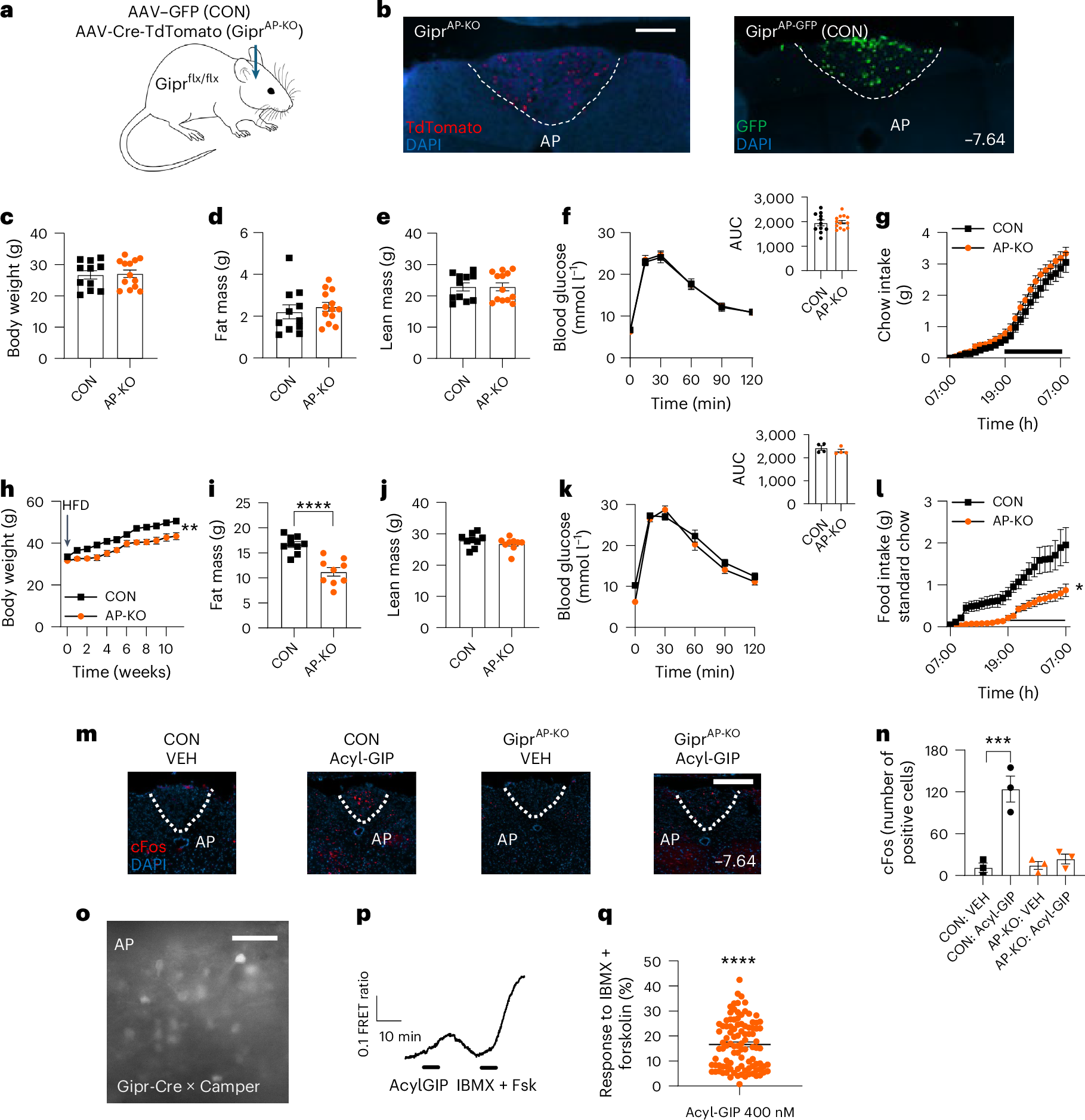
The experiment was a deletion map. The team used genetically engineered mice lacking GIPR in the brainstem, mice lacking it in the hypothalamus, and unmodified controls, then dosed each group with combinations of a GIPR agonist, a GIPR antagonist and a GLP-1 drug while tracking food intake, body weight, fat mass, blood sugar control and brain activity [6]. Comparing across groups localises each drug's effect: if removing the receptor from one region abolishes a response, that region is where the drug was working.
Agonists worked through the brainstem, where activating GIPR reduced appetite and lowered body weight [2]. Antagonists worked through the hypothalamus, where the same receptor appears to act as a brake limiting how strongly the brainstem responds to signals that the body is full; blocking it releases the brake [3]. Note what that implies: the brainstem is the effector in both arms, reached directly in one case and disinhibited via the hypothalamus in the other [12]. The apparent contradiction was never a data artifact. It was two addresses with the same name on the door.
This matters for combination design more than for mechanism trivia. GLP-1 drugs such as Wegovy and Ozempic act on the GLP-1 receptor [5], and the Cambridge group reports that both GIPR agonism and GIPR antagonism can increase weight loss when paired with certain GLP-1-based medicines [7]. They also report evidence that blocking GIPR enhances the effects of emerging drugs aimed at the amylin receptor [8]. If the two GIP strategies engage separable circuits, then pairing decisions depend on which circuit a partner drug already occupies, rather than on which GIP direction is intrinsically better.
There is a tolerability implication worth flagging, and the source does not draw it. The Cambridge description of the brainstem is a region involved in appetite and nausea [10], and that is precisely the region through which GIPR agonists suppress appetite [2], which puts the efficacy node and a known liability node in the same neighbourhood [13]. The hypothalamic route arrives at the same behavioural endpoint from a different starting position.
The obvious limits: this is mouse work [1], and genetic deletion of a receptor is not the same manipulation as a systemically dosed molecule with its own distribution and brain penetration. Effect sizes, tissue-level receptor availability and the human relevance of the hypothalamic brake all remain open. The scale of the problem is not in doubt; more than a billion people worldwide live with obesity, which raises the risk of type 2 diabetes, cardiovascular disease and cancer [9].