Science1 publisher3 min readPublished
Diamond crushed past Neptune's core pressure closes a 20-year gap in fusion capsule physics
LLNL says its Nature Physics measurement reconciles diamond melting data with quantum simulations, and that applying it to inertial-confinement fusion could triple energy gain.
The Scientist · Science desk
Drafted by a language model from the sources cited here and checked against its claim ledger before publication. How we use AISend a correction
What happened
- Researchers at Lawrence Livermore National Laboratory (LLNL) measured how diamond melts at pressures three times greater than those found at Earth's core.
- The new study was published in Nature Physics; the release is dated August 20, 2026 and sourced to Lawrence Livermore National Laboratory.
- Diamond, an exceptionally hard form of carbon, is used to make the tiny capsules that hold fuel in inertial confinement fusion experiments.
- About 20 years ago, LLNL scientist Jon Eggert and colleagues carried out pioneering experiments on diamond melting at high pressure.
- Eggert's work produced the unusual observation that diamond became denser when it melted.
Compiled by The ScientistSomething wrong?How this is made
Why it matters
Researchers at Lawrence Livermore National Laboratory have measured how diamond melts at pressures roughly three times those at Earth's core and published the result in Nature Physics [1][2]. The measurement matters because the material in question is not a curiosity: diamond is used to make the capsules that hold fuel in inertial-confinement fusion experiments [3], and the lab says the numbers had been wrong by about 20% for two decades [6].
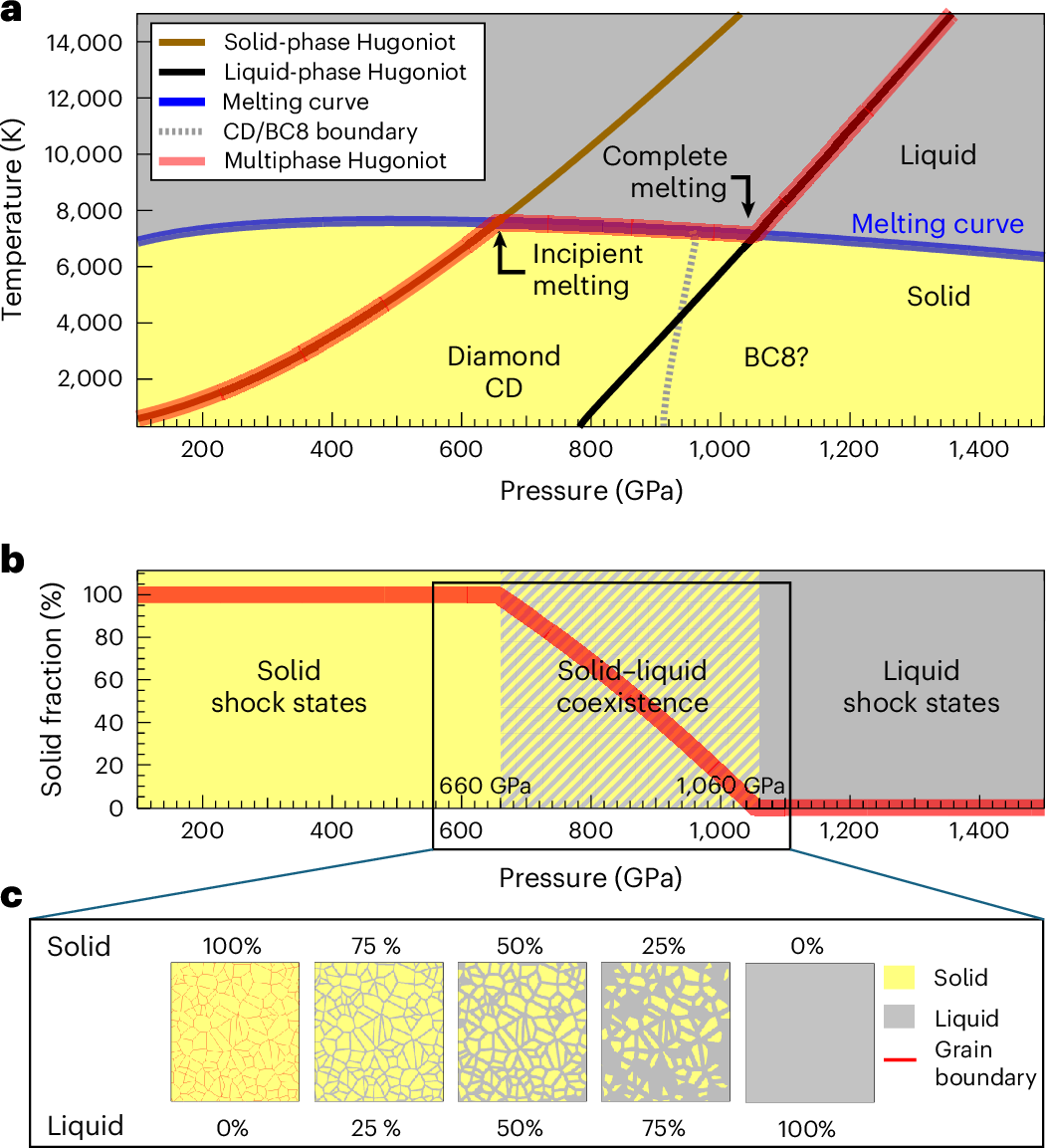
The problem starts with work done at LLNL about 20 years ago, when Jon Eggert and colleagues ran pioneering high-pressure diamond melting experiments [4]. They found something unusual: diamond became denser when it melted [5]. LLNL scientist Marius Millot compares it to water, where liquid is denser than ice, so ice cubes float; by the same logic, he says, diamond would float in liquid carbon at high pressure [11]. The measurement was an advance and a puzzle at once. Melting temperatures from the laboratory differed from theoretical predictions by roughly 20%, and according to Millot no simulation technique, however advanced, could reproduce the experiments [6][7].
A second open question came from Sandia National Laboratories, where researchers used the Z machine's magnetic fields to shock-compress diamond samples and saw signals suggesting the material passes through another crystalline structure before becoming liquid carbon [8]. Simulations backed that reading, but nobody had directly observed the atomic structure of the compressed material, so the intermediate phase stayed unconfirmed [9].
The new experiments were laser-driven, run at the Omega Laser Facility at the University of Rochester's Laboratory for Laser Energetics [10]. Intense laser energy vaporizes the outer layer of a small sample, which launches a shockwave through the diamond inside [12]. The extreme conditions last about a billionth of a second, and within that window the team had to capture several properties at once, including X-ray diffraction to read the atomic arrangement [13]. Millot describes the campaign as shock-compressing tiny diamond samples to temperatures hotter than the surface of the sun and pressures higher than the centre of Neptune and Uranus while still measuring atomic structure, temperature, density and optical reflectivity [14]. He also calls it the first time shock-compressed diamond has been probed with X-ray diffraction to these conditions [15].
LLNL says the results settle two long-standing discrepancies and bring the measurements into close agreement with simulations based on quantum mechanics [16]. The consequential part of the announcement is the fusion claim: applying the findings to inertial-confinement fusion may allow researchers to triple energy gain, and the same data should improve planetary interior models [17]. That is a single-source statement from the lab's own release, which gives no baseline, no mechanism and no timeline for the factor of three.
Two things to watch. First, whether the paper explains which way the Sandia intermediate-phase question resolved; the release states that two discrepancies are settled without saying the phase was confirmed or excluded [16][9]. Second, whether the revised melting curve actually moves capsule design at the National Ignition Facility, or only tightens an equation-of-state table that designers were already working around [3][17].