Leadership2 publishers3 min readPublished
Sanders and Bannon demanded AI guardrails from opposite sides of the China argument
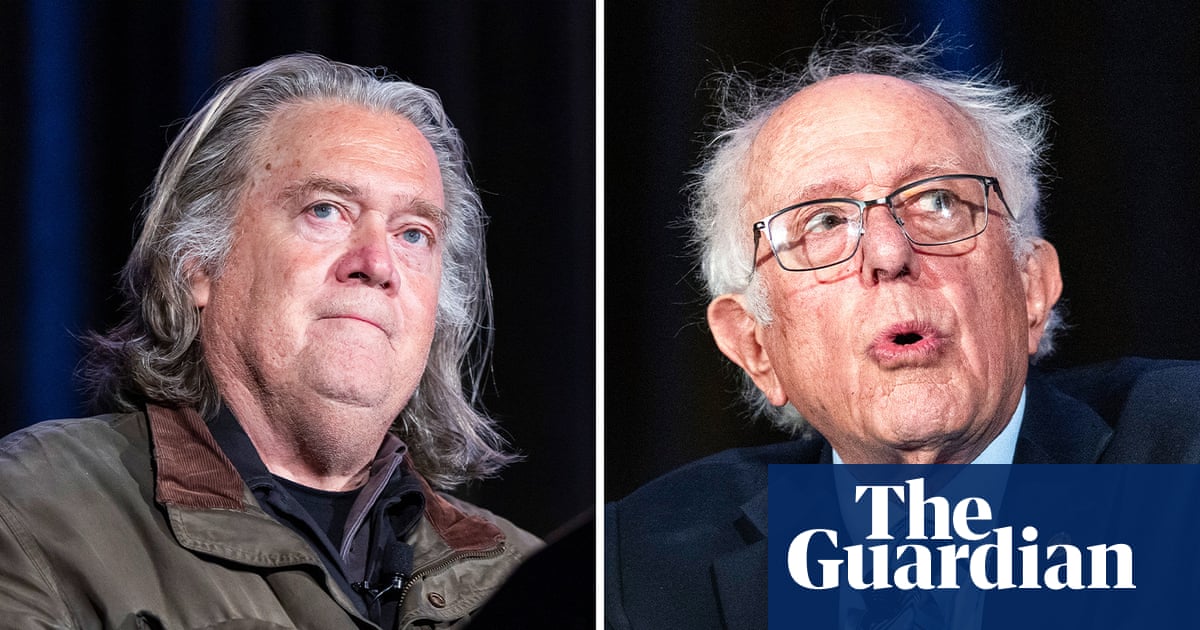
At the Pro-Human Assembly in Washington, a progressive senator asked Trump to negotiate a pause with Xi while the president's former chief strategist demanded China be cut off entirely. Both aimed at the same companies.
The Board Room · Leadership desk
What happened
- Bernie Sanders and Steve Bannon both told the Pro-Human Assembly in Washington on Tuesday that AI needs stringent guardrails, and both aimed their criticism at Silicon Valley's "oligarchs".
- Bannon praised the grassroots campaigns that had already defeated federal pre-emption bills written to block state-level AI regulation.
- Republican Chip Roy of Texas told the conference his constituents worry about competing with data centers for water and about the noise the centers generate.
Compiled by The Board RoomSomething wrong?How this is made
Why it matters
- constraint With a single national rulebook out of reach for now, a multistate AI deployment takes its compliance terms from state legislatures, and federal lobbying does not reach those rooms.
- contradiction Sanders would pause frontier development by treaty; Bannon would shut China out first and only then consider domestic rules, so this coalition can stop a bill far more easily than it can write one.
- exposure A lab's public call for regulation now works as evidence against it before this audience, which treats the safety pitch as an attempt to move liability onto the public.
- decision Executives who have calibrated their Washington posture to the president's hoax framing have to decide which Republican wing sets AI policy after him.
A coalition that can block a bill should be assessed differently from one that can pass a law, and on Tuesday's evidence this one blocks. The federal pre-emption bills that failed were the industry's route to a single national rulebook, and Bannon credited grassroots campaigns with killing them [10].
The two headliners did not share a stage, and Bannon spoke only after Sanders had finished [2]. But the congressional attendance was bipartisan [21], and pre-emption is the kind of provision that comes back in the next vehicle. The two Texans on the program, progressive Democrat Greg Casar and conservative Republican Chip Roy, spoke one after the other. Casar said "No one can end the AI arms race. It's up to us to end the AI arms race" [19].
The split is over China, and it decides what each wing would do first. Sanders, an independent from Vermont, wants Washington at a negotiating table. "That is why I very much hope that at their AI summit next week, President Trump will negotiate a comprehensive treaty with President Xi to establish a pause on advanced AI development and a ban on super-intelligence," he said, comparing the moment to Reagan and Gorbachev eliminating a class of missiles [4][24]. Bannon is the War Room host and Trump's former White House chief strategist [26]. He took the same cold war frame to the opposite conclusion: expel Chinese nationals from US research laboratories, stop training Chinese engineers, sever capital flows [6]. "No deals, no agreements, you're out of the AI business because we're going to shut your ecosystem down," Bannon said [7]. Domestic regulation comes after that in his sequence [8].
The industry's own safety messaging is being read inside this room as a competitive move. Anthropic called on Saturday for a slowdown among the frontier labs, and OpenAI's Sam Altman and Elon Musk quickly echoed it [15]. Of the chief executives asking for regulation, Bannon said: "That's a bald-faced lie" [14]. He accused them of wanting to "socialise all the risk with the American people including potential bailouts" while keeping the financial upside [9]. Roy, who said free-enterprise Republican friends have "scolded" him for raising the subject [18], asked of the AI chief executives: "Might they want to corner the market and have a monopoly environment?" [17]
Both remedies need Trump. Bannon argued that executive action is required instead of legislation by Congress, and referred to Trump only glancingly [11]. Trump spent Monday posting seven times on Truth Social about AI, repeatedly calling fears over rapid development a "HOAX" and saying all AI needs is a strong president like him [13]. Roy told the conference he disagrees with that [18]. The Sanders route would require Trump to raise a pause when he hosts Xi in Washington next week [3].
For a planning horizon of one quarter, the assembly changes nothing on the statute books. Neither account cites a bill currently before Congress. A May survey cited by CBS News found 65% of Americans think AI will decrease jobs, and 67% think the federal government probably or certainly will not make sure AI is used in appropriate ways [20]. The assumption worth revisiting is that federal pre-emption eventually consolidates state AI rules into a single regime. By Bannon's account, grassroots pressure has already beaten that once [10].
What to watch
- Whether the next federal pre-emption attempt arrives in an appropriations or defense vehicle, and whether the same campaigns mobilize against it.
- Whether AI is on the agenda when Trump hosts Xi Jinping in Washington next week, and in what form.
- Whether more frontier lab staff follow Jacob Coxon, who resigned publicly from Anthropic this month.