Science1 publisher3 min readPublished
Two robots in orbit will decide whether satellites stop being disposable
Katalyst's LINK is trying to save a NASA telescope after tumbling out of control. Northrop Grumman's servicing vehicle reaches its first geostationary customer in about a year.
The Scientist · Science desk
Drafted by a language model from the sources cited here and checked against its claim ledger before publication. How we use AISend a correction
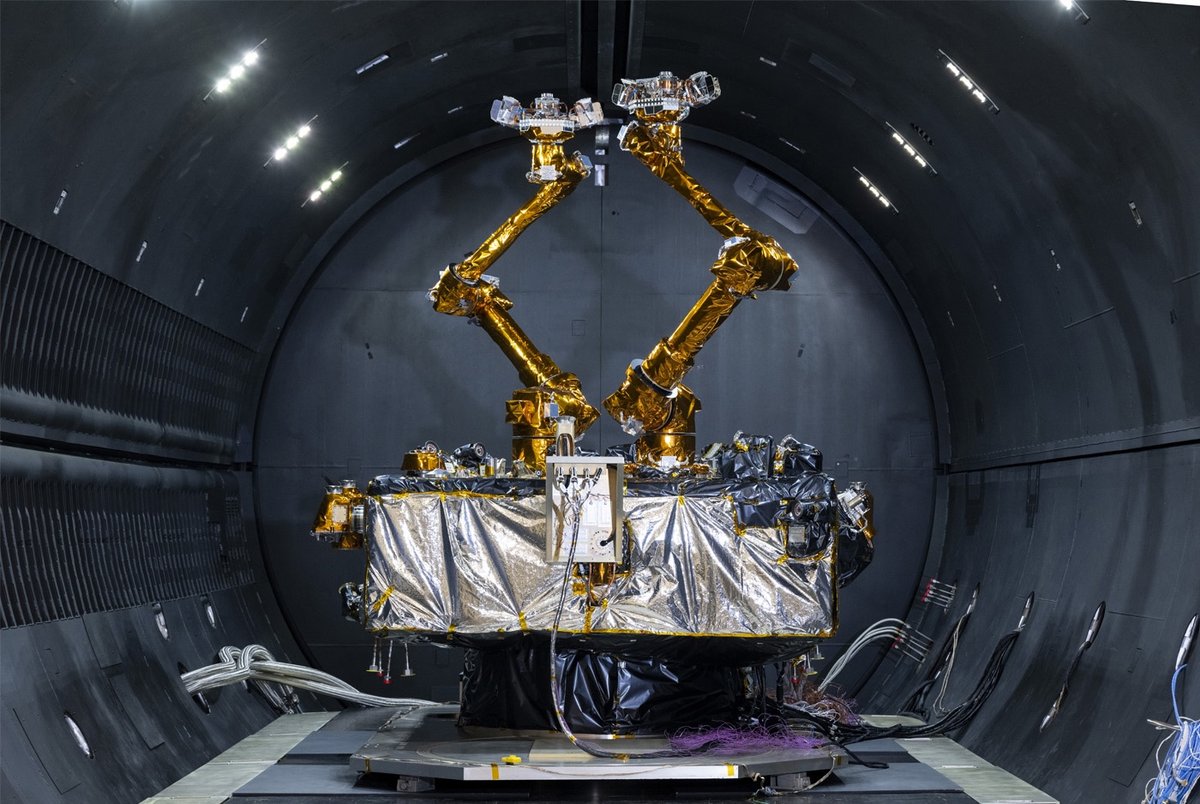
What happened
- Katalyst Space Technologies' Lightweight In-Space Navigation and Kinematics (LINK) spacecraft is a troubled high-stakes project to rescue an aging NASA space telescope, with its failure or success set to unfold in coming months.
- Northrop Grumman's Mission Robotic Vehicle (MRV) launched last month and will close on its first target in about a year.
- Since the dawn of the space age, spacecraft have been treated as disposable because salvaging them was too expensive or too technically challenging compared with launching fresh replacements.
- LINK lifted off in early July to boost the decaying orbit of NASA's Neil Gehrels Swift Observatory, which launched in 2004.
- Weeks after liftoff LINK ran into trouble, spinning out of control and suffering sporadic communications; controllers have since pulled it back from the brink, but whether it can still save Swift is unclear.
Compiled by The ScientistSomething wrong?How this is made
Why it matters
Two robotic spacecraft are attempting the same unproven thing at different altitudes and very different prices, and both will resolve within roughly a year: Katalyst Space Technologies' LINK vehicle is trying to raise the decaying orbit of NASA's Neil Gehrels Swift Observatory [1][4], while Northrop Grumman's Mission Robotic Vehicle is en route to its first target and closes on it in about a year [2]. What they settle is not whether robots can grab things in space but whether the industry's founding assumption, that spacecraft are disposable because salvage costs more than a replacement, still holds [3].
The LINK attempt is the ugly one. It lifted off in early July to boost Swift, which launched in 2004 [4]. Weeks later it spun out of control with sporadic communications; controllers have pulled it back, but whether it can still save the telescope is unclear [5]. To finish the job it has to reach Swift about 190 miles up, grapple it with three robotic arms and push it higher [6]. Shawn Domagal-Goldman, who directs NASA's astrophysics division, calls it a "Hail Mary" and says there is still "a pathway to success here in a number of ways," with capabilities sufficient to grab the telescope and extend its life [7].
The arithmetic explains why NASA is willing to watch a wobbling spacecraft. Swift cost about $250 million to develop and launch; Katalyst was paid about $30 million to try to save it [8], roughly 12 percent of the original outlay [19]. That ratio is the entire argument. If it holds even occasionally, a science mission's end-of-life becomes a procurement decision rather than a fact.
The commercial case is cleaner. The Mission Robotic Vehicle carries a Robotic Servicing of Geosynchronous Satellites payload co-developed by DARPA and the U.S. Naval Research Laboratory [9], and is heading for Optus D3, parked some 22,000 miles above the equator serving Australia and New Zealand [10]. Two 10-foot arms will bolt an electric "jet pack" thruster onto the nearly 17-year-old satellite so it can hold station for at least another six years [11]. Two unannounced Intelsat satellites are next [12]. Optus D3 reportedly cost around $150 million and a replacement could cost twice that [14], about $300 million [18]; Northrop says servicing adds half again the satellite's life for maybe a quarter as much, though its SpaceLogistics subsidiary has not published a price [15]. Read against a $300 million replacement, that implies something near $75 million [20], which is the number operators cannot yet check.
Market size is the part that decides whether this becomes an industry or two anecdotes. James Shoemaker, who runs the RSGS program at DARPA, puts it at "on the order of 20 to 25 opportunities, on average, per year for servicing in GEO" [13], against a population of hundreds of geostationary satellites [16]. That is a real but thin flow, and it is why the same hardware is pitched for two jobs at once: extending one-of-a-kind missions and reducing derelict spacecraft [17].
Watch three things: whether LINK actually grapples Swift in the coming months [6], whether the Optus D3 thruster installation happens on schedule roughly a year out [2][11], and whether SpaceLogistics ever discloses a price [15]. Until a servicing fee is public and repeatable, mission budgets cannot assume it, and the disposable spacecraft stays the default.