Product1 distinct publisher3 min readPublished
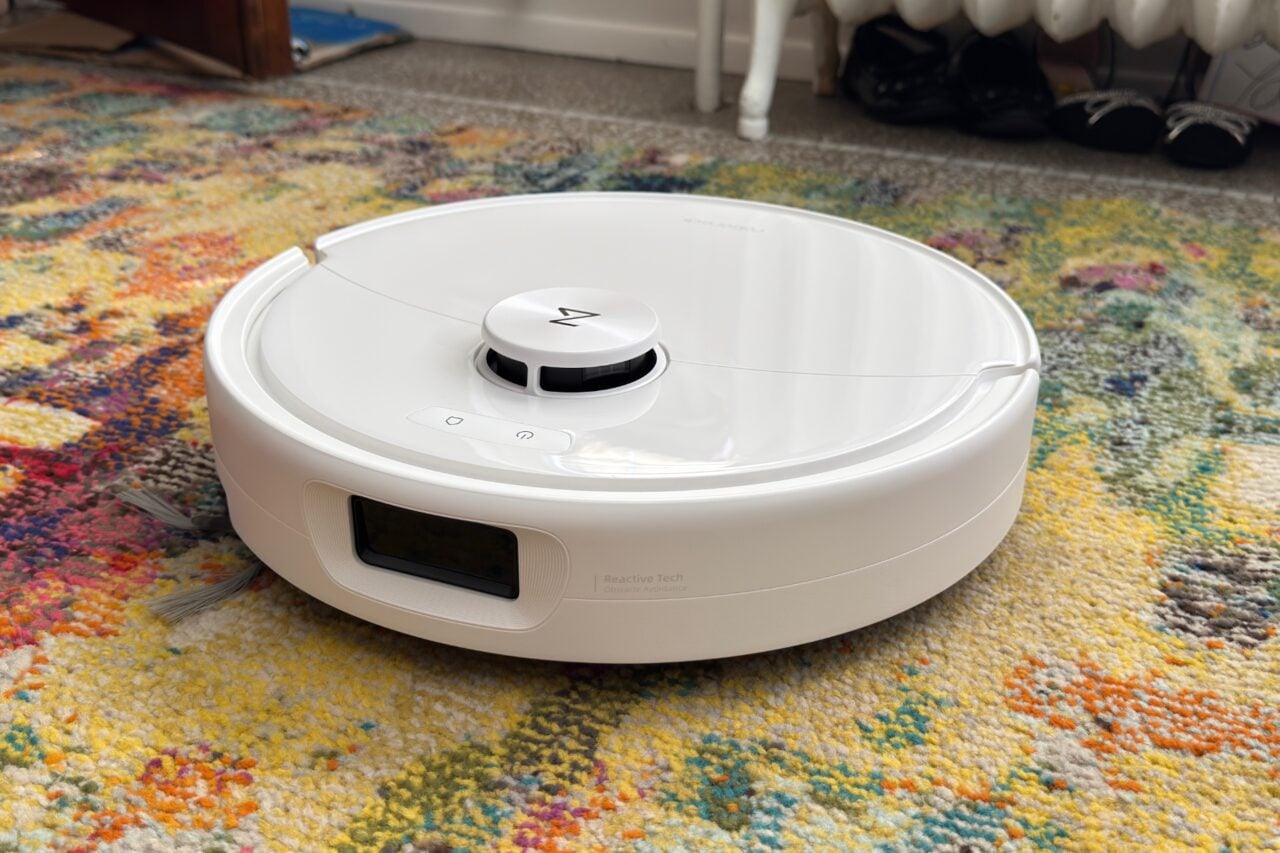
The reviewer still had to fish USB cables and socks out of the Qrevo 2 Pro and fence off a rug by hand in the app, which is a useful way to see what the premium robovac tier has actually been selling.
The Product Desk · Product desk

Compiled by The Product DeskSomething wrong?How this is made
Anyone spending $800 here is buying back time on two different jobs, and only one of them is printed on the box. The first job is mechanical: washing the mop pads and emptying the dustbin, both of which the all-in-one dock takes over [2], and both of which an owner can confirm inside a week. The second job is judgment, which means recognising that a sock on the floor is not debris and that the border of a rug is not hard floor. Judgment is what the expensive tier advertises, and in Gizmodo's testing it did not show up at $800 or, by the reviewer's account, in machines priced above $1,600 either [4][4]. He was still pulling USB cables and socks out of the robot [3], and still drawing boundaries in the Roborock app so it would stop mopping a dining room rug [5].
The setup numbers are worth laying out, because they show where the friction actually sat. Unboxing and app pairing ran about 11 minutes, the first mapping run another 11 [6], so 22 minutes from carton to finished map [1]. Then the robot could not seat itself on the charging contacts and could not reload its mop pads [7], and the reviewer spent an hour and a half on it before emailing Roborock, which attributed the problem to a manufacturing defect [8]. That works out to roughly 80% of the elapsed time before support was contacted going into one plastic part [2]. The firmware update he waited for changed nothing; the fix was levering the plastic piece under the roller brushes until its edge slipped beneath the tab meant to hold it down [9].
On coverage, the machine vacuumed and mopped his 750-square-foot apartment in just under two hours with a little over half its charge left [10], which puts a full battery somewhere near 1,500 square feet [3]. So the buyer is someone with hard floors, an apartment rather than a house, and the patience to outline carpet in an app once. Ketchup took two passes [13], which is a fair marker of what mopping means at this price. Against that, the machine picked up small debris reliably on both hard floors and rugs, never clogged, and stayed quiet enough to talk over unless pushed into its MAX+ mode [11].
The comparison that helps is a 2x2: one-time against recurring interventions on one axis, fixable by you against fixable only by the vendor on the other. Map edits to fence off a rug are one-time and yours [5]. The docking defect was one-time and the vendor's [8]. Cables and socks on the floor are recurring and yours, and no navigation software picks them up [3]. The quadrant that would justify paying double is recurring interventions the vendor removes for you, and nothing in this review landed there. What owners actually do is tidy the floor, then press clean. What the product copy implies is that they stop thinking about the floor at all, and Gizmodo's own verdict on the Qrevo 2 Pro is that it cannot quite clean unsupervised [14]. The honest way to compare tiers, then, is to price the supervision you will still be doing yourself, and then see how much of the gap between $800 and $1,600 is left to pay for.
Ranked by verification strength, evidence, and original report placement.
Gizmodo's reviewer says he still had to yank USB cables and socks out of the Qrevo 2 Pro's maw during testing.
After several days of testing, Gizmodo's reviewer found the Qrevo 2 Pro a much less frustrating and more effective machine than autonomous vacuums that cost more than twice as much.
After the first mapping run the Qrevo 2 Pro could not get onto the dock's charging contacts, and when it did charge it could not pick up its mop pads on its own; a firmware update the reviewer waited for did not resolve it.
The reviewer spent an hour and a half trying to find the cause before emailing Roborock for help, and Roborock attributed the situation to a manufacturing defect.
The cause was the plastic piece under the robot's roller brushes not being seated properly; levering it up with a screwdriver until its edge slipped beneath the retaining tab let the robot dock and collect its mop pads without issue.
The Qrevo 2 Pro vacuumed and mopped the reviewer's 750-square-foot apartment in just under two hours with a little over 50% of its battery remaining.
Distinct publishers with included, body-backed reporting in this cluster.
1 article · August 30, 2026
Follow any of these and your For You feed starts watching them — no settings page required.
product
LiDAR frees the robot mower from the sky. At $3,200 it is still priced for the biggest lawns1 distinct publisher
product
From $50 to $2.25M: Niu Lai prices human authorship, not AI reputational risk2 distinct publishers
product
Texas siting risk moves from the county to the capitol as both Senate candidates run at data centers1 distinct publisher
product
From Omaha students to ICE: the shock glove sold as camera-proof force1 distinct publisher
Evidence-backed comparisons of source perspectives and observed adoption signals. Read the methodology
Which Builder, Operator, and Investor concerns the observed source mix emphasized—not a truth score.
Evidence, demonstrated adoption, hype gap, incentives, and confidence are assessed independently, each on its own current evidence. How these are measured.
One reviewer, one unit, unusually exact numbers
Everything quantified in this story — 11 minutes to unbox, 11 to map, ninety lost to a screwdriver, 750 square feet on half a battery — comes from a single Gizmodo tester with a single machine over several days. That is genuinely first-hand and specific enough to check, which keeps it from scoring low. It is also unreplicated, and the unit that produced the figures arrived with a fault Roborock itself called a manufacturing defect, so the sample behind the numbers is not a representative one.
Availability, not uptake
There is no measurement of anyone using this machine except the reviewer. A product on sale at $800 tells us it shipped; 'Roborock bubbles up the most on Reddit' is a read of forum chatter with no sample behind it; and the only deployment described anywhere in our coverage is one review unit in one 750-square-foot apartment. Sales, install base or return rates would move this, and none appear.
The framing outruns a feel-based comparison
Our own headline leans on a machine at $800 outperforming units at twice the price, and the comparison underneath it names no rival and describes no side-by-side run — it is the reviewer's overall sense after several days. Gizmodo's own verdict pulls the other way, and the review volunteers the swallowed cables, the mopped rug and the broken part rather than burying them. So the stretch lives in the framing, not the reporting, which is why the gap is small and positive instead of wide.
The vendor supplies both exculpatory lines
The two most convenient statements in this story come from Roborock: the failed docking was a one-off manufacturing defect, and eating flat cables is an intended compromise of the price tier. Neither was independently checked, and both convert a product problem into either bad luck or a design choice. Against that, the review reaches its object-avoidance conclusion squarely against the company's interest and closes on whether the saving is worth the snagging — and it never says whether the unit was bought or sent, which is exactly the disclosure a reader would want here.
Trust the observations, not the generalisation
One publisher, one box, several days, and a test article that needed a screwdriver before it would work at all. The individual observations are credible and specific; extending them to what a buyer will receive is a leap this reporting cannot make. A second tester whose unit docks on the first try, or a count of how many other owners met the same unseated brush plate, would move this quickly in either direction.