Product1 publisher3 min readPublished
From Omaha students to ICE: the shock glove sold as camera-proof force
Compliant Technologies pitches its electric glove as compliance without the bad video. The specification being sold is not less pain, it is less evidence.
The Product Desk · Product desk
Drafted by a language model from the sources cited here and checked against its claim ledger before publication. How we use AISend a correction
What happened
- Immigration and Customs Enforcement (ICE) officers will soon be getting electric shock gloves that can be used to inflict pain on anyone they choose.
- The gloves are made by Compliant Technologies and are touted as a way to get compliance without the risk of viral videos where arm-swinging beatings make officers look bad.
- The shock gloves have already been used against students at schools in Omaha, Nebraska, though police have said they will stop after public outcry.
- The modern shock glove made by Compliant Technologies is also known as the Generated Low Output Voltage Emitter (G.L.O.V.E.).
- A video on Compliant Technologies' YouTube page features company President and COO Dan De La Cruz demonstrating the shock glove on a willing participant moaning in pain.
Compiled by The Product DeskSomething wrong?How this is made
Why it matters
ICE officers will soon be getting electric shock gloves that can be used to inflict pain on anyone they choose, according to Gizmodo [1]. The gloves are made by Compliant Technologies and are touted as a way to get compliance without the risk of viral videos in which arm-swinging beatings make officers look bad [2], and the same device has already been used against students at schools in Omaha, Nebraska, where police said they would stop after public outcry [3]. Anyone who sells hardware into institutions should study that order of events.
The pitch is unusually candid about what the product is for. In a video on the company's YouTube page, Compliant Technologies president and COO Dan De La Cruz demonstrates the glove, also known as the Generated Low Output Voltage Emitter, on a willing participant moaning in pain [5][4]. De La Cruz's argument is that when officers meet someone who will not make their hands available to be handcuffed, they are "forced to strike them, dig their knees into them, do multiple things," and "none of this looks good on camera when it finally comes to it" [6]. The volunteer, a police officer, said "it was horrible." De La Cruz's summary was "everything they saw on camera, I didn't strike you," and the officer added "there's no blood," and "no puncture wounds from taser probes" [7]. Gizmodo notes that taser probe wounds would be an obvious indicator of force [8].
That is a product requirement, and it is not reduced pain. Both people in the demo agree the experience was awful; what they market is that afterwards there is nothing to read.
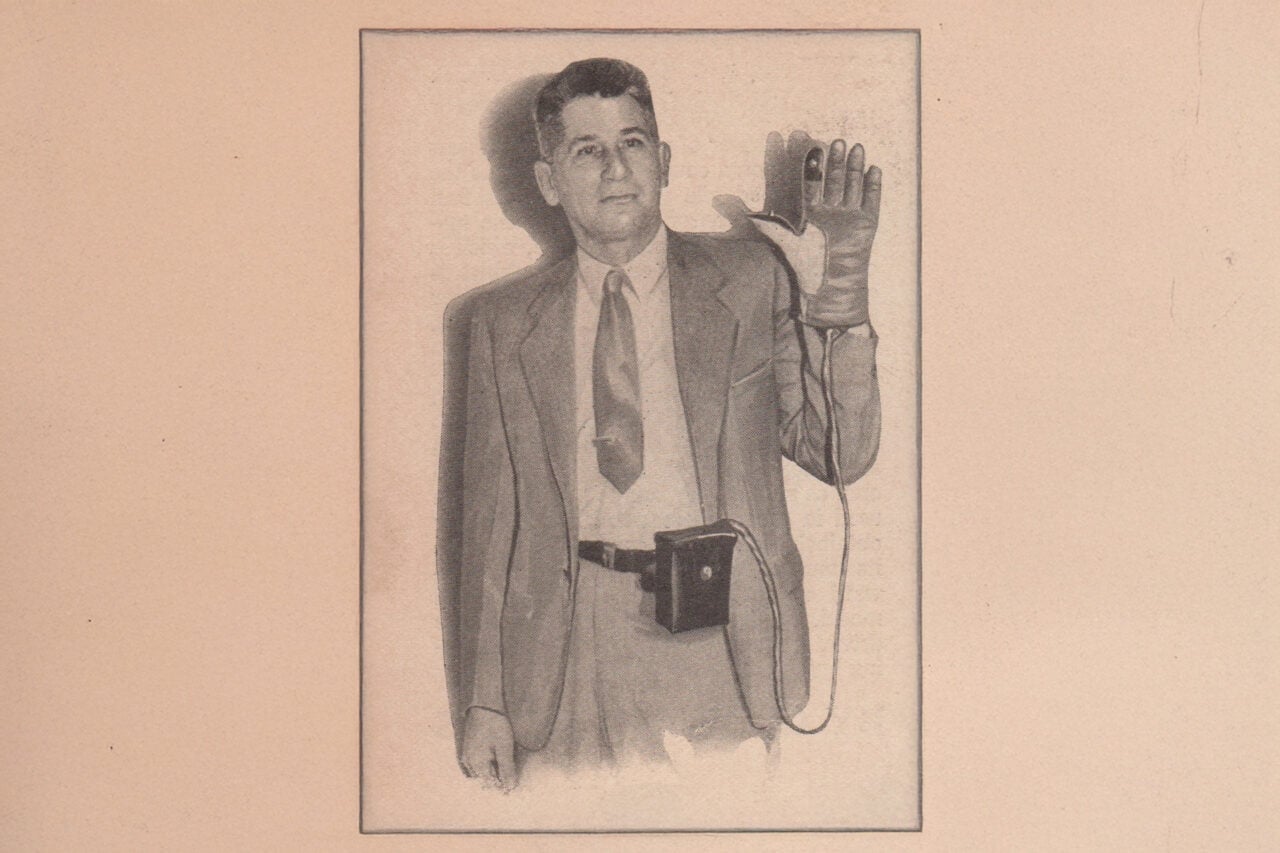
The frame is roughly as old as electrified policing. Cirilo Henriquez Diaz, a Cuban inventor, filed for a shock glove patent in 1932 and was granted it the following year [9]; it delivered 1,500 to 5,000 volts as long as the officer wore a battery pack on his hip [10]. Popular Science insisted the effect was paralyzing but considered it "humane" because there were "no burns or other after-effects" [11]. An Associated Press report in the June 21, 1935 Wilmington Morning News described the device as an idea born of Ohio mill riots in 1930, said it would incapacitate a person without injuring him, and reported Diaz's claim that its chief value was to incite fear, because clubs cause persons to fight back [12]. He also promised it would force confessions from recalcitrant prisoners [13]. Gizmodo reads the "without injuring" claim as meaning the subject feels tremendous pain but carries no marks to prove it [14], and argues that the fear rationale is what connects the two devices across 90 years [18].
Procurement interest is not adoption. Diaz demonstrated the glove for the New York Times in the summer of 1935 [16], three years after his filing [17], and the paper reported that the NYPD asked him for price quotes [c15b], but Gizmodo has found no evidence the 1930s glove was ever used by police [c15a].
Watch what documentation follows. The source describes Omaha's retreat only as police saying they will stop [3]; it records no written policy, no use count, and no audit. A device whose selling point is the absence of after-the-fact evidence is now heading to an agency whose conduct is contested chiefly through after-the-fact evidence, and the Omaha episode shows how quickly the deployment becomes the story.