Science1 publisher2 min readPublished
Nature Cities review asks flood planners to model cities and their storms as one system
Nanjing University's Long Yang and coauthors argue in Nature Cities that cities alter their own storms through heat, building roughness and aerosols. They add that green roofs and sponge-city schemes built against floods and heat can feed back on local rainfall as well.
The Scientist · Science desk
What happened
- The authors want urban rainfall research to drop the one-way "rainfall drives runoff" view for a framework linking urban form, rainfall, runoff and adaptation.
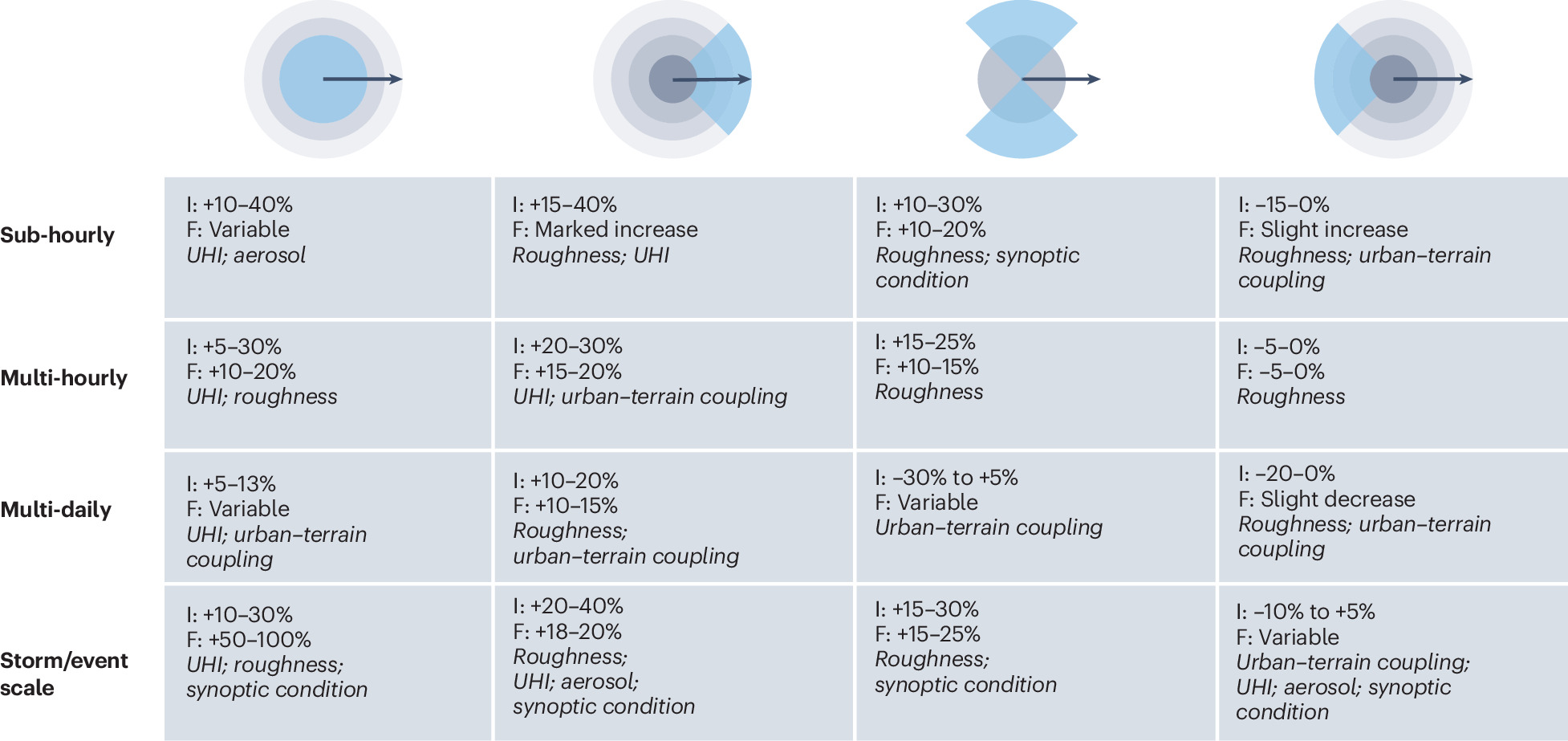
- Dense building clusters roughen the surface and alter near-surface winds, which the review links to low-level convergence, lifting and heavier rain downwind of cities.
- Urban aerosols seed cloud droplets and ice, and depending on moisture and stability they can suppress warm rain or delay it while storms grow deeper and more intense.
- Coauthors include Newcastle University's Hayley Fowler and researchers from Princeton, Delft University of Technology, France's national meteorological research centre and UT Austin.
Compiled by The ScientistSomething wrong?How this is made
Why it matters
- cost Adaptation projects approved on flood or heat benefits would, under the review's standard, also need an assessment of what they do to local moisture, boundary-layer dynamics and rainfall.
- exposure If urban roughness pushes extra rain downwind, the flood risk created by a city's growth can fall on districts beyond the dense core that produced it.
- constraint With seven conditions deciding how a city's rain responds, a correction measured in one city cannot be assumed to hold in another.
Heat is the easiest of the three routes to picture. Roads, rooftops and building materials change how much sunlight a surface reflects, how much heat it stores and how much water it evaporates [7]. The extra sensible heat builds an urban heat island [7]. Under favourable atmospheric conditions, that warming makes the lowest layer of air more buoyant, helps convection start and can intensify short-duration rainfall [7]. Each step is conditional. The review says the city's effect on rain depends on city size, urban morphology, building density, background circulation, moisture availability, aerosol loading and storm type [10].
The paper is a review. It pulls together recent work in urban hydrology, boundary-layer meteorology, extreme precipitation and flood risk [4]. The published summary does not report how much rain any pathway adds or removes in a particular city. Putting a number on it is hard because of the control. An urban rainfall effect is the difference between the storm that fell and the storm that would have crossed the same ground with no city beneath it, and that second storm is never observed.
Hayley Fowler, professor of climate change impacts at Newcastle University's School of Engineering [16], placed the work beside climate change. "We know that climate change is intensifying the short-duration rainfall extremes that can overwhelm urban drainage and cause devastating flash floods," she said [11]. "This review adds an important piece to that picture: cities are not simply passive recipients of extreme rainfall but can themselves influence the processes that shape storms," she said [12].
I think the planning case holds even without an effect size, on one condition: it should be read as an instruction about what to model. The review's implication for urban hydrology is that a city can alter the rainfall input itself, as well as the runoff that follows [15]. A flood model that takes rainfall as a fixed input while the city grows denser and hotter is holding constant something that growth can push up or down [9].
What to watch
- City-specific studies that put a size on the heat, roughness and aerosol pathways for one named city would turn the framework into a correction a drainage engineer could use.
- Sponge-city and green-roof programmes that report effects on local rainfall alongside flood and heat outcomes would show whether the review's evaluation standard is being adopted.