Product2 publishers3 min readPublished
The second-generation Spring comes in under 20,000 euros before incentives, and what gets it there is a decades-old Slovenian plant with low local wages plus a development cycle Renault says it cut to under two years.
The Product Desk · Product desk

Compiled by The Product DeskSomething wrong?How this is made
Nine hours from 15% to 80% on a domestic socket is the number that sorts this car's buyers [10]. Work it backwards: 15% to 80% of a 27.5kWh pack is about 17.9kWh, so nine hours means roughly 2kW going in [5]. The same top-up takes two hours 55 on a 7kW wallbox [10], and 28 minutes if you have paid the 500 euros for the Charge Pack and its 50kW DC connection [21][11].
Set that observed daily average against the 250km WLTP figure and a single charge covers about seven days of driving [3][8]. Households that park off-street get a standard 6.6kW charger sized to what owners were already doing, not a corner cut. Households that park on the street are left with nine hours on a socket as their entire charging plan, and no sticker price fixes that.
The regulatory clock explains the timing. The European Commission imposed countervailing duties on battery EVs built in China in October 2024, and several national subsidy schemes have since been rewritten to favour cars assembled in Europe [4]. The phrase in the launch materials is a subsidy-qualification statement wearing a slogan's clothes.
The new architecture gets credit for the price, but that is only part of the story. Novo Mesto has built small Renault-group models for decades and turns out the Twingo E-Tech alongside the Spring [12][19], so nobody had to pay for a new factory. The Next Web identifies Slovenian labour costs, well below France or Germany, as the part that lets a sub-20,000 euro sticker survive the move west [13]. A shorter design cycle reduces development spend, which gets amortised across the production run. The wage bill shows up in every single unit.
French credits are worth roughly 5,700 euros, about 32% of the base price [1]. The energy figures do not quite reconcile either: 27.5kWh usable over 250km implies 11.0kWh per 100km, while Dacia quotes 12.7kWh per 100km, which on the same pack works out to about 216km [8][2]. That is the number to plan a commute around.
A whole range under 20,000 euros against a 17,900 euro base leaves about 2,100 euros of headroom for the upper trim and the options list, and the Charge Pack alone takes roughly a quarter of it [4]. So the specification decision turns on two facts about the driver rather than about the car: whether there is a wallbox where the car sleeps, and whether any regular journey runs past 200km. If you have a wallbox and only make short trips, the base car is enough and the pack is skippable. With a wallbox and the occasional long run, that 500 euros buys back an afternoon of your time. Without a wallbox, short trips turn the pack from optional to necessary. And without a wallbox on longer trips, this simply is not the right car at any price.
Three more all-electric Dacias are due by 2030 [17]. The repeatable ingredient is an amortised plant in a low-wage member state paired with a platform shared across the group. The two-year cycle trimmed development cost, but the wage bill is what actually keeps the price down.
Ranked by verification strength, evidence, and original report placement.
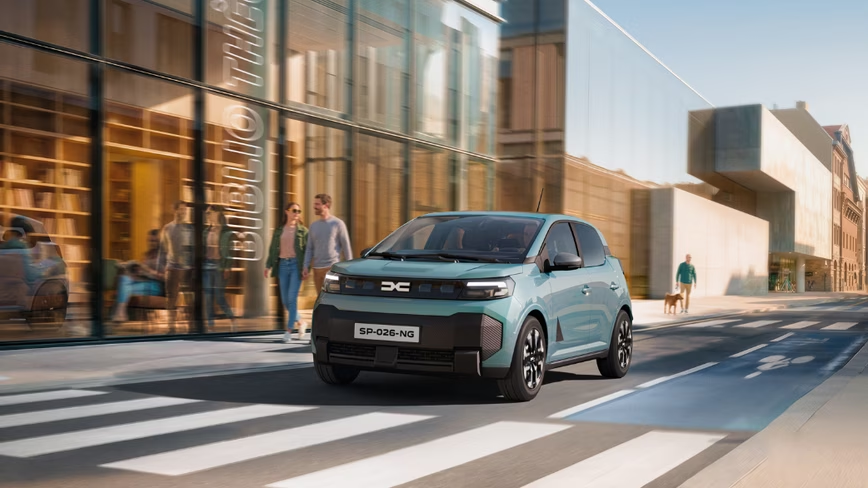
Dacia has revealed a second-generation Spring built at Renault's Novo Mesto plant in Slovenia, and the entire range is priced below 20,000 euros before government subsidies.
The LFP battery holds 27.5kWh of usable capacity for up to 250km on the WLTP combined cycle; the car weighs from 1,212kg and consumption is 12.7kWh per 100km.
The optional Charge Pack adds an 11kW AC and 50kW DC charger, bringing the DC figure down to 28 minutes, and brings vehicle-to-load with it.
The Novo Mesto plant has built small Renault-group models for decades and sits inside the EU customs union, so a Spring assembled there faces none of the duties a Chinese-built one does and counts as European for every subsidy scheme that asks.
Dacia says first-generation owners drove an average of 34km a day and charged at home three quarters of the time.
Two trim levels, Expression and Journey, share the same motor, battery and charger; both get a 7-inch digital cluster, and Journey adds a 10.1-inch touchscreen with wireless CarPlay and Android Auto plus eight years of connected navigation.
Follow any of these and your For You feed starts watching them — no settings page required.
Evidence-backed comparisons of source perspectives and observed adoption signals. Read the methodology
Which Builder, Operator, and Investor concerns the observed source mix emphasized—not a truth score.
Evidence, demonstrated adoption, hype gap, incentives, and confidence are assessed independently, each on its own current evidence. How these are measured.
One launch pack, two unreconciled numbers
Pack size, cycle time, owner mileage and option prices all come from Dacia, and neither outlet checked any of it against a third party. Two figures already argue with each other: 27.5kWh over 250km is 11.0kWh per 100km, not the 12.7 quoted, and the nine-hour charge The Next Web pins to a household socket Engadget pins to the 6.6kW charger itself.
Predecessor volume, successor unshipped
The car under discussion has not reached a customer. What is actually measured belongs to the outgoing China-built Spring: 210,000 sales across forty countries since 2021, plus Dacia's telemetry on daily distance and home charging. There is nothing yet on Novo Mesto's Spring line rate, order intake, or first deliveries.
Framing ahead of the wage and ranking evidence
The subsidy logic is plausible and the prices are specific, but the two conclusions doing the most work are the thinnest: Engadget's 'Europe's cheapest EV' has no comparison behind it, and The Next Web's wage explanation has no wage. Against that, the specification is reported plainly, nine-hour socket charging included, so the overshoot sits in the framing rather than the numbers.
The relocation nobody had to announce
Renault gains from every reading in which this car is European enough to earn incentives, and loses nothing by leaving China out of the press pack. The Next Web notices that omission and makes it the story; Engadget does not. Both pieces were written from the same reveal within half an hour of each other, with no dealer, rival, or Commission voice in either.
Solid on price and place, soft on cause
Assembly location, prices and specification agree across both accounts and will be easy to verify once cars ship. The chain from October 2024 duties through Slovenian wages to a €17,900 sticker rests on one outlet's reasoning, and that chain is what the headline rides on.
science
3.2 million replies, 88 candidates, and the gender gap that prevalence metrics erase1 publisher
product
Cathay flew more than 80 flights on Google contrail forecasts sent over in-flight Wi-Fi1 publisher
science
Text watermarks land on 2 December. The detection they imply does not.1 publisher
product
The cheapest part in the car is now the one that stops the line1 publisher
Publishers with included, body-backed reporting in this cluster.
1 article · September 8, 2026