Invest1 publisher3 min readPublished
Recordkeepers and independent advisors compete for 401(k) savers nearing retirement
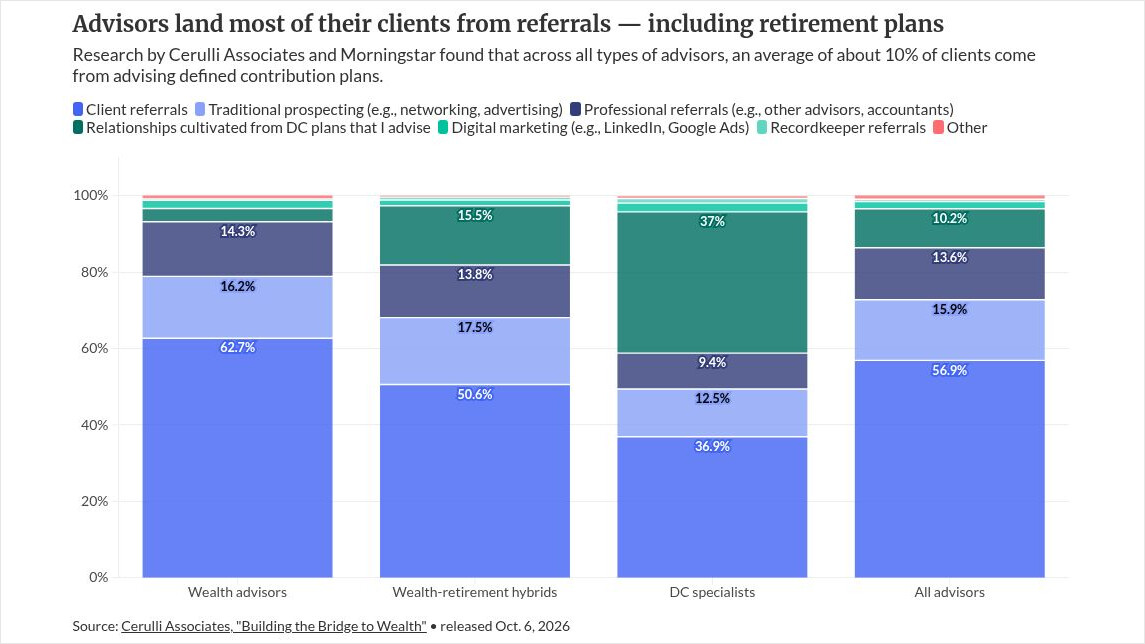
Cerulli Associates and Morningstar found 53.4% of advisors who don't prioritize wealth growth rank help converting 401(k) participants a top-three need. Recordkeepers are courting the same savers, so an advisor who turns away small accounts risks the sponsor and the eventual rollover.
The Investor · Invest desk
Drafted by a language model from the sources cited here and checked against its claim ledger before publication. How we use AISend a correction
What happened
- Fidelity, Schwab, Empower and Vanguard increasingly offer planning and advice to build participant relationships and manage assets beyond the retirement account, the report says.
- Advisors told the researchers they lack the time and resources to use new technology and need better access to participant data.
- Carson Wealth's Jason Juhl said participants within five to seven years of retirement tend to be the most engaged prospects.
- The Retirement Studio's 401(k) practice serves plans of $2 million to $50 million and earns nearly equal revenue from its plan and wealth businesses.
Compiled by The InvestorSomething wrong?How this is made
Why it matters
- decision Home offices that hand plan advisors lead lists are paying for the smaller stated need; among advisors not chasing wealth growth, the larger one is help converting participants.
- exposure An advisor who declines small participant balances weakens the sponsor relationship that gives access to later rollovers, in plans where recordkeepers already sell advice.
- precedent If more recordkeepers copy the few that already win rollovers, the pre-retirement rollover turns into a sale the plan advisor has to compete for.
Two answers in the Cerulli Associates and Morningstar survey belong side by side. Among advisors who don't treat wealth management growth as a priority, 43.7% named help identifying leads as one of the three most valuable resources a firm could give them, and 53.4% named help converting those prospects into clients [5][4]. The gap is 9.7 percentage points [18]. These advisors already work with the plan. More of them want help with the close than with the search, and about half of all advisors working with defined contribution plans say they need more support on both [3].
Some recordkeepers have already closed. "A few have been effective in generating rollover and crossover, and others are adopting the strategy," the report said [8]. Independent RIAs and broker-dealers are doing the same from their side, converting participants into clients outside the plan when they can [1]. American Banker's summary describes the two camps as competing directly for the same participants [2].
The report's warning is about the small account. Advisors cautioned against both a sales pitch and turning away smaller accounts [14]. "You don't want it to be salesy in nature," Jason Juhl of Carson Wealth said. "You want it to be more consultative in nature." [15] According to American Banker's summary, advisors who refuse smaller participant balances, or who don't keep servicing participants over time, can damage their standing with the plan sponsor and give up pre-retirement rollover assets [6]. I think that cost shows up years after the account is declined. Juhl said younger participants need serving too [17], and for many Americans the 401(k) is the largest asset they own [19].
The case against this view starts with the report's own count: "a few" converting recordkeepers is a small number, and if it stays small the independents face a narrower threat than the competition framing implies [8]. Sponsor access may also be easy for anyone who asks. On asking employers to allow individualized participant guidance, Juhl said, "Nine times out of 10, they're going to agree to that." [11] And some independents begin with the owner. Brian Boswell, co-founder of The Retirement Studio in Georgetown, Texas, said his firm sometimes takes a business owner as an advisory client first and then helps set up or manage the company's 401(k) [12]. In that model the sponsor is a wealth client before the participants are prospects.
Even so, I think the advisors who skip wealth growth are making an allocation choice whose cost arrives at rollover. They service the plan and leave the participant relationship to whoever offers advice inside it, and the report names the large recordkeepers as the firms building that offer [7]. In my view their request for better participant data [9] is the weakest point in the independent position. The firms keeping the plan records are the same firms competing for the participant.
The thesis fails if recordkeeper rollover capture stays with a few firms and sponsors keep their advisors regardless of participant service. As American Banker describes it, the report does not quantify rollover dollars won by either camp or count sponsors that changed advisors. It rests on a survey of 338 advisors and 22 interviews [16].
What to watch
- Rollover and crossover figures from Fidelity, Schwab, Empower or Vanguard showing whether more than "a few" recordkeepers convert participants at scale.
- Whether wealth manager home offices add conversion support for plan advisors, the resource 53.4% of the less-engaged group ranked in its top three.
- Evidence of sponsors replacing plan advisors over participant-level service, the direct test of the small-account risk.