RAI Institute's bicycle robot does wheelies and front flips with five actuated degrees of freedom
RAI Institute's 51-pound bicycle robot reaches 8 meters per second with five actuated degrees of freedom, using a movable mass and learned control. Testing so far has been limited to a motion-capture laboratory.
The Product Desk
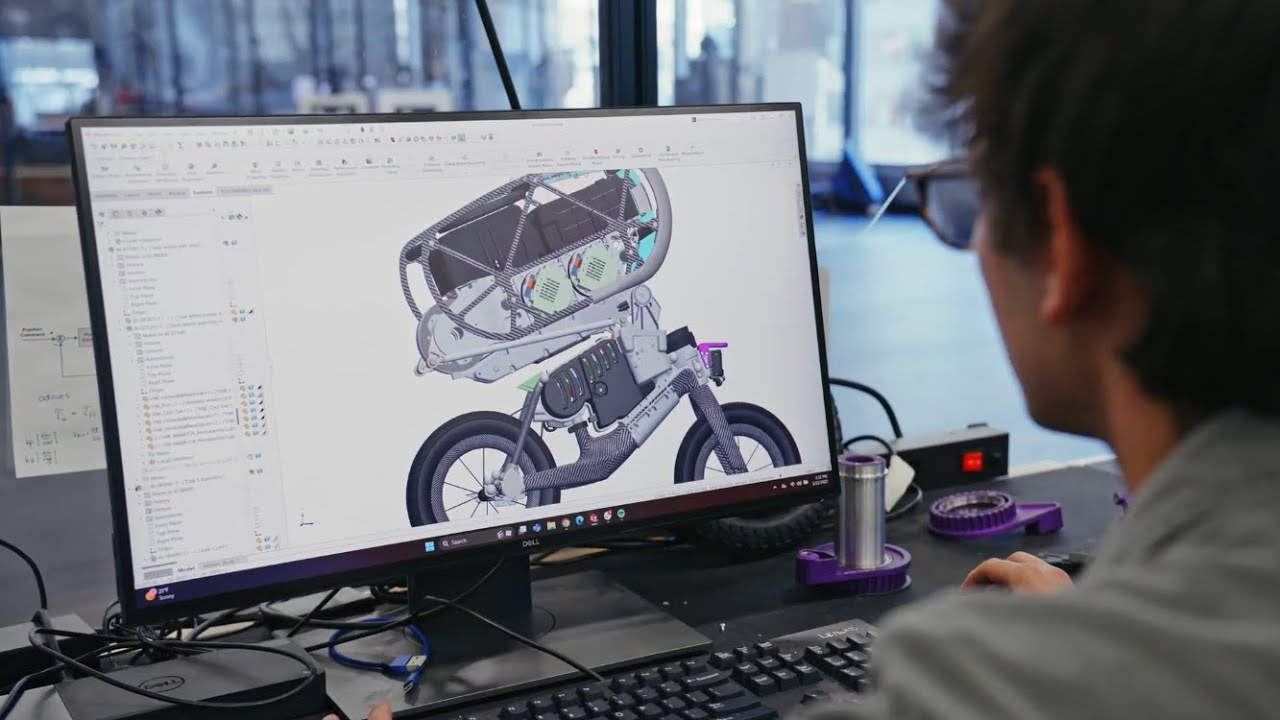
Three figures: the UMV autonomously jumped onto a 1-meter-high platform, repeating the sequence 15 times; its pitch angular velocity in a front flip reached approximately 17 radians per second; it drives at up to 8 meters per second (18 mph).
| Figure | Value | Note | Claim |
|---|---|---|---|
| Platform height the UMV jumped onto, autonomously | 1 meter | sequence repeated 15 times | 12 |
| Front-flip pitch rate | 17 rad/s, approx. | 14 | |
| Driving speed, up to | 8 m/s | 18 mph | 3 |
What happened
- The researchers developed four main control policies, one each for driving, wheelies and hopping, flipping, and jumping.
- Trained in simulation, the policies transferred to the physical robot without additional training.
- For a front flip, the robot jumps and pulls its body into a tighter shape, which cuts rotational inertia and lets it spin faster.
- Most of the robot's mass sits in a head that holds the computer, the batteries and the powerful jumping actuators.
Why it matters
- constraint The delivery and reconnaissance uses the team describes depend on onboard sensing and sturdier hardware that it still lists as future work.
- capability Hopping on the rear wheel lets a wheeled platform move sideways in several directions, a move conventional wheeled platforms cannot make.
- decision Anyone comparing wheeled and legged platforms for a delivery pilot has to decide whether lab runs with external tracking count as evidence for a route that has none.
The platform run is the part of the demonstration an operator can map to a job. According to Interesting Engineering's report on the work, the UMV approached a 1-meter-high platform autonomously, jumped onto it, drove across and jumped down, then repeated the sequence 15 times with consistent jump trajectories on the way up [12]. The wheelies and the flip show range. The 15 repeats show consistency, and we would ask about that first for any delivery job.
The hardware is sparse by design. A neck and two tie rods link the head to the bicycle frame and let the robot shift its mass and change orientation [6]. There are no reaction wheels, kickstands or other dedicated static stabilization mechanisms [7]. The report says the five actuated degrees of freedom reduce mechanical complexity compared with conventional legged robots [4]. It does not give a degree-of-freedom count for a legged robot, a price or a battery run time.
In our view the complexity moved into software. The policies were trained in simulation with Proximal Policy Optimization [8], with mass distribution, friction, motor strength, control delays and sensor noise varied so they would cope with real-world differences [9]. They command the joints through lower-level proportional-derivative controllers [20].
In the flip, pitch rate reached about 17 radians per second [14]. A full turn is about 6.28 radians, so finishing in under half a second [15] takes an average of at least 12.6 radians per second [21], about 74% of that peak [22].
The tests ran in a laboratory with motion-capture equipment, there to improve state estimation [16]. Today the robot is for researchers. The team names urban delivery and long-distance reconnaissance over rough terrain as applications [18].
For any robot demo, we sort each claimed capability two ways: where it ran, on the machine or only in simulation, and how the robot sensed its state, onboard or through external tracking. As the report describes the tests, the UMV's jumps, wheelies and flip sit in the cell for hardware with external tracking [11][16]. Delivery and reconnaissance work would sit in the cell for hardware with onboard sensing alone. We would put nothing in a rollout plan until a result lands there.
What to watch
- A UMV test outside the motion-capture laboratory using onboard sensing alone.
- Run time, price or battery figures for a revised build.
- A published degree-of-freedom comparison against legged robots doing the same jumps.
Clarity's read
What the record supports and how the coverage leans. The claims behind it follow.
Reality
- Evidence50
- Adoption3
- Hype gap+10
- Incentives
- Insufficient
- Confidence50
Claim ledger
Ranked by verification strength, evidence, and original report placement.
- [1]
Researchers at the Robotics and AI Institute (RAI Institute) developed the Ultra Mobility Vehicle (UMV), a bicycle-based robot designed to combine fast wheeled movement with the agility of legged machines.
- [2]
The UMV weighs 51 pounds (23.5 kilograms).
- [3]
The UMV can drive at speeds of up to 8 meters per second (18 mph).
- [4]
The design uses a movable reaction mass and reinforcement learning to achieve its maneuvers with just five actuated degrees of freedom, reducing mechanical complexity compared with conventional legged robots.
- [5]
The UMV's head houses most of the robot's mass, including its computing hardware, batteries and powerful jumping actuators.
- [6]
A spatial linkage made of a neck and two tie rods connects the head to the bicycle frame, allowing the robot to shift its mass and change its orientation during movement.
- [7]
The system performs its maneuvers without reaction wheels, kickstands or other dedicated static stabilization mechanisms.
- [8]
The researchers trained the UMV in simulation before transferring the learned control policies to the physical robot, using NVIDIA Isaac Laboratory and the Proximal Policy Optimization algorithm.
- [9]
During training the simulation varied mass distribution, friction, motor strength, control delays and sensor noise (domain randomization), intended to help the policies handle differences between simulated and real-world conditions.
- [10]
The researchers developed four main control policies, for driving, wheelies and hopping, flipping, and jumping.
- [11]
The resulting behaviors transferred from simulation to hardware without additional training.
- [12]
In one experiment the UMV autonomously approached a 1-meter-high platform, jumped onto it, drove across the surface and jumped down, repeating the sequence 15 times with consistent jump trajectories during ascent.
- [13]
The robot performs front flips by jumping and drawing its body into a tighter configuration, which reduces its rotational inertia and lets it spin faster.
- [14]
During the front flip the robot's pitch angular velocity reached approximately 17 radians per second.
- [15]
The robot completed the flip rotation and landed in less than half a second.
- [16]
The researchers tested the system in a laboratory using motion-capture equipment to improve state estimation.
- [17]
Future development will focus on more robust hardware, improved batteries and motor drivers, and onboard sensing that reduces reliance on external motion-capture systems.
- [18]
The team sees potential applications in urban delivery and long-distance reconnaissance across rough terrain, where speed, maneuverability and obstacle clearance are important.
- [19]
During rear-wheel hopping the robot can move laterally in different directions, overcoming the directional limitations of conventional wheeled platforms.
- [20]
The policies control the robot's joint movements through lower-level proportional-derivative controllers.
- [21]
A full 360-degree rotation (2 x pi, about 6.28 radians) completed in under 0.5 seconds requires an average pitch rate of at least about 12.6 radians per second.
- [22]
The minimum average rate of about 12.6 rad/s is about 74% of the 17 rad/s peak pitch rate.
Get this ledger inside ChatGPT. Ask about any of our stories and the answer brings its figure, each claim’s verdict and the sources. Free, no account.
Sources
1 independent publisher whose own reporting we read for this story.
- interestingengineering.comBicycle-inspired robot can perform wheelies, jumps, and front flips at high speeds
1 article · October 14, 2026
Topics and entities
Follow any of these and your For You feed starts watching them — no settings page required.