LeadershipNot yet confirmed elsewhere1 publisher3 min readPublished
Digital Reef's own filing says its £14.7bn London campus cannot meet a 1.5C trajectory
The East Havering application concedes non-alignment with net zero by 2050 while projecting more than 72m tonnes of CO2e over 60 years. The conflict is now on the record.
The Board Room · Leadership desk
What happened
- In its planning application, Digital Reef says the £14.7bn East Havering project "does not align with a science-based 1.5C compatible trajectory and achieving net zero by 2050".
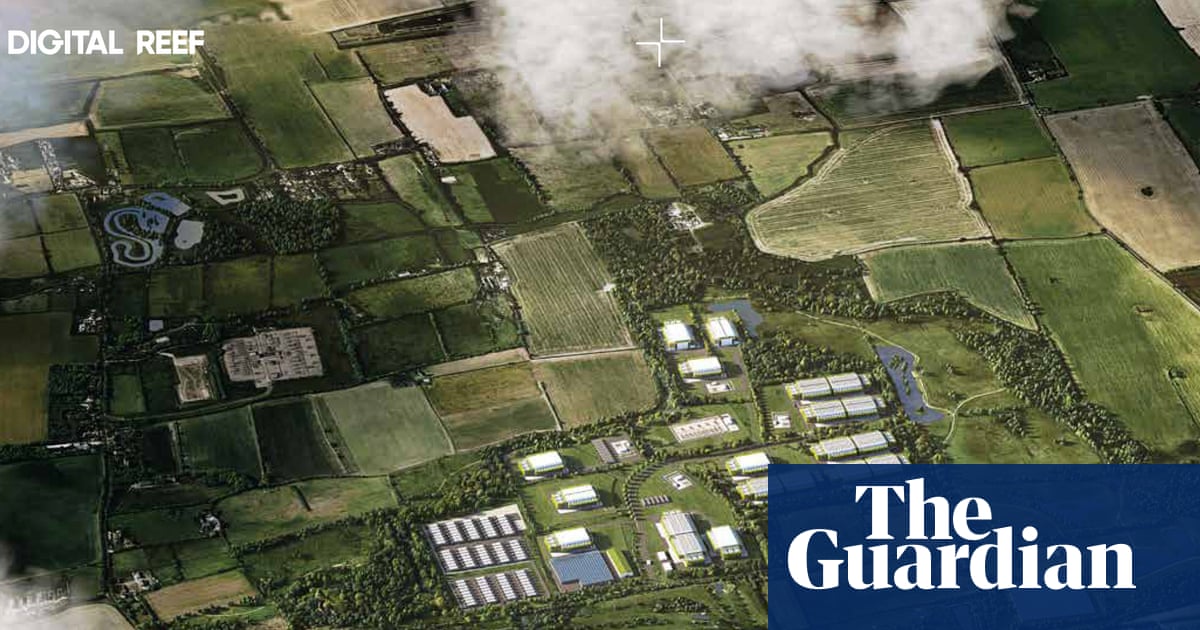
- The East Havering Data Centre Campus in north Ockendon would use 218 hectares of green belt to run servers and data storage for AI and cloud computing, and would be one of the largest datacentres in Europe if approved by Havering council.
- Digital Reef has described the scheme as "a unique opportunity to create a sustainable datacentre campus of the future".
- Planning documents show the datacentre would generate more than 1m tonnes of carbon dioxide a year, and 1.2m tonnes annually once fully operational.
- Documents estimate the development would generate more than 72m tonnes of CO2e over its projected 60-year lifespan.
Compiled by The Board RoomSomething wrong?How this is made
Why it matters
A developer seeking consent for what would be one of Europe's largest datacentres has written into its own planning application that the scheme "does not align with a science-based 1.5C compatible trajectory and achieving net zero by 2050" [1]. That sentence, in support of a £14.7bn project, is the point at which AI capacity growth and corporate climate commitments stop being presented as reconcilable and start being filed as a trade-off [1].
The East Havering Data Centre Campus would take 218 hectares of green belt at north Ockendon to run servers and storage for AI and cloud computing, and would rank among Europe's largest if Havering council approves it [2]. Its developer, Digital Reef, has separately described the scheme as "a unique opportunity to create a sustainable datacentre campus of the future" [3]. The documents put operational output at more than 1m tonnes of CO2 a year, rising to 1.2m tonnes once fully operational, and more than 72m tonnes of CO2e across a projected 60-year life [6][7]. Those two figures multiply out exactly, so the disclosure assumes near full-load emissions for essentially the whole life of the asset rather than a decarbonising glide path [20]. Guardian analysis of planning documents for the dozens of UK datacentres now proposed found EHDCC's projected emissions to be the highest any developer has disclosed [8]. Using the International Civil Aviation Organization's calculator, the Guardian equated 1.2m tonnes to 26,795 Heathrow-to-JFK flights a year [9].
The electricity numbers are the operative constraint. Digital Reef says that at a "likely" 50% load the campus would consume 2.65bn kWh a year [10]; against Ofgem's 2,500 kWh average household figure, that is about 1.06m homes [11][21]. Delivery rests on a 600MVA connection via the Warley substation, requiring a new 400kV National Grid substation and a new 132kV UK Power Networks facility, with the full connection expected in 2033 [12]. By 2038, operational emissions alone are projected to consume nearly 20 times the entire carbon budget of the borough of Havering and almost 1% of the UK's [13].
The policy backdrop has moved in the developer's favour. Datacentres were designated critical national infrastructure in 2024 [14]; by early 2025 the government estimated they used 2.5% of UK electricity and predicted a fourfold increase by 2030 [15]; and in January planning legislation was amended so developers can apply as nationally significant infrastructure projects, largely bypassing local authorities [16]. Neso, the grid operator, has told MPs that datacentre developers have requested 72.8GW of connections by 2039, nearly 60% more than last year's UK peak demand [17]. The national policy statement promised for the sector, from the now-disbanded DSIT, has not been published [18].
Donald Campbell of the nonprofit Foxglove called the projected emissions "staggering" and a threat to UK decarbonisation, and argued the companies served should be required to carry the cost [4][5]. The North Ockendon Residents Association called the plan a "massacre" of green belt farmland [19].
Three things to watch. Whether this application stays with Havering council or migrates to the NSIP route now available [16][2]. Whether the unpublished national policy statement attaches emissions conditions to consent, or ratifies the current position [18]. And whether the 2033 connection date holds, given that the site needs two new substations before it can draw its full load [12].
Clarity's read
What the record supports and how the coverage leans. The claims behind it follow.
Reality
- Evidence74
- Adoption24
- Hype gap+22
- Incentives72
- Confidence63
Claim ledger
Ranked by verification strength, evidence, and original report placement.
- [1]
In its planning application, Digital Reef says the £14.7bn East Havering project "does not align with a science-based 1.5C compatible trajectory and achieving net zero by 2050".
ReportedSupportedSource: Digital Reef planning application, reported by the Guardian2 sources— create a free account to open themView cited source - [2]
The East Havering Data Centre Campus in north Ockendon would use 218 hectares of green belt to run servers and data storage for AI and cloud computing, and would be one of the largest datacentres in Europe if approved by Havering council.
- [3]
Digital Reef has described the scheme as "a unique opportunity to create a sustainable datacentre campus of the future".
- [4]
Donald Campbell, advocacy director at the tech justice nonprofit Foxglove, said the EHDCC's projected emissions were "staggering" and "a big threat to the ability to decarbonise in the UK", as well as "a big drain on important resources that are needed by homes and other businesses".
ReportedSupportedSource: Donald Campbell, Foxglove2 sources— create a free account to open themView cited source - [5]
Campbell said datacentres will ultimately serve the wealthiest companies in the world and so should be required to carry the social and environmental costs rather than leaving them to the public and the environment.
ReportedSupportedSource: Donald Campbell, Foxglove2 sources— create a free account to open themView cited source - [6]
Planning documents show the datacentre would generate more than 1m tonnes of carbon dioxide a year, and 1.2m tonnes annually once fully operational.
- [7]
Documents estimate the development would generate more than 72m tonnes of CO2e over its projected 60-year lifespan.
- [8]
Guardian analysis of planning documents for the dozens of proposed datacentres in the UK shows the EHDCC has the highest projected carbon emissions disclosed by a developer.
- [9]
The 1.2m tonnes of CO2e the EHDCC expects to emit would amount to 26,795 long-haul flights from London Heathrow to New York JFK, according to the UN International Civil Aviation Organization's carbon calculator.
- [10]
Digital Reef said in its proposal that at a "likely" 50% load the campus would consume 2.65bn kWh of electricity per year, equivalent to the demand of more than 1m UK households.
- [11]
According to Ofgem, average UK household electricity consumption is 2,500 kWh per year.
- [12]
The campus would be powered primarily by a 600MVA connection to the National Grid via the Warley substation; because the existing site lacks capacity, upgrades are planned including a new 400kV National Grid substation and a new 132kV UK Power Networks facility on adjacent land, with the full connection expected by 2033.
- [13]
By 2038, EHDCC operational emissions alone are projected to consume nearly 20 times the entire carbon budget of the borough of Havering and almost 1% of the UK's entire carbon budget.
- [14]
The government designated datacentres as critical national infrastructure in 2024, putting them on an equal footing with water, energy and emergency services systems.
- [15]
By early 2025 the government estimated datacentres used 2.5% of the UK's electricity, and predicted this would increase fourfold by 2030.
- [16]
In January, planning legislation was amended so datacentre developers can apply as nationally significant infrastructure projects, largely bypassing local authority planning procedure and seeking approval directly from government.
- [17]
Neso, Britain's grid operator, has warned MPs that datacentre developers have requested 72.8GW of electricity connections by 2039, a "huge step change for the sector" and nearly 60% more than the UK's peak power demand last year.
- [18]
The government said last year the now-disbanded Department for Science, Innovation and Technology would produce a national policy statement for the datacentre sector, but it has not yet been published.
- [19]
The North Ockendon Residents Association said the development would be a "massacre" of green belt land, citing loss of crop-producing farmland, wildlife habitats and pollution costs.
- [20]
The disclosed annual figure of 1.2m tonnes CO2e sustained for the full 60-year life gives 72m tonnes, matching the disclosed lifetime total, implying no assumed decline in annual emissions.
- [21]
2.65bn kWh a year equates to roughly 1.06m average UK households.
Sources
1 independent publisher whose own reporting we read for this story.
- theguardian.comProposed London datacentre will have annual carbon footprint of 27,000 flights to New York
1 article · August 21, 2026
Topics and entities
Follow any of these and your For You feed starts watching them — no settings page required.
Topics
Entities
- Digital ReefFollow
- East Havering Data Centre CampusFollow
- Havering CouncilFollow
- NesoFollow
- National GridFollow
- UK Power NetworksFollow
- OfgemFollow
- FoxgloveFollow
- Donald CampbellFollow
- North Ockendon Residents AssociationFollow
- Keith PrinceFollow
- Department for Science, Innovation and TechnologyFollow
- International Civil Aviation OrganizationFollow