Science1 publisher3 min readPublished
Montana Instruments built a cryostat that cycles to 4 K and back in about two hours
Montana Instruments says its RapidCycle 100 EC cools to 4 K in an hour and warms back about as fast. On the company's own figures, that puts cryogenic screening of ordinary electronic parts on a bench timescale.
The Scientist · Science desk
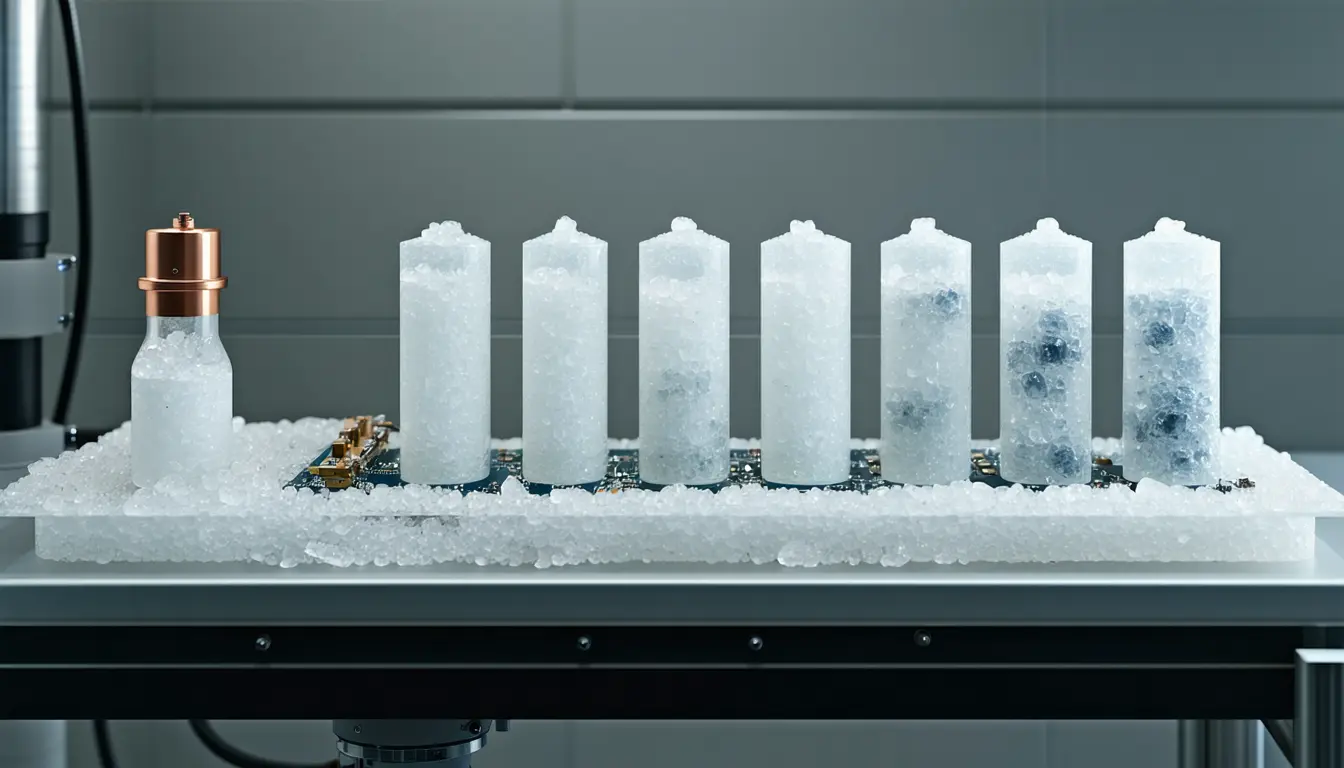
What happened
- Montana Instruments has built a cryostat, the RapidCycle 100 EC, that the company says cools from room temperature to 4 K in under an hour and warms back up again just as quickly.
- Senior design engineer Ben Wilbur says a dilution refrigerator takes days or weeks to cool down, and one faulty component forces a full warm-up that can waste the best part of a month.
- Component suppliers rarely characterise their devices in the cryogenic regime, so quantum developers either test the parts themselves or risk a faulty device ruining a complex machine's performance.
- Samples sit on a 100 mm platform with space around them for an easy-access wiring system, and the configuration can be adapted to different testing protocols.
Compiled by The ScientistSomething wrong?How this is made
Why it matters
- decision Component vendors now have a capital choice to make: buy cryogenic screening and ship pre-qualified parts, as Gale suggests, or let customers find the failures after integration.
- constraint A pass at 4 K narrows the set of parts that can fail, and it does not clear a device for the colder stages of a dilution refrigerator, so the fridge stays in the qualification path.
- contradiction One account carries both a threefold speedup and a one-third cut. They point to baselines of six hours and three hours. The difference changes how much schedule a buyer recovers.
- cost With the thermal cycle down to two hours, the remaining cost per screened part is mounting, wiring and measurement time. The cryostat leaves that labour untouched.
The heat that has to be removed is not spread evenly across the temperature range. "Most of the thermal energy is from room temperature down to around 50-70 K, so that is where we needed to focus our development efforts," said Ben Wilbur, a senior design engineer at Montana Instruments, who added that below that point the temperature falls much more rapidly because the heat capacity of the materials becomes much lower close to absolute zero [4]. So the design work went into taking mass out of the cold volume. "To optimize the performance we needed to think carefully about the materials we used, and about the amount of thermal mass that really needed to be in the system," Wilbur said. "The more you have in there, the longer it will take to cool down." [5] Reaching 4 K, and generating enough cooling power to hold the device there while the test runs, took further iterations on the earlier work [6].
An hour down and an hour back is a cycle of roughly two hours [2]. Run continuously for a day, that is about twelve parts [12]. Real throughput depends on the test, and the figure assumes no time at all for mounting a sample, wiring it up and taking the measurement.
The screen answers one question: does the part still work at 4 K. Whether a part that passes at 4 K also behaves at the base temperature of the dilution refrigerator it will eventually sit in is a separate measurement. Product manager Patrick Gale said many of the components going into quantum computers were not designed for ultralow temperatures, and pointed to radio-frequency devices, which control and read out qubit states but come from manufacturers unlikely to have the expertise or equipment to know whether they work in that regime [7]. "This system is designed for companies that want to understand how their devices perform at ultralow temperatures, but without needing to hire a cryogenics engineer," Gale said [8].
The speed claim arrives in two forms in the same account. Physics World reports the overall cycle time as around three times faster than for similar systems [9]. Against a two-hour cycle, that implies comparable machines near six hours. The same article describes the engineering task as cutting the cycle time by a third, which implies a baseline nearer three hours [10][13]. Neither figure is attached to a named comparison system [14].
Gale's pitch is that screening can be sold as a feature. "Having the capability to characterize their own components could offer suppliers a competitive advantage, allowing them to pre-qualify their devices and even to improve their low-temperature performance for quantum applications," he said [11]. The idea first emerged in 2023, was set aside while the company dealt with more immediate priorities, and was restarted about a year ago [15].
What to watch
- An independent cool-down measurement, or a named comparator with its own published cycle time, would show which of the two speed figures describes the product.