Science1 publisher2 min readPublished
ICTER team suppresses OCT speckle by scattering light differently in every frame
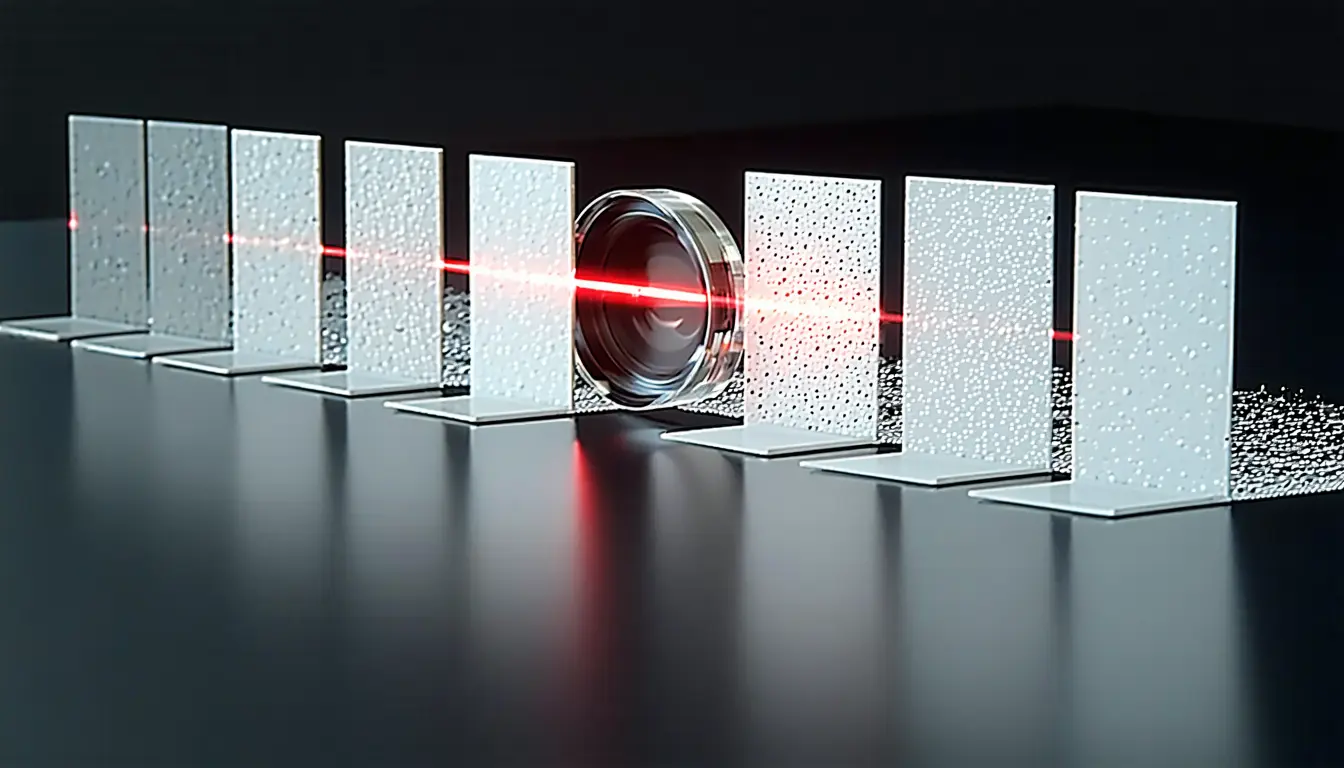
ICTER researchers report that averaging OCT frames shot through a deliberately changing scattering layer gives a clearer image than a single frame. The layer lowers the laser's effective coherence enough to vary speckle between frames while keeping the interferometry OCT depends on.
The Scientist · Science desk
What happened
- A dynamic scattering medium supplied the variation, making small, time-varying changes in the direction and phase of the light reaching the sample.
- Tuning matters: the variation must make each frame's speckle independent without scattering so hard that the object's signal is erased and the image blurs.
- To test the idea, the team combined a mathematical model, computer simulations and optical coherence tomography experiments.
- Klaudia Nowacka-Pieszak is first author of the Scientific Reports paper, with Piotr Kasprzycki, Patricio Espinoza Guevara, Karol Karnowski and Dawid Borycki.
Compiled by The ScientistSomething wrong?How this is made
Why it matters
- cost Each image needs a series of measurements of an object that holds still. The speckle gain is paid for in acquisition time, and moving samples were not part of the test as described.
- decision Instrument designers who would otherwise add complex optics to fight distortion now have a scattering layer plus frame averaging to try first, on the authors' account.
- constraint The aberration claim covers only selected aberrations, so the method cannot yet be treated as a general replacement for correction optics.
Speckle is the grain in an OCT image. It is a random field of bright and dark spots that forms where waves scattered from different parts of a sample overlap, reinforcing in some places and cancelling in others [6]. It comes from the light, not the electronics [7]. Speckle is tied to spatial coherence, and incoherent light has none [7]. Incoherent light also cannot support interferometric imaging such as OCT, which uses coherence to pick out the photons carrying structural information [7].
The ICTER group, at the Polish Academy of Sciences' Institute of Physical Chemistry [2], built its method around a stationary sample. The dynamic layer changes the phase relationships of the light from one measurement to the next [11]. Once the frames are independent enough, the object's fixed structure accumulates across them and the shifting speckle and distortions fade [8].
The comparison reported is a varied series against a single frame [1]. For a still object under highly coherent light, that is close to a fair control. Such light produces persistent speckle [11], so repeat frames taken without the moving layer would carry the same pattern, and averaging them would not remove it. The thing this doesn't tell you is how the result scales with the number of frames.
"Scattering is usually seen as the enemy of high-resolution imaging," said Klaudia Nowacka-Pieszak, the paper's first author [12]. "This opens a new way of improving the robustness of optical imaging without relying on increasingly complex optical hardware," she said [12].
I think the experiment is a clean test of a sound idea, on the kind of sample it was designed for. Imaging through tissue is a separate question. The phys.org account does not report how many frames were averaged, how far speckle contrast fell, or whether any sample was living tissue. Until those figures are in hand, the cheaper-imaging case rests on the physics and on the authors' own description.
The authors also compared two ways of combining the frames. The first, magnitude averaging, relies mainly on signal intensity and is the simpler of the two [13].
What to watch
- The paper's own figures: how many frames were averaged and how far speckle contrast fell against a single frame.
- A test through living tissue or in the eye, where the sample moves between frames and adds variation of its own.
- How the paper's second frame-combining method compares with magnitude averaging on image quality.