Product1 publisher3 min readPublished
At $280 with no ANC, Ozlo's Sleepbuds 2 show the form factor is solved and the price is not
Gizmodo puts the second-generation Sleepbuds at 1.6 grams, about half a Soundcore Sleep A30, and still lists "too pricey" and "no ANC" as the headline drawbacks.
The Product Desk · Product desk
Drafted by a language model from the sources cited here and checked against its claim ledger before publication. How we use AISend a correction
What happened
- Ozlo, a company that makes sleep earbuds called the Sleepbuds, has a new pair on the market: the $280 Sleepbuds 2.
- Gizmodo lists "No ANC" as a con of the Ozlo Sleepbuds 2.
- The Sleepbuds 2 weigh just 1.6g, about half the weight of the Soundcore Sleep A30.
- Ozlo advertises the Sleepbuds 2 as "the world's smallest earbuds designed for sleep."
- Gizmodo argues sleep-focused earbuds need to be flat as well as light, because that is what separates them from regular earbuds and allows them to be slept on without hurting the ears, including for side sleepers.
Compiled by The Product DeskSomething wrong?How this is made
Why it matters
Ozlo has shipped a second generation of its sleep earbuds at $280, and Gizmodo's review concludes they are solid but that the price is prohibitive [1][18]. The interesting part is not the verdict but the split it exposes: the hard engineering problem in this category, making something you can lie on for seven hours, looks finished, while the price is still being set as though it were not.
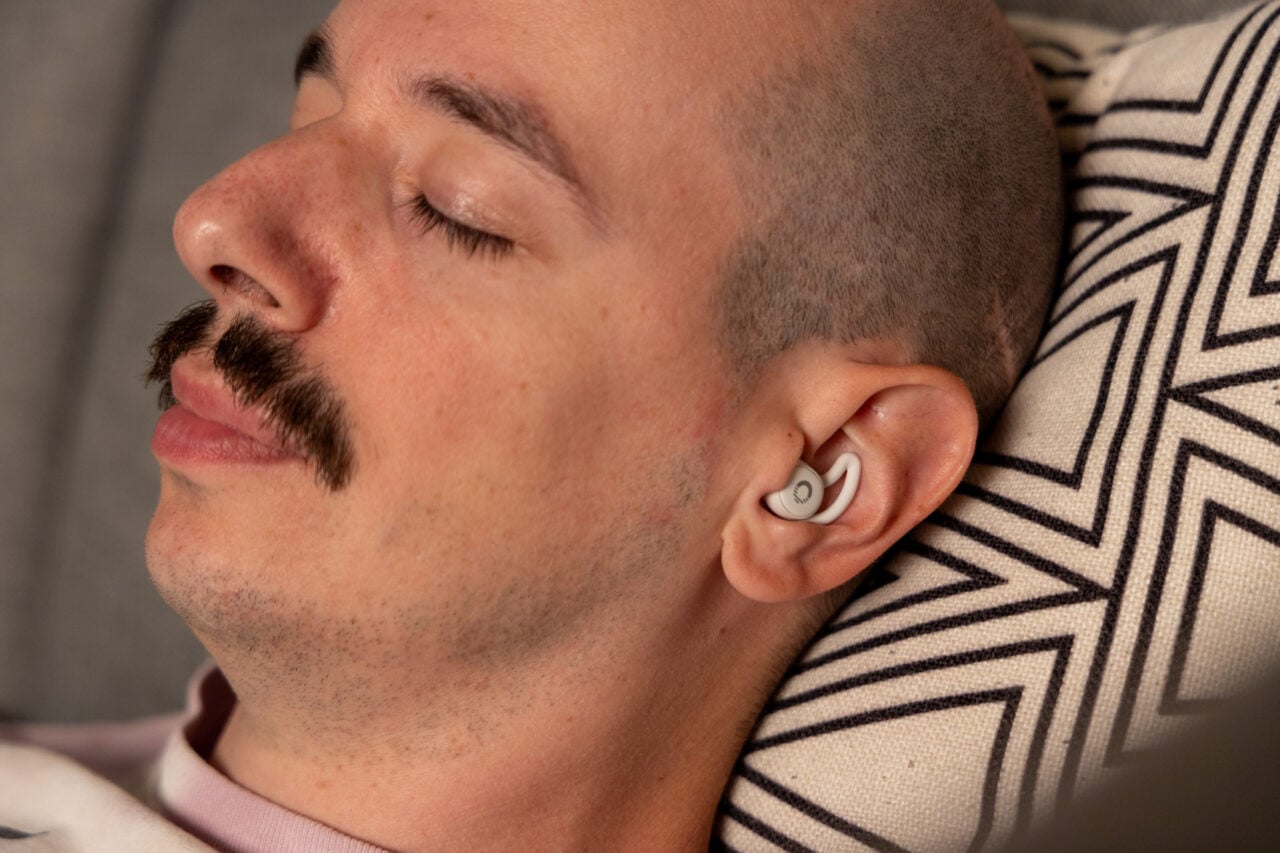
The physical evidence is specific. Each bud weighs 1.6 grams, which the reviewer notes is about half the weight of Anker's Soundcore Sleep A30, implying roughly 3.2 grams for the comparison pair [3][17]. Ozlo markets them as "the world's smallest earbuds designed for sleep" [4]. The reviewer, a side sleeper, wore them for stretches of 7 hours or more with his head flat against a pillow and reported no complaints, crediting a very squishy ear tip and a malleable stabilising wing, with the default size out of four fitting correctly [6][8][7]. Gizmodo's framing is that flatness, not lightness alone, is what separates a sleep bud from a normal one [5], and on comfort it rates the Sleepbuds 2 ahead of the Soundcore A30 by a small margin [9].
What $280 does not buy is active noise cancellation, which Gizmodo lists as a con alongside the price and charging-case sensors that "feel a little tacked on" [15][2]. Sound isolation is therefore passive plus masking audio: the app offers a set of free sleep sounds, some noise-masking and some ambient, which can be downloaded onto the buds to play locally and save battery [10]. Audio quality is described as fine for soundscapes but unbalanced and dark for podcasts, even using the Spoken Word tuning preset meant for speech [11]. The pros column is comfort, battery, and the breadth of modes and sleep metrics [16].
The software is where the value argument gets shakier. There are four modes: Simple, which auto-plays a downloaded sound and shuts off Bluetooth after 10 minutes; Auto, which hands off from phone audio to a sleep sound once you fall asleep; Sensing, which streams external content and transitions when it detects sleep; and Manual, triggered from the app or the case [12][13][19]. Gizmodo expects Simple to be most people's default because it needs no effort, and notes that Simple does not produce sleep tracking data, a gap that cost the reviewer a night of it [14]. So the mode most users will land in disables one of the two features doing the heaviest lifting on the spec sheet, and the tracking that remains depends on case sensors the same review calls tacked on [14][15].
What to watch: whether the next wave of sleep buds competes on price now that the mechanical problem is largely solved, and whether tracking becomes a default rather than a mode you have to opt into and remember. If comfort parity is this close between a 1.6 gram bud and a roughly 3.2 gram one [3][9][17], the remaining differentiation is software behaviour and what the sensors can actually resolve.