Owner.com now routes 83% of new customers through a product it gives away free
After three years of rebuilding, the demo booking and the onboarding specialist are gone, replaced by a free five-minute AI build. Owner earns a cut of payment volume, which is what lets it call a customer login a defect.
The Investor · Invest desk
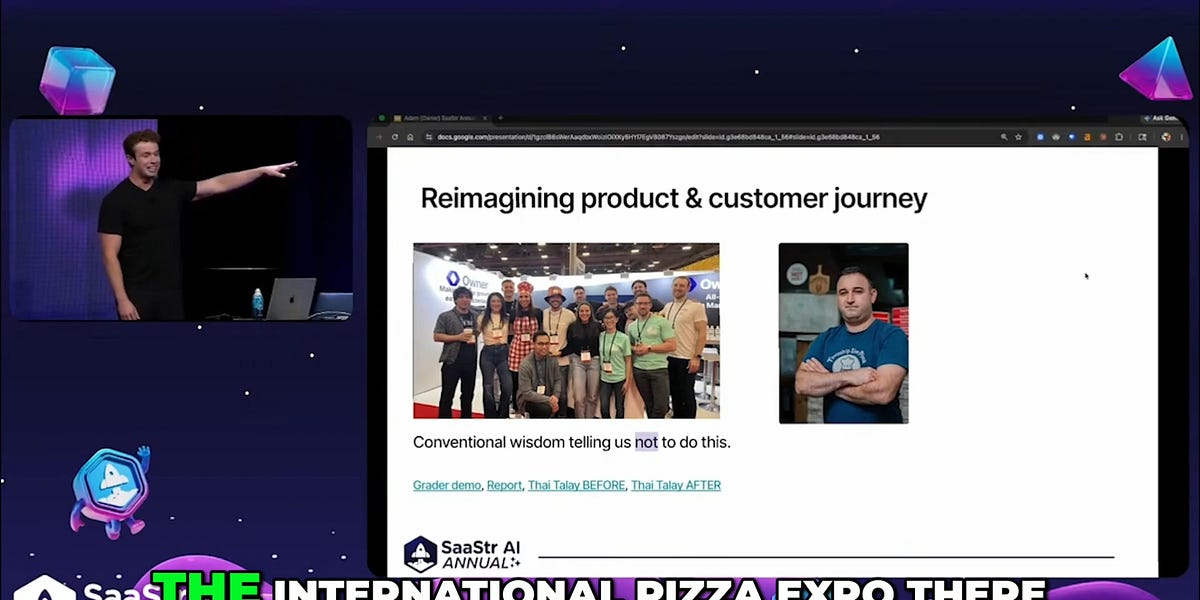
What happened
- Owner.com spent three years rebuilding around AI, and more than 83% of its new customers now begin their journey inside an AI product rather than a sales conversation.
- Its Grader product replaced both the demo booking with a salesperson and the onboarding specialist, running a free AI build that finishes in five minutes.
- The company has grown past $100M ARR at triple-digit rates, faster than the year before, according to CEO Adam Guild's account of the rebuild.
Why it matters
- constraint Declaring logins a defect is only affordable if revenue does not depend on them, so any per-seat vendor borrowing the metric has to reprice before it can ship the agent that would trigger it.
- cost The saving on sales and onboarding headcount is paid back out as delivery cost incurred on prospects who have not paid, which lands on Owner's payments take rate rather than the customer's invoice.
- capability Pre-contact volume prediction turns a free giveaway into something rankable, letting Owner decide how much unpaid work each prospect is worth instead of spending uniformly.
- exposure Anyone treating this as a playbook is leaning on conference figures from the founder, amplified by his seed investor and board member, with no conversion or margin data attached.
Take the residual first. If more than 83% of new customers now begin inside an AI product [13], and the funnel was previously 100% sales-led inbound [3], then fewer than 17% of new customers meet a human before they meet the software [19]. That subtraction is the entire story, and note what it is not measuring: nothing in the account says the restaurant websites got better, only that acquiring one stopped requiring a demo booking, a salesperson and an onboarding specialist [2].
The part I find more interesting than Grader is the lead qualification agent, which estimates gross payments volume for a restaurant it has never worked with to within about $250, before anyone at Owner speaks to it [15]. Owner takes a cut of payment volume rather than a seat fee [7], so a pre-contact estimate of payment volume is a pre-contact estimate of lifetime revenue. That is underwriting. And it matters because the free tier is expensive: a finished website, upscaled photography, generated video and a full SEO and CRO audit are delivered before anyone pays [4], on top of a crawl that checks roughly 90 factors, pulls nearby competitors and reads the restaurant's reviews [9]. Free-for-everyone only pencils if you can rank prospects before you spend. Or rather, the more useful version: it makes free-for-everyone selectively affordable, which is a different business than a free trial.
This is where the copy-this framing gets thin. Guild's metric inversion, in which every login to fix what the software did counts as a failure of the software [5], is survivable because the money follows the restaurant's sales rather than the restaurant's clicking [7]. On flat per-seat pricing the same inversion bills you for the behaviour you just declared a defect, and the renewal conversation becomes an argument about shelfware [8]. Growth teams inherit the same problem from the other end, since most activation definitions are some version of returning within seven days and most retention cohorts are login cohorts [18]. So the transferable lesson is narrow: outcome-priced companies can afford to make their software invisible, seat-priced ones have to reprice first.
What would prove the distribution thesis wrong is conversion, and the source does not have it. There is an entry-mix number and an ARR level [13][14], and no CAC, no free-to-paid rate, no gross margin on the giveaway. If the Grader cohort converts materially worse than the demo-booked cohort did, Owner has bought volume with delivered cost of goods and the old funnel was cheaper per closed dollar. Second reading: growth came from restaurant payment volume expanding under a take rate [7], and the AI entry path is correlated rather than causal. Third: it works and holds, in which case the defensible asset is the open-web crawl and review corpus [9], not model access. Worth pricing the sourcing too, since these are stage numbers from the CEO at SaaStr AI 2026 written up by the investor who led the seed round and sits on the board [1], which is informed rather than audited.
The allocation point is the quiet one. Three years of build went into the path in and into internal coordination, where an agent named Owen absorbs about 90% of builder coordination and finance moved its primary artifact out of Excel into Claude [16], while the rebuild itself was elective at a company already exceeding its plan [17]. Guild shipped five products himself in two months without ever having written production code at Owner [6]. One every twelve days [12].
What to watch
- Any Owner disclosure giving Grader-sourced cohorts their own retention and free-to-paid curve.
- Whether seat-priced vendors adopting the login-as-defect metric follow it with a repricing to usage or outcome terms.
- Whether Owner starts gating parts of the free build, such as generated video or upscaled photography, as prospect volume rises.
Clarity's read
What the record supports and how the coverage leans. The claims behind it follow.
Reality
- Evidence28
- Adoption44
- Hype gap+36
- Incentives86
- Confidence33
Claim ledger
Ranked by verification strength, evidence, and original report placement.
- [1]
The account is a write-up of a talk by Owner.com CEO Adam Guild at SaaStr AI 2026 by an author who led Owner's seed round at SaaStr Fund and sits on its board.
- [2]
Owner's Grader product replaced both the demo booking with a salesperson and the onboarding specialist with a free AI build that finishes in five minutes.
- [3]
Owner was previously 100% sales-led inbound: book a demo, talk to a salesperson, then an onboarding specialist.
- [4]
The free product delivers a finished website, upscaled photography, generated video, and a full SEO and CRO audit before anyone pays anything.
- [5]
Owner counts every login to fix what the software did as a failure of the software rather than as engagement.
- [6]
Guild personally shipped five products in the past two months, as a CEO who had never written production code at Owner.
- [7]
Owner takes a cut of payment volume, so its revenue follows the restaurant's sales rather than the restaurant's clicking.
- [8]
On per-seat or per-active-user pricing, the login-as-defect metric and the revenue model point in opposite directions, and the renewal conversation becomes an argument about shelfware.
- [9]
Grader checks roughly 90 SEO and CRO factors before rebuilding anything, crawling every place the restaurant appears on the open web, pulling in nearby competitors, auditing the Google Business Profile, and reading the restaurant's reviews.
- [10]
Owner's own customer research said restaurant owners feared AI; it was three months old and completely wrong.
- [11]
Owner had to build its own outcome instrumentation to replace engagement metrics, and a model that can predict a prospect's payment volume can also see whether an existing customer's sales rose after activation.
- [12]
Five products in two months is roughly one product every twelve days.
- [13]
After three years of rebuilding Owner.com around AI, more than 83% of new customers now start their journey inside an AI product.
- [14]
Owner.com has grown past $100M ARR, at triple-digit rates and faster than the year before.
- [15]
Owner's lead qualification agent estimates gross payments volume for a restaurant it has never worked with to within about $250, before anyone talks to them.
- [16]
An agent called Owen absorbs about 90% of builder coordination work at Owner, and the finance team moved its primary artifact out of Excel and into Claude.
- [17]
The rebuild was elective: Owner was winning, exceeding a triple triple double double trajectory and growing efficiently when Guild made the call.
- [18]
Most activation definitions are a version of 'came back within 7 days' and most retention cohorts are login cohorts, so shipping an agent that works lowers D7 return rate.
- [19]
Fewer than 17% of Owner's new customers still enter through the human-first path.
Get this ledger inside ChatGPT. Ask about any of our stories and the answer brings its figure, each claim’s verdict and the sources. Free, no account.
Sources
1 independent publisher whose own reporting we read for this story.
Topics and entities
Follow any of these and your For You feed starts watching them — no settings page required.