Science1 publisher2 min readPublished
Nanometre-thick graphene lets a long-pulse laser push protons to 132 MeV
University of Osaka researchers drove protons to 132 MeV with a long-pulse laser and graphene targets that survived the prepulse. That shows ultrathin targets can work with long pulses, though the release reports a peak energy without the beam figures a practical accelerator needs.
The Scientist · Science desk
Drafted by a language model from the sources cited here and checked against its claim ledger before publication. How we use AISend a correction
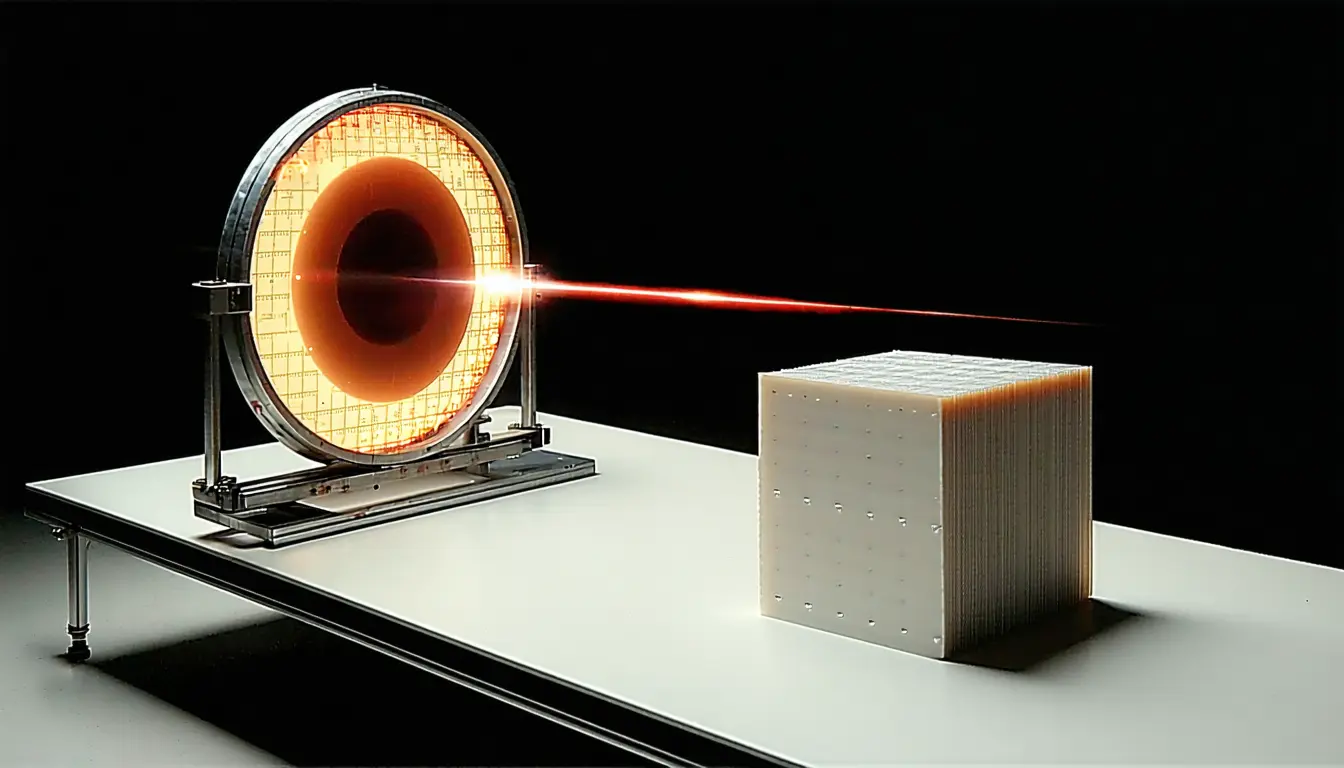
What happened
- Simulations indicate a moving electrostatic wave in the plasma carried the protons forward for several picoseconds, the 'surfing' named in the paper's title.
- The study, led by Takumi Minami with senior author Yasuhiro Kuramitsu, is published in Progress of Theoretical and Experimental Physics.
- The group says real-time online ion detectors are in development, aimed at laser experiments that eventually analyse and optimise their own results.
Compiled by The ScientistSomething wrong?How this is made
Why it matters
- capability If graphene's survival repeats shot after shot, the prepulse stops ruling out ultrathin targets for long-pulse ion acceleration.
- exposure The 132 MeV confirmation leans on a classifier: at 99.2% precision roughly 8 in 1,000 flagged hits would be noise, a real margin when top-energy protons are rare.
- constraint The case for a smaller alternative to conventional accelerators cannot be judged from a peak energy; proton counts and energy spread decide whether this is a usable beam.
The measured quantity here is the top energy [1]. The travelling wave said to have delivered it is a simulation result [5]. The paper's title still names the process outright: proton surfing acceleration via propagating electrostatic waves on large-area suspended graphene [11].
The target is the part with direct experimental support. In laser-driven ion acceleration, ultrathin targets are vulnerable to the weak prepulse that runs ahead of the main high-intensity pulse [3]. The Osaka graphene was nanometre-thick, and it withstood that prepulse and was still intact when the main pulse arrived [4]. "By using ultrathin graphene layers and a relatively long laser pulse, we are able to accelerate protons for an extended period and reach a record energy of 132 MeV," said lead author Takumi Minami [6]. "Our results show that long-duration acceleration can push proton energies beyond those typically achieved with shorter laser pulses," he said [7].
The record also depends on software. "The challenge is not only to produce these rare high-energy protons, but also to reliably identify them," said senior author Yasuhiro Kuramitsu [8]. "We need to search millions of detector images for signals left by individual ions and distinguish the highest-energy protons from background noise," he said [9]. A precision of 99.2% means about 0.8% of the signals the network flagged, roughly 8 in 1,000, would be background [1]. Precision counts false alarms. It does not count real protons the network missed, and the release gives the figure for a single high-energy measurement [10].
The release does not give the pulse duration, the laser energy, how many protons reached the top of the spectrum, their energy spread, or the earlier figure that 132 MeV beats. It presents laser-driven ion acceleration as a possible alternative to conventional accelerators [2]. It also says this approach could feed next-generation machines with fewer concerns about target vulnerabilities [12]. I think the second claim, about targets, is the better supported, because graphene's survival of the prepulse is reported as part of the experiment, separate from the simulations [4]. A smaller accelerator that is practical to run would be judged on proton counts and energy spread, and this report stops at the peak energy.
What to watch
- A shot-by-shot count of protons near 132 MeV, with their energy spread, from this group or a follow-up paper.
- Another laser facility reproducing graphene's survival of the prepulse with a long pulse.
- Recall figures for the neural network, or an independent check of its top-energy hits against a conventional analysis of the detector images.