Science1 publisher2 min readPublished
Graphene reservoirs make cryo-EM ice thickness tunable through reservoir depth
Researchers report that graphene reservoirs confine sub-100-nm liquid films for cryo-EM, so ice thickness can be tuned by reservoir depth. They trace decades of trial-and-error ice preparation to thin films that drain and rupture on their own before anything freezes.
The Scientist · Science desk
What happened
- Researchers built cryo-EM reservoirs by laying graphene over perforated support films, controlling ice thickness through the size and edge profile of the holes.
- According to the authors, the reservoirs held liquid better than conventional preparation methods, and reservoir depth tuned the resulting ice thickness.
- The authors report higher contrast, reduced particle motion and improved particle orientations across a broad range of macromolecules.
Compiled by The ScientistSomething wrong?How this is made
Why it matters
- capability Ice thickness could be chosen when the grid is fabricated, before any sample is applied, where labs now screen grid after grid until one happens to carry usable ice.
- constraint If packed macromolecules steadied the films behind past structures, as the authors suggest, conventional grids have favoured concentrated samples over dilute ones.
- decision Graphene sandwiches already failed on reproducibility once, so facilities will need independent evidence of uniformity before building workflows around the reservoir design.
The trouble starts with van der Waals forces. In a film thinner than about 100 nm, liquid migrates out of thinner patches into thicker neighbours, where those interactions are energetically more favourable [5]. Thin spots get thinner. The film then breaks into microscopic droplets at places no one can predict [5]. The theoretical threshold for this, about 100 nm, is the same range high-resolution imaging needs its ice to be in [4].
The authors call this a previously overlooked determinant, one that acts before vitrification [13]. If they are right, the poor reproducibility and patchy thickness of current methods [2] begin in the liquid, before anything is frozen. That would explain why decades of effort on ice control have not solved it [1].
The paper also offers a reason cryo-EM has worked as often as it has. Earlier studies found that closely packed macromolecules partly stabilise thin films, and the authors write that this is "potentially contributing to previously successful structure determinations" [6]. They present it as a possibility. If it holds, conventional grids would have served dilute samples worst.
Confinement is the proposed remedy. In earlier work, liquid held in tight confinement diffused 2 to 8 orders of magnitude more slowly than bulk liquid [7], a factor of 100 to 100 million [1]. Graphene is the natural membrane: atomically thin, flexible and conductive [14]. Graphene sandwiches have been tried before and had the same reproducibility and uniformity problems. The authors attribute that to a lack of control over the confinement architecture [8].
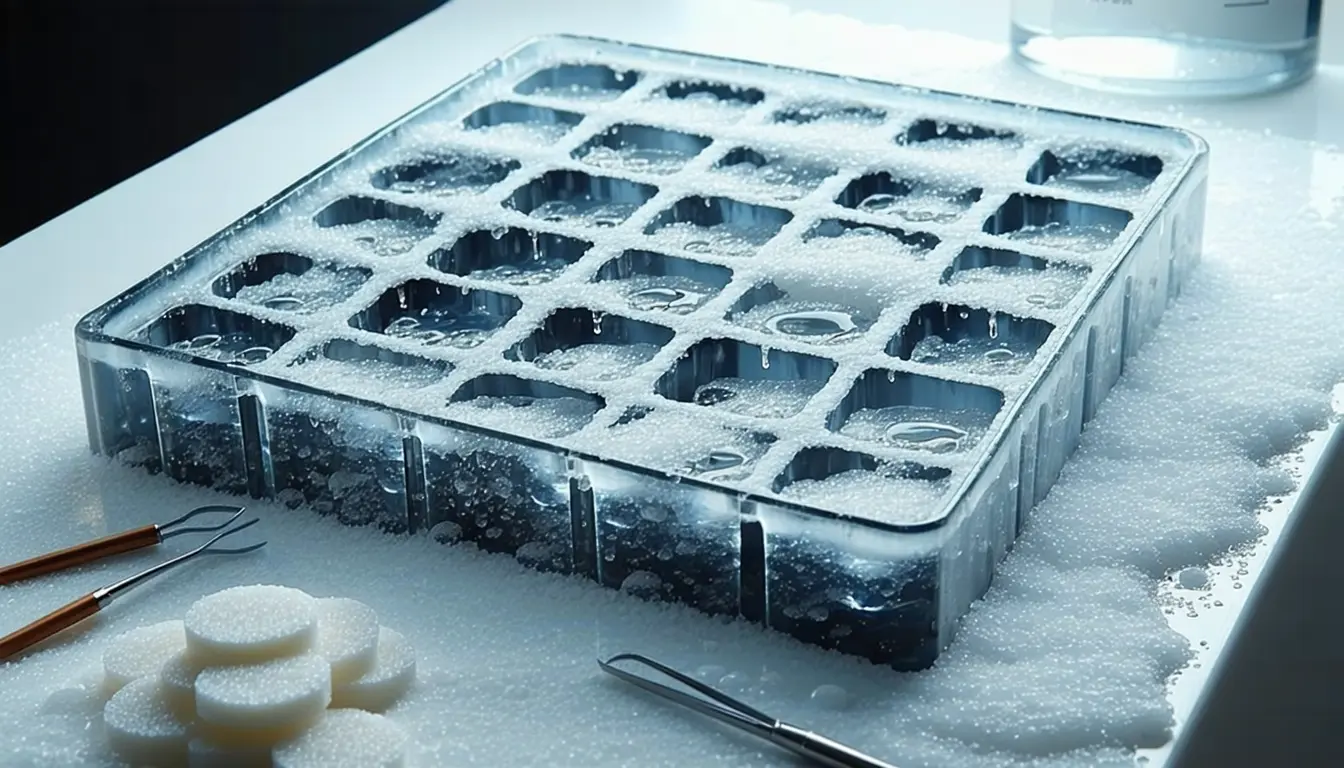
The new element is geometry. The team laid graphene over perforated support films and controlled ice thickness through the dimensions and edge profiles of the holes [9]. Reservoir depth tunes the resulting thickness [10], so the thickness is chosen when the grid is made.
According to the authors, the reservoirs retain liquid better than conventional techniques [10] and deliver precise thickness control with robust reproducibility and large-area uniformity [11]. Those are the right things to measure. Ice thickness governs background noise, how particles distribute and the resolution a reconstruction can reach [3]. The thing this excerpt doesn't tell you is the effect size: it does not include the measured spread in thickness, the number of grids, or the resolution gained over a conventionally prepared control.
I think the diagnosis is on firm ground, because it rests on established thin-film theory [4]. The reservoir claim is the harder one to prove. It depends on the reproducibility numbers, and reproducibility is exactly where earlier graphene sandwiches fell short [8].
What to watch
- The full-text figures: measured ice-thickness spread across grids and reconstruction resolution against conventionally prepared control grids.
- Replication by other cryo-EM facilities fabricating their own graphene reservoirs, since reproducibility is where earlier graphene sandwiches failed.
- Results on dilute samples, which would test the authors' suggestion that packed macromolecules explain past successes.