Science1 publisher3 min readPublished
Sheet size and oxidation decide whether a graphene oxide droplet dries into a web or a mosaic
Two graphene oxide suspensions dried into opposite deposits, one a radial web and one a field of patches. Synchrotron scattering and rheology tie the difference to how tightly the nanosheets stack before the water leaves.
The Scientist · Science desk
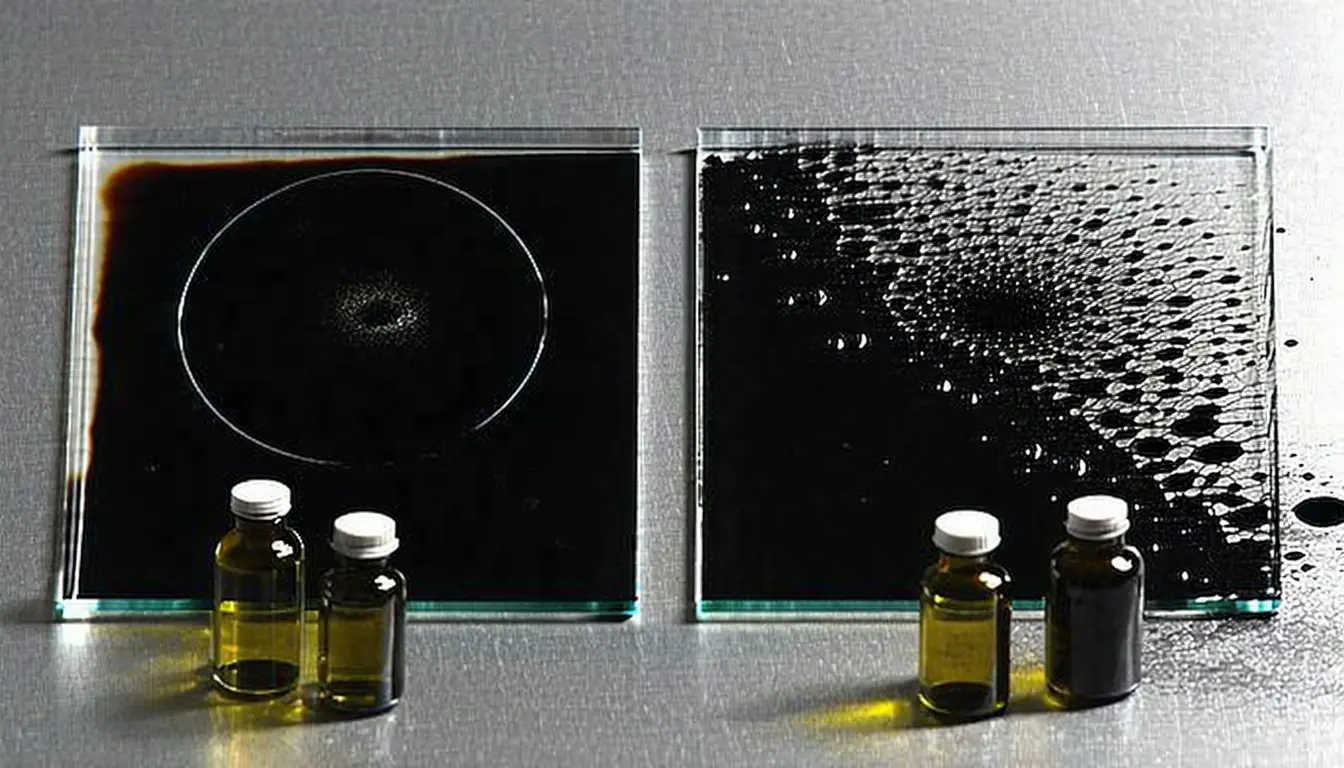
What happened
- A Langmuir study reports that a drying graphene oxide droplet leaves either a spider-web deposit or a mosaic one, set by the size of the nanosheets and the amount of oxygen bound to them.
- Sheets about 2.2 micrometers across, with a carbon-to-oxygen ratio of 14.4, dried into thin radial stripes running from the center of the droplet out to the edge.
- Sheets about 0.5 micrometers across, more heavily oxidized at a carbon-to-oxygen ratio of 10.4, instead left small bright regions spread across the droplet like mosaic tiles.
- The authors attribute the split to packing: loose paper-like stacks wrinkle as evaporation compresses them, while tightly ordered brick-like stacks resist folding and break into compact patches.
Compiled by The ScientistSomething wrong?How this is made
Why it matters
- capability If the pattern follows the feedstock, the deposit becomes something a formulator selects when mixing the ink, and the authors name printed electronics, coatings and possibly supercapacitors as the places that would use it.
- constraint A process engineer wanting mosaics cannot yet tell whether to buy smaller flakes, more oxidized flakes, or both, because the reported comparison moved the two together.
- decision Anyone printing these suspensions now has a reason to measure shear response as a process variable, since the same nominal material behaves as a liquid or as a soft solid depending on its internal order.
- cost Confirming the internal packing took synchrotron beamtime, so a production line would be relying on the bench rheometer as the stand-in for the structural measurement.
The two formulations that produced those patterns differ in two ways at once. The web-forming sheets were about 2.2 micrometers across, with a carbon-to-oxygen ratio of 14.4 [2][3]. The mosaic-forming sheets were about 0.5 micrometers across, at a ratio of 10.4 [4][5]. That is a factor of 4.4 in width [16] and about 38 percent more carbon per oxygen atom in the web material [17]. The paper does not report a third condition holding one of those properties fixed while moving the other [18]. So the comparison ties the pattern to the two properties together, and which of them is doing the work stays open.
The explanation the authors offer sits in the suspension, before drying begins. Graphene oxide sheets organize into layers in water, and the fluid flows while keeping an order usually associated with crystals [6]. Larger, weakly oxidized sheets form loosely connected stacks, broadly aligned in direction but free to slide, which the authors compare to a stack of paper [7]. Evaporation compresses that assembly against the surface, the sheets wrinkle, and the wrinkles gather into radial stripes [8]. The smaller, heavily oxidized sheets are fixed in position as well as orientation, closer to a stack of bricks, and that stiffer arrangement breaks into compact regions instead of folding [9].
Two measurements back the picture. Synchrotron small-angle X-ray scattering probed how the sheets were arranged and confirmed the contrast between the loose and the highly ordered assemblies [10]. Rheology found the matching mechanical split: the weakly bound sheets could not sustain shear and flowed readily, like a liquid, while the strongly bound sheets responded elastically, more like a soft solid [11]. Both are measurements of the ink, and whether a web conducts differently from a mosaic is a property of the dried film that neither one reaches.
The underlying problem is the coffee ring. Evaporation carries suspended particles toward the droplet edge [12], and in inkjet printing and surface coatings a rim of material is usually the thing engineers are trying to avoid [13]. Both deposits reported here put material across the droplet footprint instead of at the rim, the stripes running from the center outward and the bright patches distributed over the area [19]. The authors describe the result as a simple way to tune how the nanoflakes are arranged on a surface, naming printed electronics, coatings and potentially supercapacitors [14].
Graphene oxide is graphene decorated with oxygen-containing groups, which is what makes the sheets disperse in water in the first place [15]. Oxidation therefore does several jobs at once for a formulator: it sets dispersibility, it sets the packing order that the scattering data measured, and in this experiment it moved together with sheet size. A run with small, weakly oxidized sheets, or large, heavily oxidized ones, would say which of the two to set.
What to watch
- A formulation that holds sheet size fixed while varying the carbon-to-oxygen ratio, or the reverse, which would separate the two variables the current comparison moves together.
- Electrical measurements on the dried deposits, such as sheet resistance or capacitance, which would say whether a web performs differently from a mosaic in a printed device.
- Whether the two patterns survive at inkjet-relevant droplet volumes, substrates and humidity, rather than only in the reported drying experiments.