Science3 publishers3 min readPublished Updated
IARC's 2024 count makes Epstein-Barr the largest cancer-causing virus without a vaccine
IARC attributes 2.3 million of 2024's new cancers to infections, about 260,000 of them to Epstein-Barr, a virus no vaccine yet prevents. Infections that current vaccines and antibiotics can already stop still cause far more of the total.
The Scientist · Science desk
Drafted by a language model from the sources cited here and checked against its claim ledger before publication. How we use AISend a correction
What happened
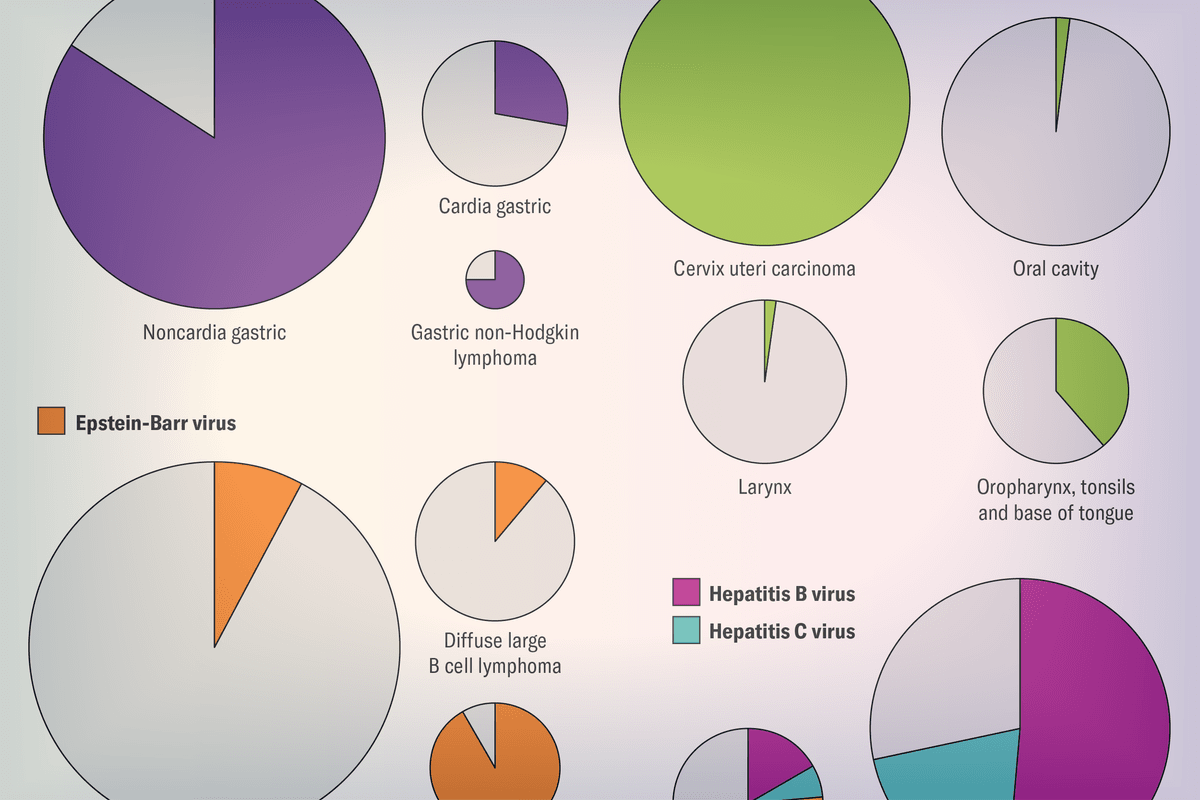
- H. pylori was linked to about 760,000 cases, almost all of them stomach cancers and more than half in eastern Asia.
- The study treats HPV as the cause of every cervical cancer, about 600,000 of the roughly 750,000 cases it links to that virus.
- About 80 percent of Southeast Asia's 34,000 Epstein-Barr cancers were nasopharyngeal, while Europe and the Americas saw more stomach cancer and lymphoma.
- In sub-Saharan Africa, Burkitt lymphoma made up a notable share of Epstein-Barr cancers, and the authors flag malaria as a possible contributor.
Compiled by The ScientistSomething wrong?How this is made
Why it matters
- decision Money earmarked for new prevention tools has its clearest cancer target in Epstein-Barr vaccines, since every larger infection-linked burden already has a vaccine or a drug.
- constraint Anyone comparing the 2024 figures with 2018's has to strip out newly counted Epstein-Barr cancers before claiming the virus's burden grew.
- capability One HPV dose protecting as well as two or three means a fixed vaccine supply can reach more girls in sub-Saharan Africa.
About 38 percent of the Epstein-Barr total comes from cancers that earlier global estimates did not count against the virus [1]. Stomach cancer and two more types of lymphoma joined its list only recently, and together they make up about 100,000 of its 260,000 cases [7]. The last estimate of this kind dates from 2018 [9]. Since then, Clifford told Scientific American, research has linked the virus to some stomach cancers and some rarer lymphomas [9].
"This updated analysis shows that the landscape of infection-related cancers continues to evolve as scientific evidence advances," said Gary Clifford, an epidemiologist at the International Agency for Research on Cancer and the study's senior co-author, in a press release [10]. "It also highlights where future investments in new prevention tools could have the greatest impact, particularly for infections such as EBV, for which effective vaccines are not yet available." [10]
The ranking supports him. Epstein-Barr's total is topped only by H. pylori, HPV and hepatitis B [2], and each of those has a tool. Antibiotics can clear H. pylori [5]. Vaccines prevent HPV and hepatitis B, and antivirals treat hepatitis B and C [13][16]. Epstein-Barr has no vaccine and no reliable way to control it once someone is infected, though several vaccines are in testing [11]. That makes it the largest cancer burden in the study with no tool against the infection itself [6].
Clifford's wider point to Scientific American was about tools that already exist. "These are very actionable risk factors. We can test for them. We can vaccinate against them," he said [21]. By case count, most of the preventable burden sits there. H. pylori and HPV together account for about 1.51 million cases [2], nearly six times the Epstein-Barr figure [3]. Add hepatitis B's roughly 360,000 [12] and the four named infections reach about 2.13 million, leaving roughly 170,000, on rounded figures, for everything else [4]. Five of the 12 infections studied caused nearly all of the total [4].
Delivery is uneven. In sub-Saharan Africa the rate of HPV-caused cancer is more than twice the global average [14]. Clifford attributed the region's higher rates partly to "disparities in investment," such as a lack of cervical cancer screening programs [15].
The strongest evidence that a vaccine changes these numbers comes from HPV, whose vaccine was first introduced in the US in 2006. In some states, cervical cancer rates have dropped by more than 50 percent among women aged 20 to 31, the first group eligible for the vaccine as preteens [16]. The comparison is observational, across cohorts, and not a trial. "There is no question that this vaccine does what it was intended to do," said Anna Giuliano, founding director of the Center for Immunization and Infection Research in Cancer at Moffitt Cancer Center [17].
Epstein-Barr is a harder target. The virus lives in nearly every adult and stays for life [18], yet only a small share of carriers ever develop a related cancer [19]. Genes, diet, surroundings, other infections and weakened immunity are all candidate cofactors [19]. The thing the 260,000 figure doesn't tell you is how many of those cancers a vaccine would prevent. The candidates are still in testing [11], and neither report includes trial results.
I think the evidence supports Clifford's case that Epstein-Barr is where money for new prevention tools would do the most, provided the newly counted stomach cancers and lymphomas hold up under further study [7][10].
What to watch
- Efficacy results from the Epstein-Barr vaccines now in testing, the first data on how much of the virus's cancer burden vaccination can prevent.
- Further studies of the Epstein-Barr link to stomach cancer and the two newly counted lymphomas, on which the virus's ranking now depends.
- Whether single-dose HPV programs in sub-Saharan Africa bring the region's HPV-caused cancer rate closer to the global average.