Build3 publishers3 min readPublished
NVIDIA's $4,999 DGX Spark 64GB is a better buy for local agents than for fine-tuning
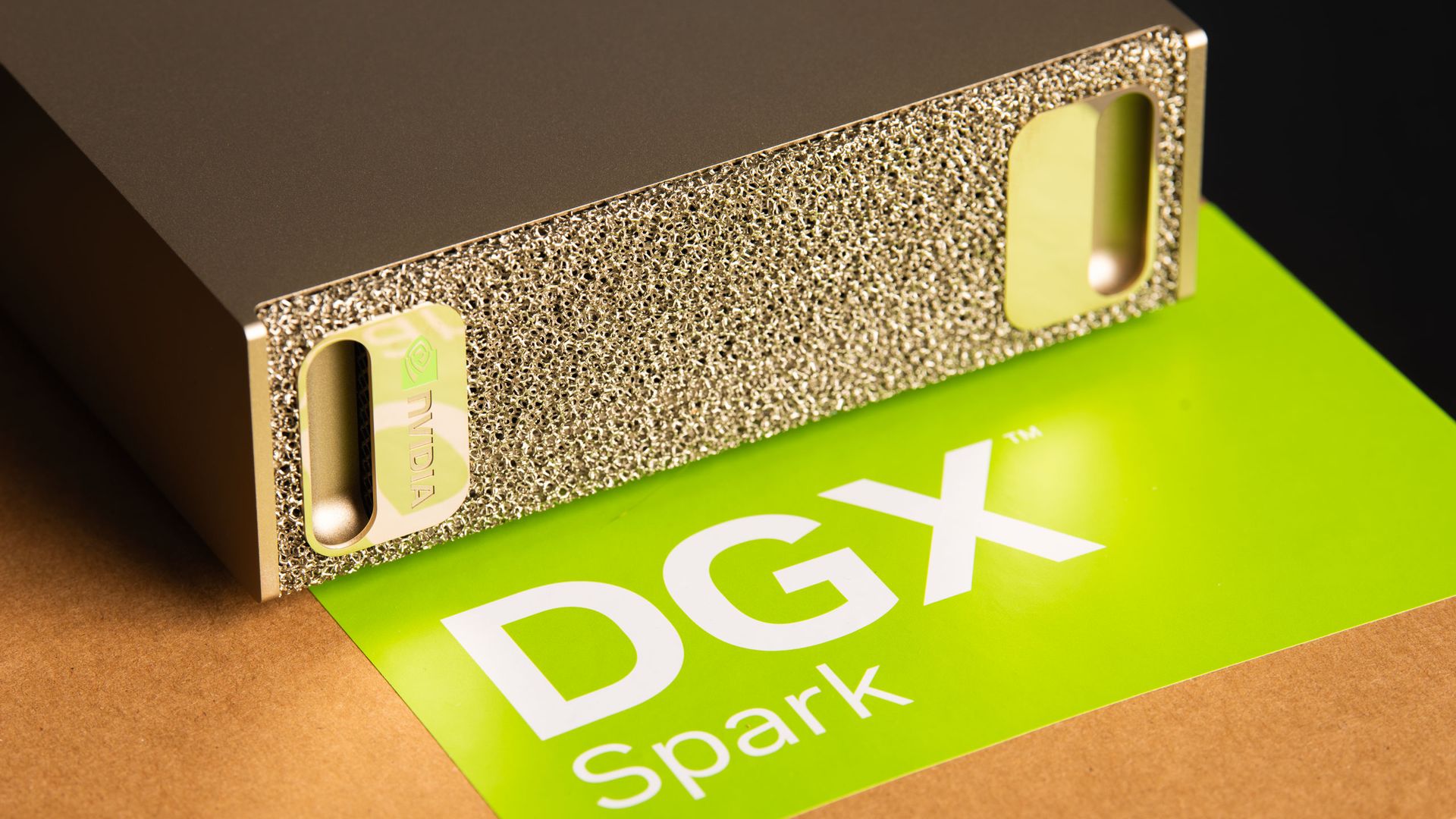
NVIDIA's 64GB DGX Spark goes on sale from six PC makers on October 23 at $4,999, about $2,000 to $4,000 below in-stock 128GB units today. Two clustered units cost more than one 128GB machine, so the purchase makes most sense for agents on models that fit in 64GB.
The Engineer · Build desk
What happened
- The 64GB model keeps the GB10 Grace Blackwell chip, DGX OS and software stack of the 128GB version, and NVIDIA says it runs models of up to 100 billion parameters.
- Two units joined by a direct QSFP cable pool their memory to 128GB, enough for models of up to 200 billion parameters by NVIDIA's count.
- Cluster Assistant in the NVIDIA Sync app detects connected units, validates their configuration and sets up the ConnectX-7 network between them.
- A Model Launcher due at the end of the month will install Qwen 3.8 27B on one unit or a pair and set up the OpenCode coding agent to use it.
Compiled by The EngineerSomething wrong?How this is made
Why it matters
- cost Getting to 128GB by pairing two 64GB units costs $998 to $2,998 more than one 128GB machine at today's street prices, so the low entry price only pays off while the work fits in 64GB.
- cost On NVIDIA's own scaling result, adding a second unit raises the price of each unit of throughput by about 18 percent.
- contradiction NVIDIA pitches the platform for fine-tuning while Tom's Hardware assigns fine-tuning to the 128GB model, so a fine-tuning budget built on the 64GB unit depends on NVIDIA's word alone.
- capability A team can buy one unit for agent work now and add a second later without reworking software, because both nodes run the same stack and Sync configures the link.
NVIDIA measured its 1.7x clustering gain on its own test bench, using Qwen 3.8 27B [8]. Tom's Hardware reports that the same model fits in 32GB of memory with limited context [9]. That means the speedup was measured on a model that already fits on one 64GB unit [8][9]. Two units gave 1.7 times the throughput of one, which is 85 percent of linear scaling [4]. For that result to carry over, a buyer's model would have to split across the link the same way, at a similar size and context length. The 200-billion-parameter ceiling for a pair comes from pooling memory. The only clustering speed figure NVIDIA gives is that same 1.7x [7][8].
The clustering software is the strongest engineering in the launch. Earlier this year, Tom's Hardware joined two Dell GB10 systems using utilities written by the community [11]. NVIDIA now does that job in its Sync app. Every node runs the same software stack, so adding a second unit needs no reconfiguration, according to NVIDIA [10]. The 64GB unit keeps the same ConnectX-7 RDMA NIC as the 128GB model [6]. NVIDIA's "without any additional setup" covers the software [17]. Someone still has to plug in the QSFP cable [7].
Now the cost. One 64GB unit starts at $4,999 [2]. Tom's Hardware reported that in-stock 128GB GB10 systems sell for roughly $7,000 to $9,000, well above NVIDIA's adjusted list price [3]. On those figures the small unit is about $2,000 to $4,000 cheaper today [1], though that sets a launch price against street prices. Tom's Hardware wrote of the launch price: "Given the ever-shifting prices of memory and storage right now, they might not stay there for long." [4] Clustering two units to reach 128GB costs $9,998 [2]. That is $998 to $2,998 more than one 128GB box at current street prices [3]. For the extra money the pair gets two memory pools at 273 GB/s each [6], 546 GB/s in total [6]. On NVIDIA's 1.7x figure, each unit of throughput costs about 18 percent more in the pair than in a single unit [5].
The sources disagree on fine-tuning. NVIDIA lists it among the platform's uses, alongside agents and inference [13]. Tom's Hardware says the 128GB Spark remains the machine for memory-hungry work such as fine-tuning [14]. Both models have the same chip and software [5], so the disagreement comes down to memory. NVIDIA's own workflow examples lead with agents: a coding or research agent left running around the clock, with a second unit added for longer context or several agents at once [15].
The sources do not include a cloud instance price. Any buy-versus-rent comparison has to come from a team's own bill. In my view the 64GB unit is a sound purchase for one job: an always-on agent running a model in the 27B class on the device, with no cloud dependency, as NVIDIA describes it [16][9]. For fine-tuning, the evidence here points to the 128GB machine [14].
What to watch
- Whether 64GB units actually sell at $4,999 after the October 23 launch, given Tom's Hardware's warning about memory prices.
- Independent clustering throughput on a model too large for one 64GB unit, somewhere between 100 and 200 billion parameters.
- Published fine-tuning results on a single 64GB Spark that would settle the disagreement between NVIDIA and Tom's Hardware.