Science1 publisher3 min readPublished
A Chinese launch institute puts a nuclear option on the record for the asteroid case DART cannot cover
Researchers at the China Academy of Launch Vehicle Technology model two ways to detonate a nuclear device against an asteroid found too late to nudge. The second reuses a DART-style impactor as a digger.
The Scientist · Science desk
Drafted by a language model from the sources cited here and checked against its claim ledger before publication. How we use AISend a correction
What happened
- A new paper from researchers at the China Academy of Launch Vehicle Technology, published in Space: Science & Technology, describes two potential scenarios for using a nuclear detonation against an asteroid.
- As of July 2024, 10,933 of the 35,269 near-Earth asteroids discovered had diameters larger than 140 m (460 feet).
- None of the known near-Earth asteroids is on a collision course with Earth.
- If one of the asteroids larger than 140 m were on a collision course with Earth, it could cause continentwide or even global devastation, resulting in the deaths of millions of people.
- Asteroid defense experts consistently warn that simulations show a large number of undiscovered near-Earth asteroids, and that in some cases the warning time between discovery and impact could be as little as a few days.
Compiled by The ScientistSomething wrong?How this is made
Why it matters
Researchers at the China Academy of Launch Vehicle Technology have published a modeling paper in Space: Science & Technology describing two ways to use a nuclear detonation against an asteroid on a collision course with Earth [1]. The interesting part is not the physics of blast coupling but the institutional fact: a state launch organisation is now on the record about the one planetary defense case a kinetic impactor cannot solve, which is short warning [1][13].
The framing numbers are worth keeping straight. As of July 2024, 10,933 of the 35,269 known near-Earth asteroids had diameters above 140 m, roughly 31 percent of the catalogue [2][16]. None of the known objects is on a collision course [3]. The scenario the paper is built for is therefore not a catalogued rock but an uncatalogued one: asteroid defense specialists warn that simulations imply a large undiscovered population, and that the interval between discovery and impact could be as short as a few days [5]. An object in that size class arriving unannounced would produce continent-scale or global damage and millions of deaths [4]. With days rather than years, the only available move is to impart as much energy as possible, either breaking the body up or sharply changing its path, and the largest energy source available is a nuclear device [6].
Mode one is the crude version: fly the warhead into the side of the asteroid and detonate it with the correct timing to shift the orbit [7]. The paper is candid about the penalties. Choosing a good detonation site is impractical at that speed, and the coupling energy, meaning the fraction of yield actually transferred into the rock, may be weak [8]. The warhead must also survive high-speed debris impacts and fire with microsecond precision, both described as major engineering challenges [9].
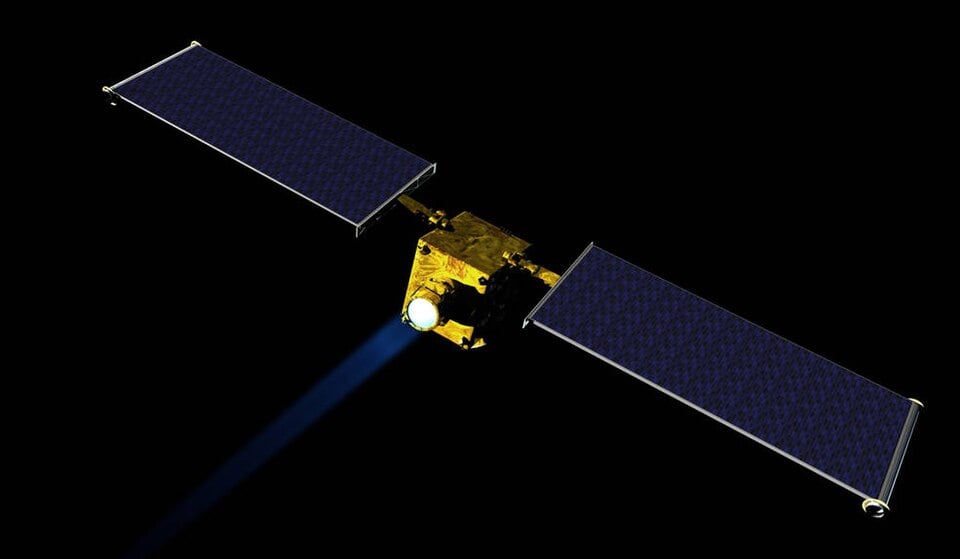
Mode two is where DART gets repurposed. Emplacing a device inside the body would couple far better, but crewed drilling is not a realistic option, so the paper builds instead on the Double Asteroid Redirection Test, which struck a non-threatening asteroid with an impactor and shifted its orbit [14][12]. On short notice a DART-class impact cannot transfer enough momentum to matter, but it can reliably excavate [13]. In the flyby pre-excavation detonation mode, a conventional penetrator, for example a "1+1" tandem impactor in which two kinetic projectiles hit the same spot in sequence, opens a crater tens of meters across, and the nuclear device then detonates inside that pit [10]. Simulations in the paper show the expected trend: the deeper the burst inside the body, the more energy goes into changing its trajectory [11].
Operators should read that as a trade, not a free win. Mode two does not remove the timing problem it inherits from mode one [9]; it adds two projectiles that must land on the same point in sequence and a warhead that must then arrive inside a pit tens of meters wide [10]. That is a sequencing chain, and chains fail at their weakest link on a mission with a single attempt.
What to watch is the quantity that decides whether any of this is worth building. The published account sets up a comparison case of a 1 km asteroid and a 3-megaton device in a shallow surface crater, but the available text stops before reporting the deflection achieved [15]. Also worth watching: whether hardware follows. The account describes simulations and a paper, not a mission, a budget, or a schedule [17].