Science2 publishers3 min readPublished
An Antiquity study counts 500 La Tène iron bars in a tonne of metal dredged from the Danube
Peter Trebsche and Marion Berranger count 193 complete bars and 307 partial ones from Deinham in Austria, Europe's largest prehistoric iron find, radiocarbon dated to the La Tene period and recovered from gravel heaps that destroyed its context.
The Scientist · Science desk
What happened
- In 2019, workers extracting gravel from the Danube near Deinham in Austria spotted unusual double-pointed iron objects and reported them to the Austrian monument authority.
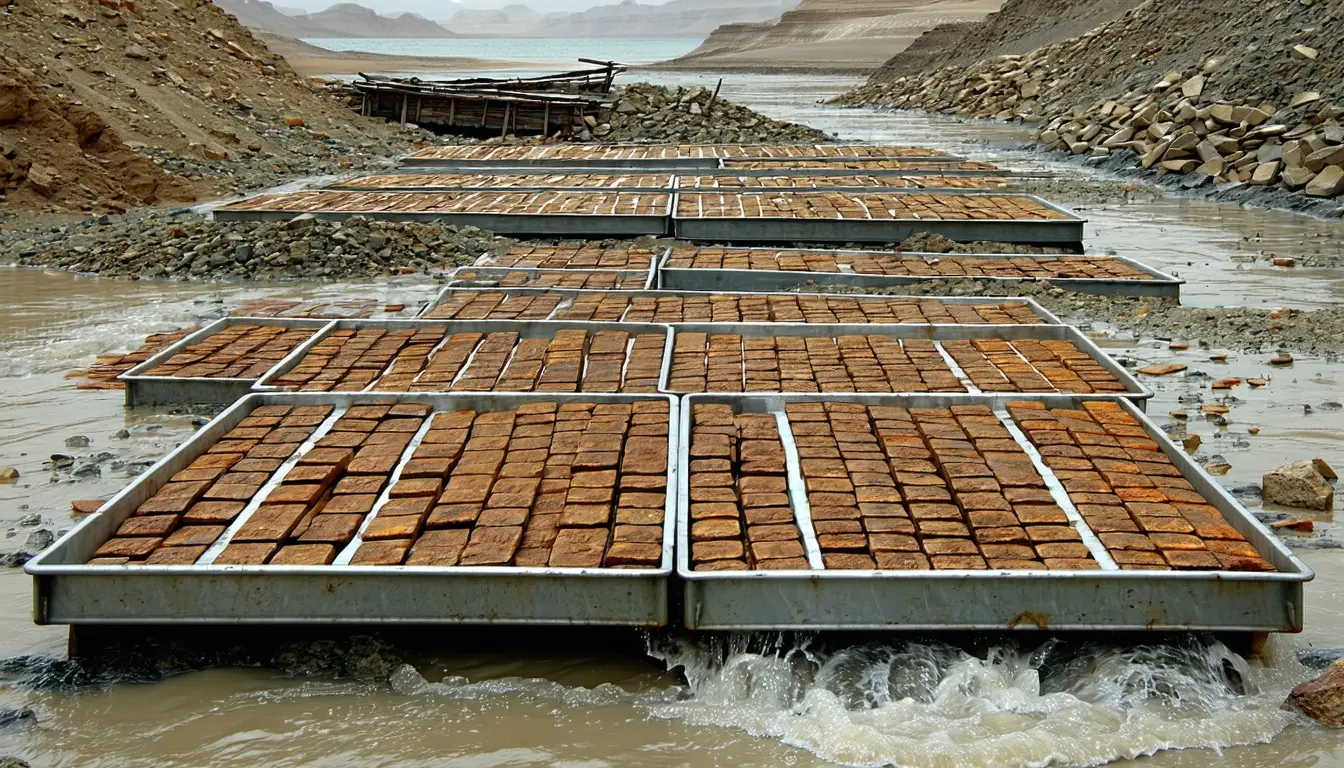
- Peter Trebsche of the University of Innsbruck and Marion Berranger of the University of Technology of Belfort-Montbeliard sorted the fragments into 193 complete bars and 307 partial ones, at least 500 in all.
- Their Antiquity paper puts the assemblage at more than one metric ton of iron semi-products, the most abundant set of Iron Age bars yet known in Europe.
- The bars are unfinished: rough-shaped, double-pointed intermediate goods that a blacksmith would have worked into finished objects.
Compiled by The ScientistSomething wrong?How this is made
Why it matters
- capability A weighed and radiocarbon-dated population of semi-products puts a number on La Tene iron output, for a class of object that usually goes unrecognized by finders and resists precise dating.
- constraint With the deposition context gone, the single-consignment reading cannot be checked against the ground, so the trace-element work is the one route left to a testable claim about origin.
- exposure Recovery of finds like this depends on gravel crews recognizing rusty lumps as artifacts, and Trebsche called this one a "minor miracle" because the usual outcome is the scrap dealer.
The 500-sword figure is a conversion of mass. Trebsche puts an average sword at 1.5 to 2 kg [10]. A metric ton divided by 2 kg gives exactly 500; divided by 1.5 kg it gives about 667 [23]. The sword count therefore sits at the heavy end of the range Trebsche himself supplies, before any allowance for metal lost in forging. He addressed that directly. "Even if we take material losses during manufacture into account, the iron from Deinham would have been sufficient to equip a large group of warriors with weapons," Trebsche said [12]. His other conversion, up to 8,000 nails [11], implies 125 g of iron per nail [24].
The bar count is a floor. The team identified 193 complete bars and 307 partial ones [3], so 39% of the assemblage survived whole [27]. At the reported mean of about 2 kg, the complete bars come to roughly 386 kg, leaving something over 600 kg spread across the 307 partial bars, close to 2 kg each [25]. Either most of those partials are near-whole bars, or the one-tonne total is rounded. Both published accounts give the average complete bar as 28.5 cm long and about 2 kg [4]. A claim about standardized production would rest on the spread around that mean, and neither account reports it.
Where the metal came from is an inference from form and geography. Bars of the same double-pointed shape are known from Manching in Bavaria, about 200 km away, and the authors write that it is plausible the Deinham bars were forged there [15]. Manching lies near a large iron mining area, and several Iron Age production sites have been found close to Bavarian oppida [22]. Nobody knows where the iron was headed [28]. Trebsche and Berranger are now analyzing trace elements in the bars, which may narrow the source [16].
The value comparison in the paper runs through gold. A hoard at Manching holds 443 coins totalling 3.7 kg of gold, and the authors suggest that sum could plausibly have been worth about a ton of iron [17]. That is roughly 270 kg of iron per kilogram of gold [26].
The paper's title ends in a question mark: "A sunken ship cargo of 500 bipyramidal bars?" [21]. The bars came out in an excavator's gravel, which destroyed the find context and with it the chance to establish how the iron entered the river [13]. "The possibility of ritual deposition cannot be excluded," the authors wrote, though "most studies on river finds have concluded that iron bars are losses incurred during transport" [14]. Trebsche said: "It is incredible that such a large quantity of iron was transported at once and was available in a single exchange transaction in the Late Iron Age." [18] Confirming a single transaction would have taken the context the excavator destroyed. Radiocarbon puts the metal in the La Tene period [8], and the study text narrows it to the third and second centuries BC [7]. What that dates is a population of bars, not one sinking.
What to watch
- Trace-element results on the bars, which would either tie the metal to Bavarian ore fields or break the Manching link.
- Publication of the full length and weight distribution of the 193 complete bars, the test of whether output was standardized.
- Whether further bars remain in the riverbed or in gravel already processed downstream of Deinham.