Science1 publisher2 min readPublished
Buried volcano beneath the Moon's Dewar swirl points to an ancient field of at least 11.4 microteslas
Anna Mittelholz of ETH Zurich and colleagues say a 60-km volcanic body under the Moon's Dewar swirl cooled in a field of at least 11.4 microteslas. They credit a core dynamo like Earth's, since the site's location makes an impact origin unlikely.
The Scientist · Science desk
What happened
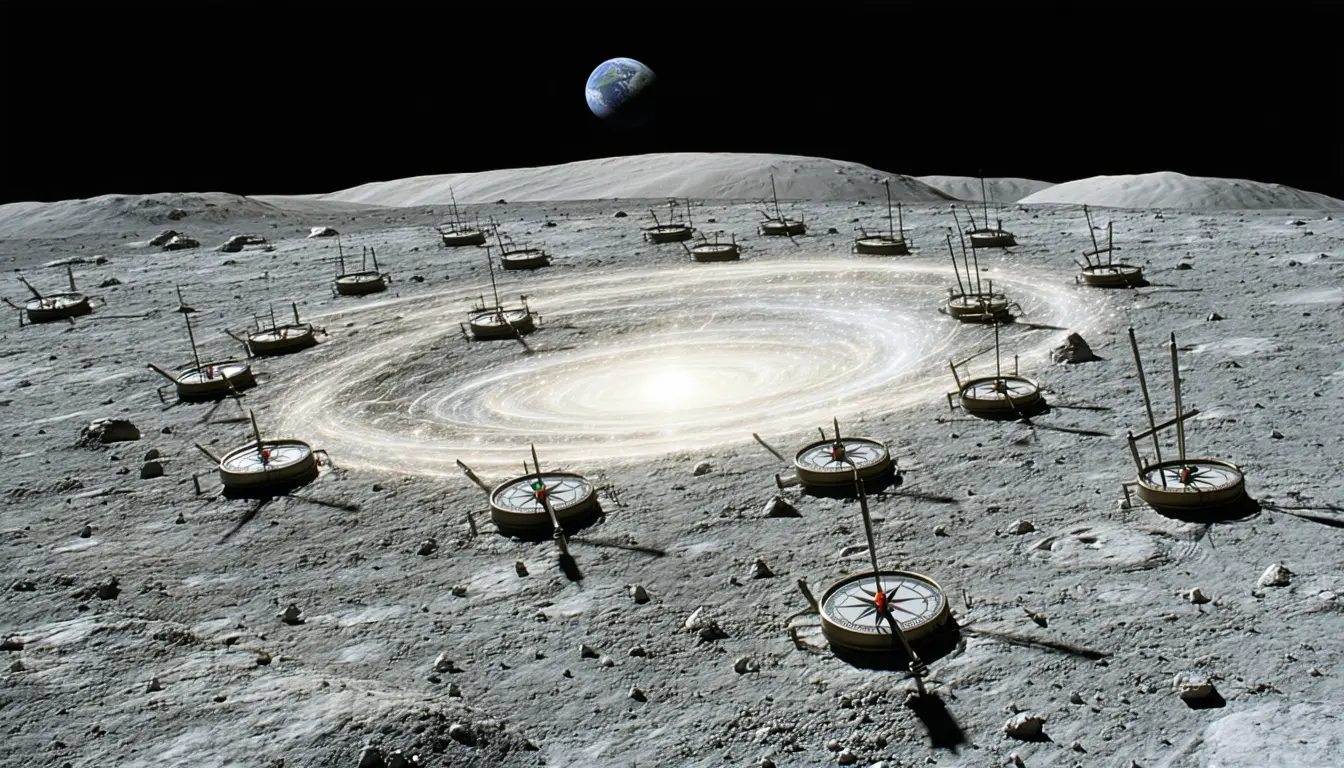
- The Dewar swirl, a bright marking beside Dewar crater on the lunar far side, holds some of the densest and most strongly magnetized rock on the Moon's surface, the researchers say.
- The team describes the rock under the swirl as a buried volcanic complex of solidified magma about 9 kilometres deep that formed some 4.2 billion years ago.
- Two explanations compete for the Moon's magnetized rock: a dynamo like Earth's, or magnetization triggered by large meteorite and asteroid impacts.
- Claire Nichols of the University of Oxford, who was not involved, told Discover the work lends more weight to the idea of an intense dynamo early in the Moon's history.
Compiled by The ScientistSomething wrong?How this is made
Why it matters
- constraint Models of the early lunar core now have to explain how what the team calls a comparatively small core produced a field at least this strong.
- capability Where gravity and magnetic anomalies overlap, researchers can identify buried magnetized rock and set a lower limit on the ancient field from gravity and magnetic observations alone.
- decision Nichols argues the result is a reason to keep adding magnetic observations during upcoming Artemis and Chang'e missions.
Each step in the Dewar inference, published in Science Advances [15], depends on the one before it. The team first needed a buried rock body that shows up in two separate signals. "The Dewar region is a genuine stroke of luck: one of the strongest magnetic field anomalies on the far side of the moon and a distinct gravity anomaly coincide spatially there," Mittelholz said [3]. From the gravity signal they calculated the density of the material under the surface, and from the density they identified what the material was [4]. Rock type then sets an expected iron content. "Because we know how much iron is present in such a rock body, we can estimate the minimum strength the magnetic field must have had as the magma cooled slowly," Mittelholz said [6].
The 11.4-microtesla figure is that minimum, and the team says the real field could have been much higher [7]. The thing this doesn't tell you is how long the field lasted. Nichols told Discover the results could be consistent with work her group published in Nature Geoscience earlier this year, which found rare but intense magnetic events lasting less than 5,000 years [13]. On her reading, the strong field Dewar recorded as it cooled could belong to one of those short episodes.
The argument against impacts is local. Dewar is one of many lunar swirls [1], and the team's case against an impact origin is made for this site alone [8].
I think the paper makes a good case that this rock cooled in a strong field that an impact is unlikely to have produced [7][8]. Mittelholz draws a wider conclusion. "But we are examining the question from an entirely new perspective," she said [10]. In her view, the question has shifted from whether there was a dynamo to how it worked [11].
What to watch
- Whether other lunar swirls with overlapping gravity and magnetic anomalies give minimum field estimates close to Dewar's 11.4 microteslas.
- Any dating work that places Dewar's 4.2-billion-year cooling inside or outside the short intense episodes Nichols's team reported in Nature Geoscience.
- Measurements from Artemis or Chang'e missions that test the far-side field record directly.