Hessian Interatomic Potentials skip autodiff and finite differences to predict molecular Hessians
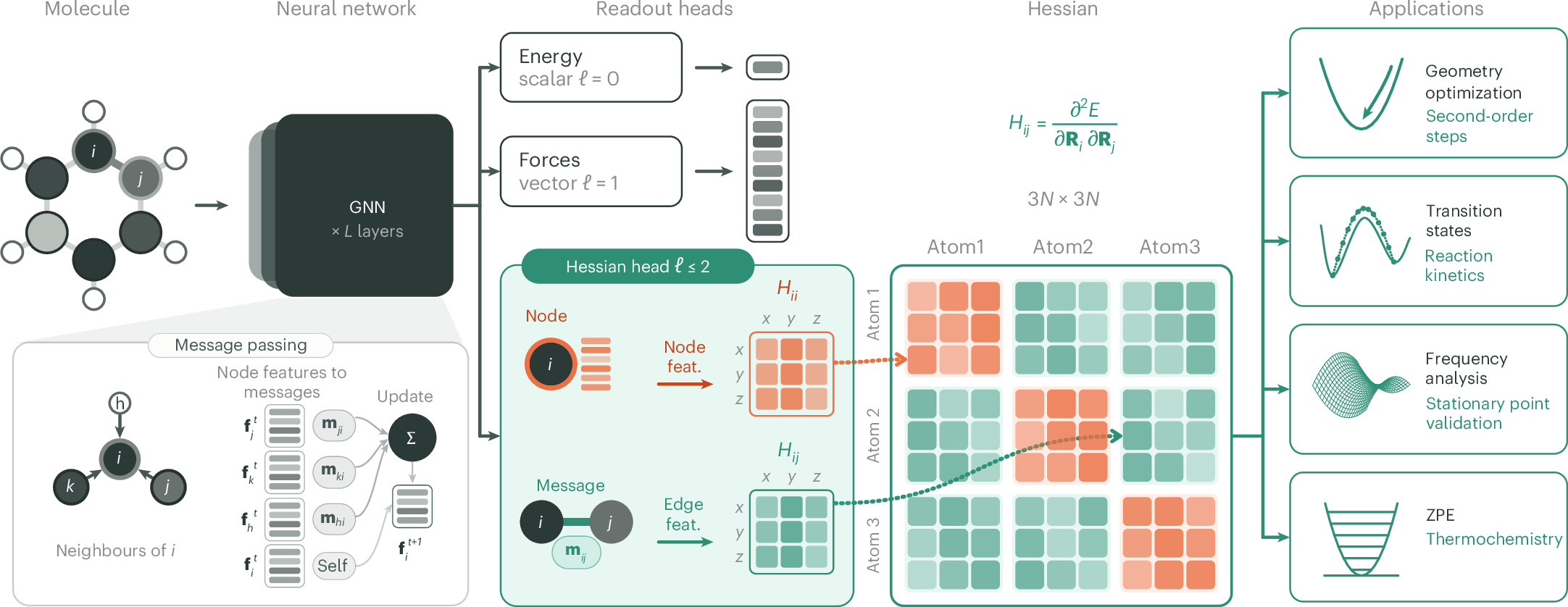
Hessian Interatomic Potentials predict molecular Hessians directly and run one to two orders of magnitude faster, their authors report. A cheaper Hessian would make second-order chemistry workflows easier to run routinely, if the reported gains survive independent tests.
The Scientist · Science desk
Key figures for an illustrative 30-atom molecule: finite differences need 180 forward passes; autodiff adds an extra cost factor of roughly 90, about 3N; the Hessian is 90 by 90, which is 8,100 entries.
| Figure | Value | Note | Claim |
|---|---|---|---|
| Finite differences, illustrative 30-atom molecule | 180 forward passes | 10 | |
| Autodiff extra cost factor, roughly | 90 × extra factor | about 3N, illustrative 30-atom molecule | 11 |
| Hessian entries, 30-atom molecule | 8,100 entries | a 90 by 90 matrix | 9 |
What happened
- A graph neural network computes irreducible-representation features up to degree 2, and the model builds symmetric, SE(3)-equivariant Hessians from them.
- The authors also report that the Hessians are more accurate, more memory efficient and easier to train, and that they scale favorably with system size.
- Validation covered transition state search, geometry optimization, zero-point energy corrections and vibrational analysis, where the authors report consistently superior performance.
Why it matters
- cost Hessian-heavy loops such as transition-state searches pay most for each extra multiple of N. The authors report favorable scaling with system size, so the saving would grow with molecule size if it holds.
- constraint The paper's own introduction says accurate energies and forces do not guarantee accurate second derivatives. An MLIP already in use cannot be assumed to give usable curvature, and any Hessian model has to be tested on second derivatives directly.
- decision With code and weights released, a group running these searches can measure wall-clock time on its own molecules before changing its pipeline.
The cost of a Hessian is set by molecule size. For a molecule with N atoms it is a 3N by 3N matrix [4]. Take 30 atoms: that is 90 by 90, or 8,100 entries [9]. The paper's introduction prices the two derivative routes in multiples of N. Automatic differentiation adds a factor of about 3N in training and inference [5], roughly 90 for our 30-atom illustration [11]. Finite differences need 6N forward passes [7], which comes to 180 [10].
HIP skips both routes: no autodiff and no finite differences [1]. Training is the other bill. Rodriguez et al. found that adding the Hessian to the loss improved data efficiency and extrapolation of energy and force predictions, but at roughly 25 times longer training [6]. A model built to output Hessians has to be judged on that axis as well as on inference time.
The authors' range of one to two orders of magnitude [12] is one phrase covering speed, accuracy and memory together. A factor of 10 on memory and a factor of 100 on speed would both fit inside it. The abstract and introduction do not include the benchmark tables, so the baselines, molecule sizes and reference level of theory behind each factor cannot be checked here.
The thing this doesn't tell you is the end-to-end gain. In a transition-state search the Hessian is one cost among several, so the wall-clock saving depends on how often the search asks for one. We think the number to ask for is time to a converged saddle point on molecules the model was not trained on.
What to watch
- The benchmark tables: which baselines, molecule sizes and reference level of theory sit behind each factor in the one-to-two-orders range.
- Independent runs of the released code and weights on end-to-end transition-state search, timed to a converged saddle point.
- A head-to-head training comparison against Hessian-supervised autodiff models, whose training the paper cites as about 25 times longer.
Clarity's read
What the record supports and how the coverage leans. The claims behind it follow.
Reality
- Evidence45
- Adoption
- Insufficient
- Hype gap+15
- Incentives
- Insufficient
- Confidence55
Claim ledger
Ranked by verification strength, evidence, and original report placement.
- [1]
Hessian Interatomic Potentials (HIPs) are a deep learning model that directly predicts Hessians without relying on automatic differentiation or finite differences.
- [2]
The authors construct SE(3)-equivariant, symmetric Hessians from irreducible representation features up to degree l = 2, computed by a graph neural network.
- [3]
The authors open source the HIP code and model weights.
- [4]
For a molecule with N atoms, the Hessian is a 3N x 3N matrix.
- [5]
Automatic-differentiation Hessians introduce high computational costs, with an extra factor of about 3N during training and inference.
- [6]
Rodriguez et al. showed that including the Hessian in the loss improves data efficiency and extrapolation of energy and force predictions but is limited by approximately 25 times longer training times.
- [7]
Obtaining Hessians from MLIPs with finite differences requires less memory but 6N forward passes.
- [8]
High accuracy of energy and forces does not guarantee comparably accurate second derivatives, and explicit Hessian training labels are required for reliable autodiff Hessians.
- [9]
For an illustrative 30-atom molecule the Hessian is 90 by 90, which is 8,100 entries.
- [10]
For an illustrative 30-atom molecule, finite differences need 180 forward passes.
- [11]
For an illustrative 30-atom molecule, the autodiff extra factor of about 3N is roughly 90.
- [12]
The authors report that HIP Hessians are one to two orders of magnitude faster than the alternatives they compare against.
- [13]
The authors report that HIP Hessians are also more accurate, more memory efficient and easier to train, and exhibit favorable scaling with system size.
- [14]
The authors say they validated predictions on downstream tasks including transition state search, geometry optimization, zero-point energy corrections and vibrational analysis, reporting consistently superior performance.
Sources
1 independent publisher whose own reporting we read for this story.
- nature.comHIP: Hessian Interatomic Potentials without derivatives
1 article · October 12, 2026
Topics and entities
Follow any of these and your For You feed starts watching them — no settings page required.
Topics
- Machine-Learning Interatomic PotentialsFollow
- Equivariant neural networksFollow
- Computational Chemistry and SimulationFollow
Entities
- Nature Computational ScienceFollow
- Hessian Interatomic PotentialsFollow