ScienceNot yet confirmed elsewhere1 publisher2 min readPublished
A lighthouse on Long Island: the 161-mile quantum network grows a wireless hop
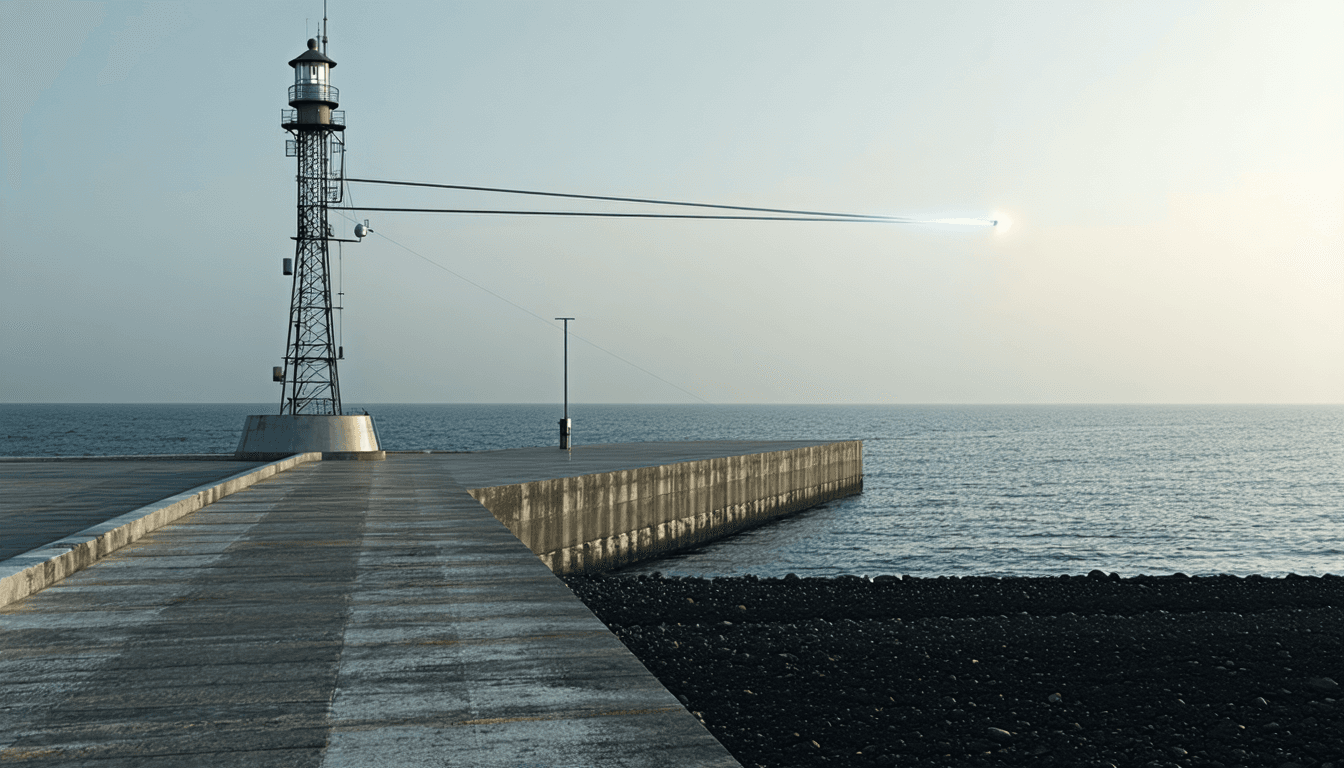
Brookhaven says its Quantum Lighthouse is the first permanent free-space optical link on the network. The 13-mile air hop is running; the 30-mile crossing to Yale is still pending.
The Scientist · Science desk
What happened
- Brookhaven National Laboratory has put a "Quantum Lighthouse" on a seven-story roof in Upton, New York, sending and receiving photons that carry quantum information.
- Entangled photons now travel 13 miles of open air to Stony Brook University's Quantum Watchtower, in what the lab calls the first permanent free-space link of its kind.
- The hop is grafted onto a 161-mile network joining Brookhaven, Stony Brook and Yale, described as the longest quantum network in the country.
- A matching station at Yale in New Haven is due to begin operating and open a 30-mile crossing over Long Island Sound.
Why it matters
- capability A hybrid path is now something a planner can cite rather than propose: fiber to the node, telescope where the cable ends, with the institutional partners already named and the hop lengths measured.
- constraint Each endpoint becomes an instrument that has to be pointed, calibrated and corrected thousands of times a second, not a splice that sits in a vault and is forgotten.
- decision Anyone costing a quantum-comms pilot against this design has to do it on an unpublished performance envelope, which favours treating free-space as an addition to fiber rather than a replacement...
- precedent If roughly a quarter of a flagship network's quoted span runs through air, water crossings become the expected place to skip cable, and future proposals will be measured against this one.
Atmosphere is what makes this hard, and Justine Haupt's account of it is unusually blunt for a lab release: along the horizon at that range the view is blurry, more magnification and a bigger lens do not help, and the correction has to be made in real time [8]. The fix comes from astronomy. Mirrors thin enough to be deformed are pushed and pulled thousands of times a second into shapes that cancel what the air has done to the wavefront [9]. Brookhaven's Instrumentation Department had the skills on hand because it built key components for the Vera C. Rubin Observatory, and Haupt says aiming a telescope at another institution proved harder in some respects than aiming one at the sky [10].
The reference architecture underneath is legible enough to copy. Entangled pairs are made at a node such as Brookhaven's Quantum Information Science and Technology Laboratory by shining a laser into a purpose-built crystal or optical device, then split and carried over commercial cable to other nodes [6]. Where the cable stops, a telescope takes over [7]. The endpoints are named and matched: Brookhaven, Stony Brook, Yale, each with its own station [2][17].
Here is the arithmetic the release leaves out. The two air hops total 43 miles, or 69 kilometres, once New Haven is operating [12]. Set that against the 161 miles the lab quotes for the network's span [c4b] and roughly 27 percent of the number is atmosphere [13]. Treat it as a ratio rather than a route, because the release does not break out fiber mileage against free-space mileage. The Long Island Sound crossing is also about 2.3 times the length of the hop already running [14], and it is the half of the plan that has not yet been demonstrated [17].
What is missing is the part an operator would need. No secret key rate, no entanglement fidelity, no loss budget, and no availability figure for nights of bad weather appear anywhere in the announcement [15]. Those are what decide whether a free-space hop substitutes for dark fiber over water or merely sits alongside it as a research path. Eden Figueroa, who directs Stony Brook's Quantum Institute, describes the work as moving past building quantum devices in the laboratory and into actively engineering large quantum systems [11]. Haupt's own framing is more modest and more useful: free-space optics is to a quantum internet what wireless was to the classical one, the thing that lets a network leave the cable plant [3]. The engineering claim becomes checkable when photons cross the Sound in weather.
What to watch
- Whether the Yale station opens on schedule and holds the 30-mile Sound crossing in poor visibility, which is the untested half of the design.
- Whether the collaboration publishes per-hop loss, key rate and fidelity numbers, without which outsiders cannot size a comparable link.
- Whether link availability is reported over a full year of weather, the figure that separates a research path from a usable one.
Clarity's read
What the record supports and how the coverage leans. The claims behind it follow.
Reality
- Evidence42
- Adoption22
- Hype gap+32
- Incentives74
- Confidence48
Claim ledger
Ranked by verification strength, evidence, and original report placement.
- [1]
The "Quantum Lighthouse" sits atop a seven-story building at the U.S. Department of Energy's Brookhaven National Laboratory and transmits and receives particles of light that carry quantum information.
- [2]
The free-space optical (FSO) link spans Brookhaven Lab, the State University of New York at Stony Brook (Stony Brook University) and Yale University.
- [3]
Justine Haupt, Brookhaven Lab's lead scientist on the cross-institutional FSO link project, said an FSO link is analogous to the wireless technology that allowed the classical internet to expand beyond wired connections to orbiting satellites and cellphones, and that it is one of the key technologies needed to make a quantum internet truly useful.
- [4]
The network, described as the nation's longest quantum network, spans 161 miles (259 kilometers) across Long Island and the New York metropolitan area.
- [5]
Researchers can now send entangled photons 13 miles (21 kilometers) through the air between Brookhaven's Quantum Lighthouse in Upton, New York and Stony Brook University's Quantum Watchtower in Stony Brook, New York.
- [6]
Entangled photons are generated at network nodes, such as Brookhaven's Quantum Information Science & Technology (QIST) Laboratory, by shining a laser into a specially designed crystal or optical device, splitting one photon into an entangled pair that can be separated and transmitted through commercial cable to other network nodes.
- [7]
Once photons reach FSO link nodes such as the Quantum Lighthouse, researchers can no longer rely on cable and instead use telescopes.
- [8]
Haupt said that looking at the horizon over such a distance is very blurry because of the atmosphere, that it does not matter how much you magnify it or how big your lens is, and that the effect has to be corrected in real time.
- [9]
Engineers use adaptive optics, including mirrors thin enough to be warped into different shapes, which are automatically pushed and pulled thousands of times per second into shapes countering atmosphere-induced distortion of the light's wavefront.
- [10]
Haupt and colleagues in Brookhaven's Instrumentation Department built key components for the Vera C. Rubin Observatory, a mountaintop facility with the world's largest digital camera, and in some ways building telescopes that transmit light between institutions was more challenging than building ones to observe faraway celestial objects.
- [11]
Eden Figueroa, director of Stony Brook's Quantum Institute, endowed presidential professor of physics and a joint appointee at Brookhaven Lab, said researchers are moving past the era of developing quantum devices in the laboratory and entering an age of actively engineering large quantum systems such as the long-distance quantum network.
- [12]
Once the Yale facility is operating, the network's two free-space hops total 43 miles (69 kilometers).
- [13]
The combined 43 miles of free-space path is about 27 percent of the 161-mile figure quoted for the network's span.
- [14]
The planned Long Island Sound crossing is about 2.3 times the length of the Brookhaven-to-Stony Brook hop already in operation.
- [15]
The reported material contains no secret key rate, entanglement fidelity, link loss budget or weather availability figure for the free-space link.
- [16]
The link is described as the first permanent FSO link of its kind, adding a wireless component to the network.
- [17]
A third identical facility at Yale in New Haven, Connecticut will soon begin operations, enabling researchers to send entangled photons 30 miles (48 kilometers) across the Long Island Sound.
Sources
1 independent publisher whose own reporting we read for this story.
- phys.orgNew free-space optical link adds a wireless component to the nation's longest quantum network
1 article · August 24, 2026
Topics and entities
Follow any of these and your For You feed starts watching them — no settings page required.
Topics
Entities
- Brookhaven National LaboratoryFollow
- Stony Brook UniversityFollow
- Yale UniversityFollow
- US Department of EnergyFollow
- Quantum LighthouseFollow
- Quantum WatchtowerFollow
- Quantum Information Science & Technology (QIST) LaboratoryFollow
- Vera C. Rubin ObservatoryFollow
- Stony Brook Quantum InstituteFollow
- Justine HauptFollow
- Eden FigueroaFollow