Product1 publisher2 min readPublished
SwRI's new index scores whether a sodium cell can do an 18650's job
Southwest Research Institute has built an index that measures whether two cell chemistries can run the same duty cycle. Its first test set sodium-ion cells against the 18650 lithium-ion format used in laptops and power tools.
The Product Desk · Product desk
What happened
- Southwest Research Institute researchers built the Electrical Interchangeability Index, a numerical framework for deciding when two battery technologies give comparable electrical performance in the same application.
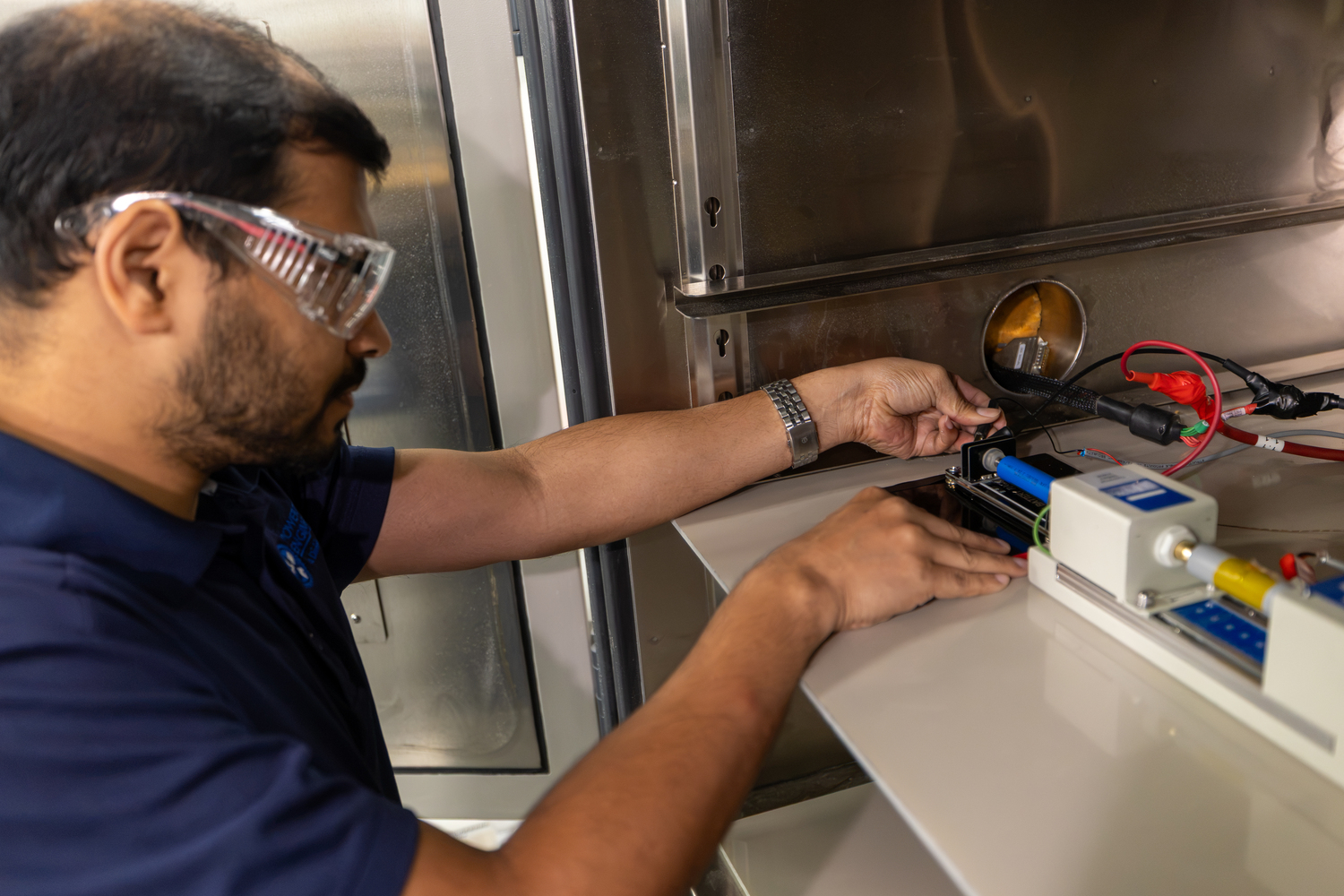
- An internally funded project tested whether sodium-ion cells could substitute for 18650-format lithium-ion batteries, the cells widely used in laptops, power tools and electric vehicles.
- Instead of comparing individual specifications, the team ran both cell types across a broad range of operating conditions and assessed charge and discharge rates, voltage limits and power tracking.
- SwRI plans to extend the index to other battery chemistries, cell formats and application areas.
Compiled by The Product DeskSomething wrong?How this is made
Why it matters
- capability A manufacturer can point to measured evidence for where a sodium cell drops into a system designed around lithium-ion and where the pack has to be redrawn, which is the part of chemistry down-selection that usually rests on judgement.
- cost Sodium's savings come from abundant salts and lower-cost current collectors, and they only reach the balance sheet where the substitution leaves the surrounding system untouched.
- constraint The published account does not describe how the index is calculated, so a hardware team cannot reproduce the score on its own cells from what is on the record.
The person who has to act on this is holding a bill of materials with an 18650 cell on it and a note from procurement asking for a second source. That case normally gets argued on datasheets, one specification at a time. Existing comparison methods examine capacity, voltage, impedance, efficiency or power capability separately, and none of those measurements settles whether two different battery technologies can complete the same application-specific task under identical operating conditions [4].
What SwRI reports instead is a map with regions on it. Shuvodeep Bhattacharjya, an engineer at SwRI, said: "We identified 'high-EII' operating regions, where the two cell types demonstrated strong functional equivalence with negligible differences in surface temperature rise, available capacity and power capability, and 'low-EII' regions, where substitution would be unacceptable" [5].
The format itself sets a hard limit on what a swap can absorb. An 18650 is 18 millimeters in diameter and 65 millimeters long [2], which gives each cell about 16.5 cubic centimeters of external volume: pi times 9 mm squared times 65 mm comes to roughly 16,540 cubic millimeters [13]. The cylinder cannot grow. Sodium-ion cells store less energy and can push a battery system to be larger and heavier [9], so inside a fixed format that deficit surfaces as watt-hours per cell, and then as cell count.
Scott Sjovall, manager of the Battery System Research and Innovation Section at SwRI, said: "From a business perspective, SwRI's EII can support chemistry down-selection, second-source qualification and assessment of alternative or hybrid battery technologies while reducing unnecessary system redevelopment" [7].
Two tests decide it for a given product line. The first is whether the duty cycle the product actually runs sits inside a high-EII region: peak current, recharge rate, the voltage window it spends its day in. The second is how much mass and volume the enclosure can give back. A cabinet bolted to a concrete floor has room to absorb a heavier pack. A cordless drill has almost none. Where both answers come out yes, the chemistry change is a sourcing decision. Where the duty cycle lands in a low-EII region, it is a redesign with a sodium cell in it, and the redesign is the real budget line.
The scope here is narrow, and SwRI says so. The initial framework does not establish that sodium-ion cells can replace lithium-ion batteries across every application or throughout their operating lifetimes [10].
What to watch
- Whether SwRI publishes the EII calculation and the high-EII boundaries for the sodium-versus-18650 pairing, so buyers can score cells without commissioning a test.
- Whether the degradation work finds high-EII regions narrowing after hundreds of cycles, which would change any warranty-length second-source claim.
- Whether a named equipment maker qualifies a sodium-ion cell as a second source in a design built around 18650 lithium-ion cells.